


 For all latest news, follow the Daily Sun's Google News channel.


Peacekeepers vs ruthless Militia
The thrilling rescue operation of seven Nepalese soldiers
Daily Sun Report, Dhaka
Published: 23 Jun 2026, 09:26 AM
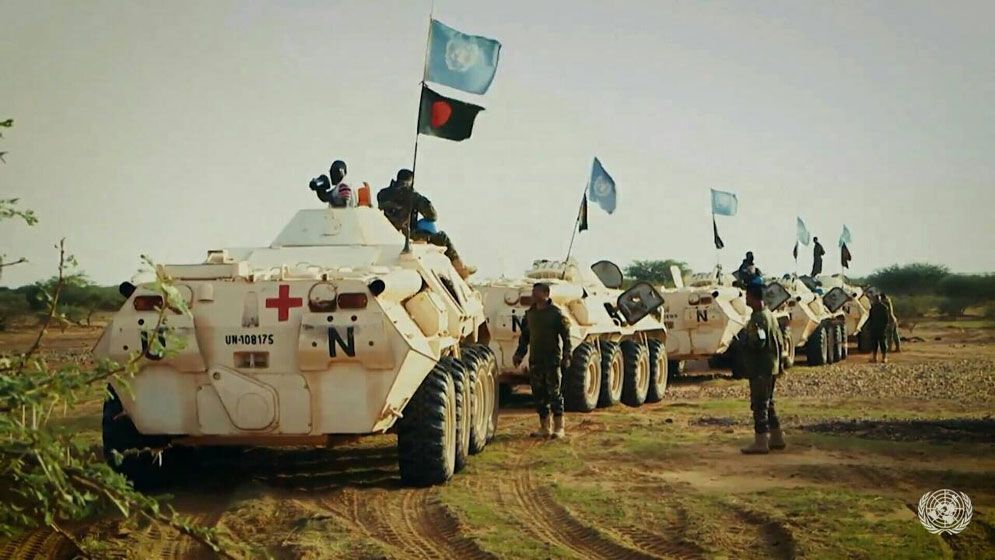
Vehicles used in UN peacekeeping operations. Photo: Collected
The United Nations peacekeeping force is widely recognised as a symbol of peace in war-torn regions. However, in 2006, peacekeepers in the Ituri region of the Democratic Republic of the Congo found themselves confronting a formidable armed militia group.
An operation launched with only a few hours' preparation soon turned into a fight for survival. During the mission, one soldier was killed, several others were injured, and seven Nepalese peacekeepers were taken hostage by the militia.
In News24 Digital’s special programme, ‘Operation Hostage Rescue’, Major General (retd) Mahbub Haider Khan and General Jhankar Bahadur Kadayat recounted the details of the operation. Their accounts highlighted the planning of the mission, faulty intelligence, the surprise attack, and the dramatic story of how the seven soldiers were eventually rescued after prolonged negotiations.
General Mahbub said that on the evening of 27 May 2006, he was instructed by the Kisangani Division Headquarters in Congo to lead an operation to capture Peter Karim, leader of the Front des Nationalistes et Intégrationnistes (FNI). However, sufficient time was not provided for gathering intelligence, preparation, or operational planning for such a major mission.
He explained that, under normal circumstances, preparations for any operation involve assessing the enemy's position, weapons, manpower and capabilities. In this instance, however, orders were issued to launch the operation immediately.
Overnight, troops were assembled from four different locations, and by around 4 a.m. the soldiers were ready to move. The operation was launched in coordination with members of the Congolese national army. General Mahbub noted that preparing troops, weapons and ammunition and deploying them to the Fataki area within such a short period had been extremely challenging. He praised Colonel Jhankar and his team for their efforts.
The operation commenced at 6 am on 28 May. A patrol team of 150 soldiers from NEPBATT, guided by members of FARDC (the Congolese National Army), advanced towards the target area. At around 7:30 am, while crossing dead ground before reaching the objective, the patrol came under intense fire from militia forces.
Although intelligence reports had suggested the presence of only three or four militants, nearly 400 militia fighters launched a well-planned ambush. The severity of the attack caused the Congolese troops to panic and retreat in disarray at an early stage of the fighting.
During the battle, Sergeant Gyan Bahadur Adhikari, a courageous radio operator, was killed, while three soldiers were injured. The forward element of the patrol became separated from the main force, and seven soldiers were taken hostage by the militia.
General Jhankar described the incident as a carefully planned ambush. He said that members of the Congolese government forces had withdrawn at the first shock of the assault, leaving the Nepalese troops in an extremely difficult situation. Three soldiers were wounded, and one forward team became isolated from the main force.
General Mahbub said that United Nations attack helicopters were deployed to regain control of the situation. Although sustained attacks were carried out against militia positions, the onset of darkness made effective operations increasingly difficult.
He added that launching a large-scale direct assault to rescue the seven soldiers could have placed the hostages' lives at even greater risk. Consequently, an alternative strategy was adopted. In the first few days after the attack, nobody knew whether the missing soldiers were still alive. Eventually, communication channels were established through the efforts of various parties. Contact with the militia was gradually established with the assistance of a local community leader named Koyani and a priest.
Nearly 11 days later, contact was made with rebel commander Peter Karim, confirming that the soldiers were alive. After 42 days of extensive negotiations, a resolution to the crisis was finally reached.
The rescue negotiations involved a range of stakeholders, including officials in Kinshasa, presidential advisers, the United Nations Development Programme (UNDP), the Force Commander, and members of parliament representing the Lendu community.
Ultimately, following all these efforts, the rebel leader handed over the seven hostages to General Jhankar through a community leader at a camp deep inside the jungle, and the soldiers returned safely to their barracks.
General Jhankar said that maintaining the morale of the troops had been the greatest challenge throughout the ordeal. Alongside the combat situation, commanders also had to manage the anxiety of the families of the captive soldiers. He revealed that there had been pressure from higher authorities to launch a military operation to rescue the hostages. However, he believed that a direct assault would have endangered their lives, and in the end, negotiations proved to be the successful course of action.