


 For all latest news, follow the Daily Sun's Google News channel.


Experts call for trade union rights for EPZ workers
Daily Sun Report, Dhaka
Published: 16 Jun 2026, 06:12 PM
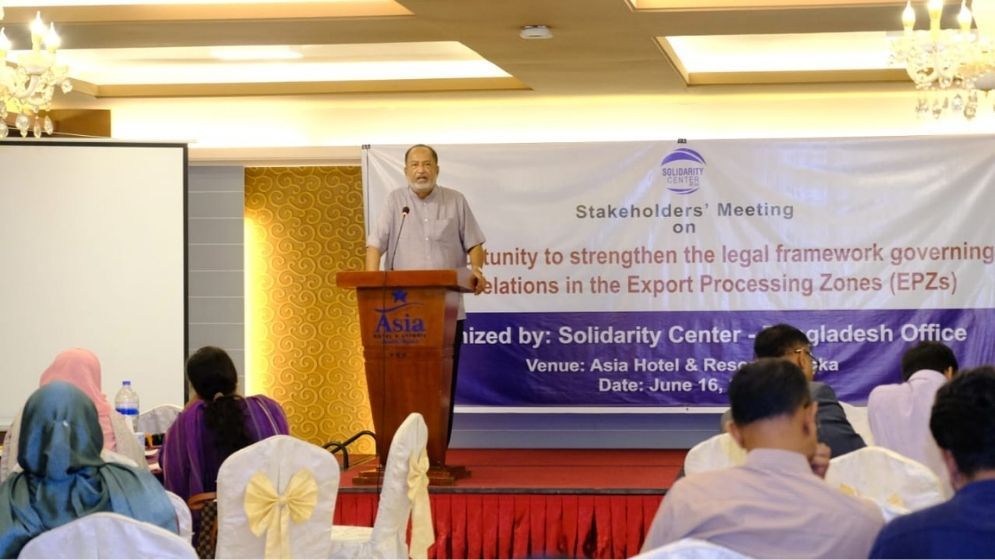
Photo: Courtesy
Labour rights experts on Tuesday called for major reforms to the Bangladesh EPZ Labour Act, 2019, demanding that workers in the country's Export Processing Zones (EPZs) be granted rights equivalent to those enjoyed by workers under national labour laws, including the right to form and join trade unions.
The demand was raised at a stakeholders'
meeting titled "The Opportunity to Strengthen the Legal Framework
Governing Labour Relations in the Export Processing Zones", organised by
the Solidarity Center Bangladesh at a city hotel.
Speakers noted that EPZs account for more
than 17% of Bangladesh's exports and employ over 500,000 workers. However,
workers in these zones continue to operate under a separate legal framework
that does not permit independent trade unions.
Presenting the keynote paper, Solidarity
Center Country Programme Director AKM Nasim said significant gaps remain in the
areas of freedom of association, collective bargaining, grievance resolution
and access to legal remedies under the EPZ Labour Act.
“Workers' Welfare Associations (WWAs), the
only form of worker organisation allowed under the law, cannot replace independent
trade unions,” he said.
According to the keynote paper, the process
for forming WWAs is restrictive and lacks transparency. It also noted that Section
178 of the Act bars WWAs from engaging with NGOs, trade unions and civil
society organisations outside the zones, limiting workers' access to legal support,
training and solidarity.
The paper identified several areas requiring
legislative reforms, including stronger protection against arbitrary
termination, maternity benefits aligned with recent amendments to the
Bangladesh Labour Act, improved lay-off compensation, fair disciplinary
procedures and the removal of inconsistencies between the Act and its
subordinate rules.
Speakers also highlighted concerns over
access to justice, saying EPZ workers have fewer opportunities to appeal labour
court decisions than workers covered under the Bangladesh Labour Act, 2006.
They criticised the grievance resolution mechanism under the EPZ Labour Rules,
2022 as lengthy and overly complex.
Executive Director of the Bangladesh
Institute of Labour Studies and former chair of the Labour Reform Commission,
Syed Sultan Uddin Ahmed, stressed the importance of worker representation in
labour law reforms.
“We should question who reforms the law and
whose interests they represent. Any dialogue on labour reform without workers'
representation is futile,” he said.
The speakers further noted that the
International Labour Organization (ILO) has identified 23 provisions in the EPZ
framework that are inconsistent with Convention No. 87 on Freedom of
Association. They urged the government to use the current reform process under
Bangladesh's 2021 ILO roadmap to align EPZ laws with international labour
standards.
Neeran Ramjuthan, programme manager for the
Labour Administration and Working Conditions Cluster at the ILO Bangladesh
office, said the ILO supervisory bodies have long observed the need to align
the EPZ framework with international labour standards, particularly regarding
freedom of association and other fundamental rights.
“ILO believes strong labour standards are
never a barrier to successful investment. We remain committed to supporting the
government, BEPZA and social partners in promoting social dialogue and decent
work,” he said.
Among others, Bangladesh Labour Foundation
General Secretary Shakil Akhter Chowdhury, BGMEA Additional Secretary Rafiqul
Islam, Tannery Workers' Union President Abul Kalam Azad, Bangladesh Revolutionary
Garment Workers' Federation President Salahuddin Shapon and Bangladesh Garment
and Industrial Workers' Federation President Babul Akter addressed the event.