


 For all latest news, follow the Daily Sun's Google News channel.


Palm trees eaten by goats
Lightning protection rods end up in thieves’ pockets
Daily Sun Report, Dhaka
Published: 16 Jun 2026, 12:14 PM
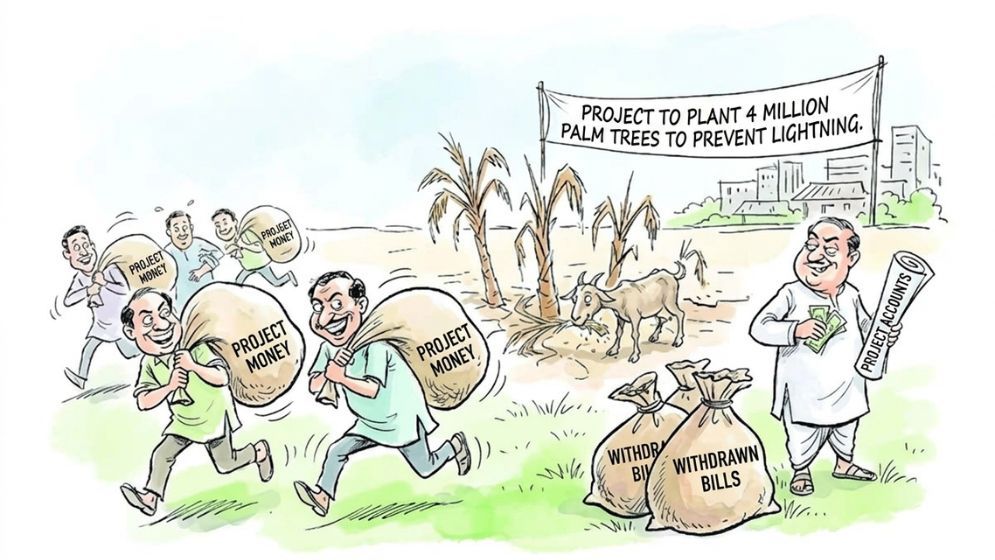
Photo: Collected
In 2017, the government spent Tk1 billion planting palm trees as part of a strategy to prevent lightning strikes. However, within a year it became apparent that many saplings had been eaten by cattle and goats, while in some areas funds were withdrawn without any trees being planted at all.
When the palm tree initiative failed to deliver the desired results, lightning protection rods were installed instead. In some locations, thieves stole copper wiring and other components from the rods. Despite lightning strikes claiming around 300 lives annually, none of the measures introduced so far have proved sufficiently effective.
According to sources at the Ministry of Disaster Management and Relief, the government is now drawing lessons from the shortcomings of previous projects and planning a new initiative based on field-level surveys. The latest plan again includes planting 1.4 million palm trees, particularly in areas where tree cover is sparse. Deputy Commissioners in all 64 districts have been instructed to conduct surveys of existing palm trees and submit reports.
Under the project, multi-purpose shelters will also be constructed in lightning-prone areas, especially in the haor wetlands. Farmers will be able to take refuge in these shelters whenever thunderclouds appear. The structures will be equipped with lightning protection systems and can also be used for paddy threshing, short-term grain storage and other agricultural activities. During floods, they will serve as emergency shelters.
Disaster Management and Relief Minister Asadul Habib Dulu said that the government had taken a range of measures to reduce lightning-related fatalities. He said the Ministry of Disaster Management and Relief, the Bangladesh Meteorological Department, local administrations and other relevant agencies were working in coordination to mitigate lightning risks and raise public awareness.
Using modern weather monitoring systems, lightning forecasts are being generated and disseminated through the media, social media platforms and Integrated Voice Response (IVR) technology. The minister added that awareness campaigns involving leaflet distribution, posters and special drills were being conducted at the grassroots level. Plans have also been undertaken to install lightning protection rods in farmers’ shelters in vulnerable areas and to carry out large-scale palm tree plantation programmes.
Statistics from the ministry show that 3,425 people have died from lightning strikes over the past 12 years. Annual fatalities were 170 in 2014, 226 in 2015, 391 in 2016, 307 in 2017, 359 in 2018, 158 in 2019, 255 in 2020, 363 in 2021, 337 in 2022, 350 in 2023, and 266 in both 2024 and 2025.
Between 26 April and 2 May this year alone, 71 people were killed by lightning strikes within seven days. The death toll this year has already exceeded 100.
Sources said that projects under the Test Relief (TR) programme were implemented in lightning-prone areas, with an allocation of Tk150 million. The funds were used to install 343 lightning protection rods, although not all designated areas received them.
In the 2021–22 fiscal year, the ministry allocated Tk195 million for the installation of lightning protection rods in 15 districts. However, the project was later marred by allegations of widespread corruption. At Rajshahi Medical College Hospital, six lightning protection rods were installed at a cost of nearly Tk3.6 million, but many of their components were subsequently stolen or went missing.
As a result, substantial public funds were spent without achieving the intended benefits, and the equipment later had to be reinstalled.
Source: Bangladesh Pratidin