


 For all latest news, follow the Daily Sun's Google News channel.


How Kaler Kantho uncovered Benazir’s ‘Aladdin’s Lamp’
The rise and fall of Benazir’s empire
How a state medal for a university student led to the exposure of former IGP Benazir Ahmed’s vast corruption empire
Daily Sun Report, Dhaka
Published: 15 Jun 2026, 11:52 AM
AI generated image
Farheen Rishta Binte Benazir won a state gold medal as an agricultural entrepreneur in Gopalganj while studying at North South University in Dhaka.
At first glance, it appeared to be an inspiring story — a university student balancing academic life with agricultural innovation. But one question lingered: what kind of agricultural enterprise had earned her such recognition?
That question marked the beginning of an investigation that would eventually expose one of the most controversial corruption scandals in Bangladesh’s recent history.
The journey to Gopalganj
It was the first week of March 2024.
Before dawn had broken over Dhaka, we boarded a non-air-conditioned bus from Gulistan bound for Gopalganj. As the vehicle sped along the Dhaka-Mawa-Bhanga Expressway, questions kept circling in our minds. Were we merely travelling to investigate a successful agricultural project, or was there something much larger hidden beneath the surface?
The woman at the centre of the story, Farheen Rishta Binte Benazir, was the daughter of then Inspector General of Police, Benazir Ahmed.
At the time, the name Benazir Ahmed symbolised immense power and influence. Even terms such as “powerful” or “untouchable” seemed insufficient to describe his standing.
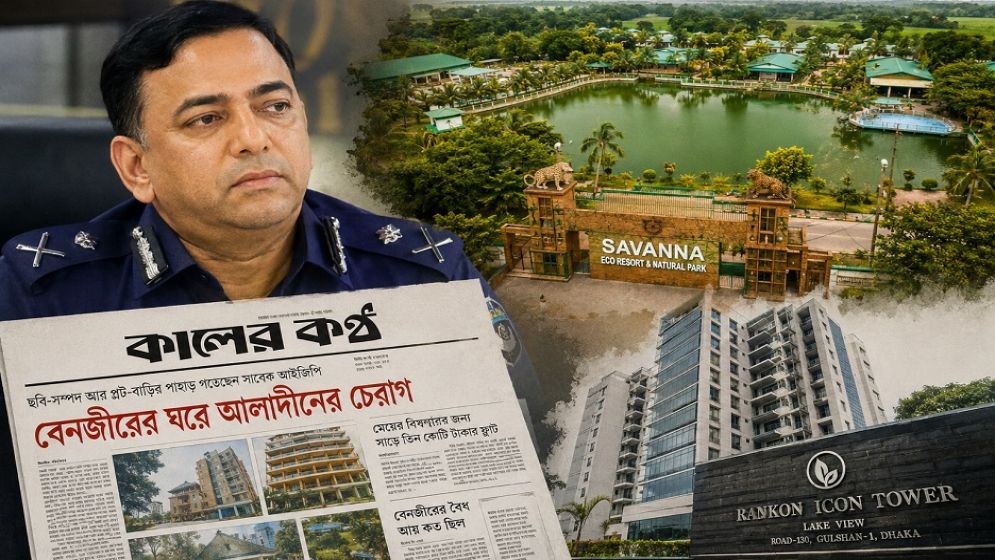
We arrived at Bairagitola village under Sahapur union in Gopalganj Sadar upazila — a quiet rural settlement far removed from urban bustle. Yet, standing in the middle of that tranquil countryside was an astonishing complex: Savannah Eco Resort and Natural Park.
We already knew there was a connection between the resort and Farheen’s award-winning agricultural activities.
A luxury empire in rural Bangladesh
The moment we entered the resort, the scale of luxury was overwhelming.
Trees, ponds, paved walkways, artificial waterfalls — the resort appeared designed to showcase opulence. Spread across nearly 1,400 bighas of land, it contained 15 ponds surrounded by guard walls and luxury duplex cottages rented out for Tk15,000 per night.
Artificial hills had been created by filling land. There was a wave-style swimming pool resembling the sea, more than a thousand Vietnamese coconut trees, numerous fruit orchards, and a massive concert hall equipped with advanced sound systems. The entire resort glittered with elaborate lighting.
After building rapport with the resort manager, we confirmed that the property belonged to former IGP Benazir Ahmed. His ancestral home lay around 25 kilometres away, also in Gopalganj. The resort had become so dominant in the area that locals had begun referring to the locality itself as “Benazir’s Chak”.
But the real story had yet to emerge.
“All this land was ours”
Near the resort’s main gate stood a small tea stall. After leaving the premises, we stopped there and began speaking with an elderly shopkeeper in his seventies.
At one point, we casually asked whether anyone objected to him operating a stall in front of such a massive resort.
The question instantly changed his expression.
“All the land inside that resort belonged to us,” he replied angrily. “Benazir seized everything through force.”
That single sentence altered the direction of our investigation.
Soon, several others gathered around us. Their stories were strikingly similar. Some claimed they had lost agricultural land, others ponds, and many said ancestral property had been taken over for the resort. Most admitted they had remained silent out of fear.
We stayed in Gopalganj that evening and spent the following days travelling throughout the area, speaking to residents and collecting testimonies.
Gradually, disturbing allegations surfaced.
A substantial portion of the land inside Savannah Eco Resort allegedly belonged to local Hindu families, particularly members of the Ball community, many of whom claimed their property had been forcibly acquired.
Following the money trail
Returning to Dhaka, we launched the second phase of the investigation.
Members of the Kaler Kantho investigative unit worked simultaneously on multiple leads. Soon another startling revelation emerged: Farhin reportedly owned a luxurious 3,500-square-foot apartment near North South University in Dhaka, allegedly purchased by her father simply so she could rest between classes. The estimated market value of the apartment was around Tk3.5 crore.
Further inquiries revealed that she had actually received the National Fisheries Medal in 2022, not an agriculture award. At that time, her father was serving as police chief, while her mother, Jishan Mirza, headed the Bangladesh Police Women Welfare Association (PUNAK).
The investigation deepened further.
We discovered another luxury property allegedly linked to Benazir Ahmed in Gulshan-1. At Rankon Icon Tower Lake View on Road 130, information indicated that he owned an 8,600-square-foot duplex apartment spread across the 12th and 13th floors.
When we visited the building, a security guard confirmed that two floors belonged to Benazir Ahmed, although we were denied entry.
Later, by reviewing the developer Rankon Development’s website and 3D visual presentations, we gained insight into the apartment’s luxurious design and infrastructure. Its estimated market value stood at nearly Tk20 crore.
A growing empire
As the investigation continued, we gathered documents from the Registrar of Joint Stock Companies, the Dhaka Stock Exchange, land offices, and other institutions.
For nearly three weeks, evidence continued to accumulate.
At one stage, estimating the total value of Benazir Ahmed’s assets became nearly impossible. New properties and investments kept surfacing in different parts of the country. However, we estimated that investments linked to his establishments in Bairagitola alone exceeded Tk500 crore.
What made the figures more shocking was the disparity with his official income.
Calculations showed that over 34 years and seven months in government service, Benazir Ahmed had earned roughly Tk2 crore in salary and allowances — from which family expenses also had to be met.
The obvious question emerged: how had such a vast empire been built?
Publishing under fear
At the time, Bangladesh remained under the Awami League government, amid increasing allegations of authoritarian control over institutions and the media. Journalists worked under constant fear of reprisals, including imprisonment or enforced disappearance.
Despite those risks, Kaler Kantho decided to publish the investigation.
On 31 March 2024, the newspaper carried the explosive front-page investigation titled “Benazir’s Aladdin’s Lamp”. Alongside it were reports detailing the luxury apartment purchased for his daughter and questions surrounding his legal income.
The reaction was immediate.
Before sunrise that day, the reports had spread across the country. The public, long familiar with Benazir Ahmed’s power, was confronted with allegations regarding his immense wealth and alleged corruption.
A second instalment followed on 2 April under the headline “Benazir’s Resort on Forest Land”, accompanied by reports on property allegedly linked to him in Cox’s Bazar and Saint Martin’s Island.
Public outrage and collapse
As public anger intensified, local residents in several districts began protesting alleged land grabbing associated with Benazir Ahmed.
On 21 April, Barrister Syed Sayedul Haque Sumon formally applied to the Anti-Corruption Commission (ACC) seeking an investigation into the allegations.
Under mounting pressure, the ACC was compelled to act. Other media outlets also began publishing investigations into corruption involving influential figures. Stories involving public service commission question leaks, tax officials, and other state-linked corruption scandals soon followed.
The atmosphere in the country changed rapidly.
Benazir Ahmed initially reacted defiantly. In Facebook posts, he dismissed the reports as slander and even challenged critics to prove corruption allegations, promising to hand over assets if evidence was produced.
But Kaler Kantho continued publishing investigations, including reports on land acquisitions, company ownership, and alleged abuse of power by family members and associates.
Eventually, the pressure became overwhelming.
On 4 May 2024, Benazir Ahmed reportedly fled the country through Dhaka airport.
Public anger over corruption, inequality, and abuse of power continued to intensify. What began as frustration over isolated scandals soon merged with broader discontent against authoritarian rule.
Many observers later viewed those investigations as part of a wider awakening that contributed to the political upheaval that followed.
Meanwhile, the ACC’s legal process continued. After pursuing international cooperation, authorities sought assistance from Interpol in efforts to arrest Benazir Ahmed.
Finally, on 12 June, Dubai Police arrested the once all-powerful former Inspector General of Police in the United Arab Emirates.
The empire that once appeared untouchable had ultimately collapsed under the weight of its own excesses.