


 For all latest news, follow the Daily Sun's Google News channel.


Major portion of population remains outside labour market
Daily Sun Report, Dhaka
Published: 10 Jun 2026, 09:45 AM
Twenty-eight-year-old Md Rakib, a resident of Mirpur in Dhaka, completed his master’s degree from the National University about a year ago. However, he has yet to secure a job.
“I finished my master’s degree a year ago, but I still haven’t found suitable work,” Rakib said. “I’m trying, but I’m not getting opportunities anywhere. Most employers want experience, and the salaries offered for entry-level jobs are very low.”
Rakib’s experience is far from unique. A significant portion of Bangladesh’s population remains outside the labour market, despite the rapid growth in the number of working-age people.
According to the latest data from the Bangladesh Bureau of Statistics (BBS), the country’s total population stands at approximately 175.83 million. Of these, more than 114.4 million people are aged between 15 and 64, making them part of the working-age population. Around 65% of the population is now of working age, a demographic trend widely regarded as a major opportunity. In addition, there are about 31.5 million young people aged between 15 and 24, representing roughly 19.11% of the total population. The number of young people in the labour force aged 15 to 29 stands at 26.7 million. However, not all members of this large group are active in the labour market.
According to the latest Labour Force Survey, only 62.4% of people aged 15–64 are in the labour market, meaning they are either employed or actively seeking work. Meanwhile, the labour force participation rate stands at 58.90%, indicating that a large share of the working-age population remains outside economic activity.
The survey also shows that around two million members of the labour force aged 15–29 are unemployed. Among them, 13.5% hold bachelor’s degrees, while 7.13% have completed higher secondary education. In other words, one in every five unemployed individuals is either a graduate or a higher secondary certificate holder.
Furthermore, nearly 29% of unemployed young people aged 15–29 are graduates. This means that roughly one in every three young graduates is unemployed.
Dr Mustafa K Mujeri, former Director General of the Bangladesh Institute of Development Studies (BIDS) and Chief Economist at Bangladesh Bank, said Bangladesh is currently passing through a critical period.
“The number of working-age people is increasing, but the economy is not generating quality employment at the same pace. As a result, many people are either not entering the labour market or are unable to remain in it,” he said.
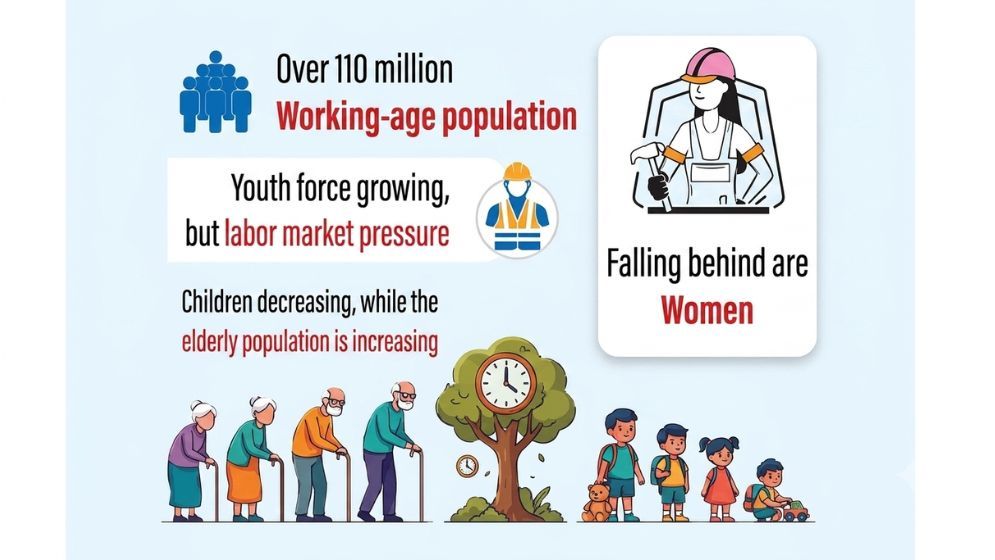
More than 110 million working-age people
According to BBS estimates, Bangladesh currently has 49.4 million people aged between zero and 14, 114.4 million people aged 15–64, and more than 11.9 million people aged 65 and above. Compared with 2011, the proportion of children has declined, while the number of elderly people has increased.
This shift is viewed as a demographic transition. In economic terms, it represents a “demographic dividend”, where a larger working-age population creates opportunities for higher productivity. However, there is one key condition: these people must be brought into productive employment.
The growing number of working-age people means that vast numbers of young people are entering the labour market every year. However, questions remain as to whether employment opportunities are being created at the same pace.
At present, there are around 2.7 million unemployed young people in the country, equivalent to 3.66% of the total population. While the figure may appear relatively low, many people are in reality underemployed or engaged in low-income work.
Women lagging behind in the labour market
The greatest disparity in labour force participation is evident among women. According to the latest census, women slightly outnumber men in Bangladesh. However, women remain significantly underrepresented in the labour force. Of the approximately 2.75 million unemployed people, nearly one million are women.
Unemployment is particularly high among highly educated women. Discrimination, social constraints and unfavourable working conditions are causing many women to lose interest in pursuing careers. Analysts warn that this trend could hinder the expansion of the country’s economic capacity.
Economists say the decline is worrying because greater female participation could significantly increase overall economic productivity.
According to BBS data, the female labour force participation rate was 35.6% in 2015–16. It gradually rose to 42.77% in 2022 before falling again to 41.5% in 2023 and 38.40% in 2024. The figure has reportedly increased further since then.
Dr Mujeri said: “A decline in women’s participation in the labour market means we are failing to utilise a large part of our potential. Social barriers, security concerns and a lack of suitable jobs are all contributing to women falling behind.”
Fewer children, more elderly people
The country’s population structure is also undergoing significant changes. While children accounted for 34.6% of the population in 2011, that figure is projected to fall to 28.1% in 2026. By contrast, the proportion of people aged over 65 has risen from 4.7% to 6.8%.
According to BBS estimates, there are now nearly 50 million children aged between zero and 14, while the number of people aged 65 and above is approaching 15 million.