


 For all latest news, follow the Daily Sun's Google News channel.


Industrialised countries must help pay for climate damage, speakers say
Daily Sun Report, Dhaka
Published: 07 Jun 2026, 12:49 AM
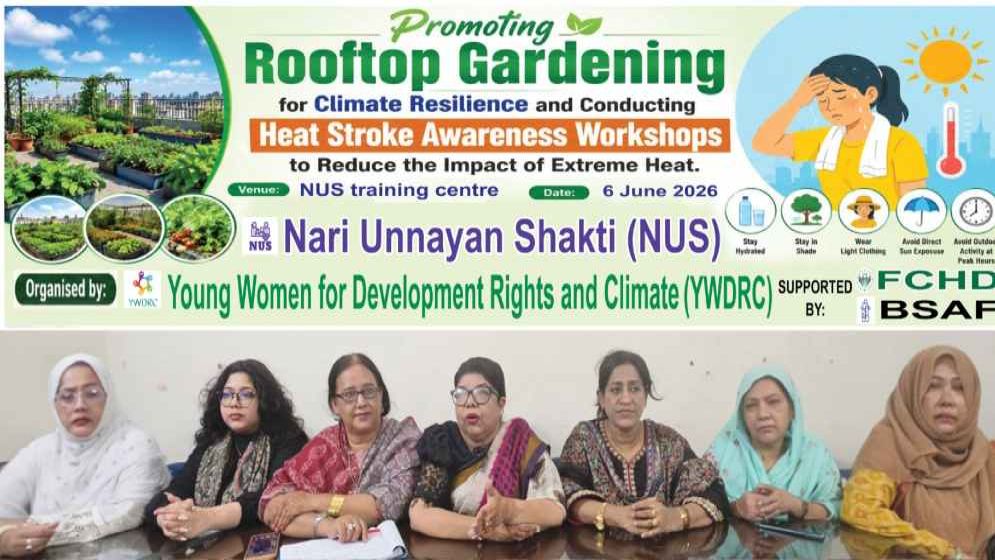
Photo: Courtesy
Environmental and rights organisations on Friday called on developed countries to compensate nations hardest hit by climate change, saying major polluters must shoulder greater responsibility for climate adaptation, rehabilitation and sustainable development.
The call came at a workshop on rooftop gardening promotion and heatstroke awareness jointly organised by Young Women for Development Rights and Climate (YWDRC) and Nari Unnayan Shakti at the latter's training centre in Banasree, Dhaka, marking World Environment Day.
The Bangladesh Child Rights Forum and the Forum for Culture and Human Development supported the programme.
Nusrat Sultana Afroj, executive chairperson of YWDRC, presented the keynote paper, while Dr Afroja Parvin, executive director of Nari Unnayan Shakti, chaired the session.
Speakers said Bangladesh remains among the countries most vulnerable to climate change despite contributing only a small share of global greenhouse gas emissions. They noted that rising sea levels, river erosion, floods, cyclones, droughts, extreme heatwaves and increasing salinity continue to threaten livelihoods and displace thousands of families across the country.
They also highlighted the growing impact of climate change on public health, agriculture, the environment and the national economy.
The participants said decisions adopted under the United Nations Framework Convention on Climate Change (UNFCCC) and various climate conferences place moral and financial responsibilities on developed nations to support countries suffering the consequences of global warming.
They urged the international community to operationalise the Loss and Damage Fund adopted at COP27 and ensure adequate financing for highly climate-affected countries, including Bangladesh.
The organisations also called on the government to strengthen diplomatic efforts to secure greater climate compensation and adaptation funding through international mechanisms, including the UNFCCC, the United Nations Environment Programme (UNEP), the Green Climate Fund (GCF) and the Loss and Damage Fund.
Among their key demands were increased international funding for climate adaptation, rehabilitation of families affected by climate-related disasters, support for climate refugees, investment in renewable energy and environmentally friendly technologies, expansion of climate-resilient agriculture and enhanced coastal protection measures.
The speakers also stressed the need for stronger international cooperation in public awareness campaigns, healthcare initiatives and heatstroke prevention programmes as extreme weather events become more frequent.
Sahida Wahab, president of the Forum for Culture and Human Development; Md Khairuzzaman Kamal, vice-president of the Bangladesh Child Rights Forum and executive director of Bangladesh Manobadhikar Shangbadik Forum; Nasima Haque, secretary-general of the Domestic Worker Employer Association Bangladesh; Nazmin Banu, executive head of Bikalpa Unnyan Karmashuchi; Advocate Siratul Jannat Swapna; Abdul Momin, coordinator of Nari Unnayan Shakti; Selina Khatun, publication secretary of SHELEAD; Nargis Begum; and Khadija Khatun, among others, attended the workshop.
The participants pledged to expand rooftop gardening, tree plantation and environmental conservation initiatives across the country under the slogan, “Every rooftop garden should become a part of a green Bangladesh.”