


 For all latest news, follow the Daily Sun's Google News channel.


Eid on Bangladesh’s chars
When Qurbani remains out of reach
Kongkon Karmaker
Published: 30 May 2026, 05:54 PM
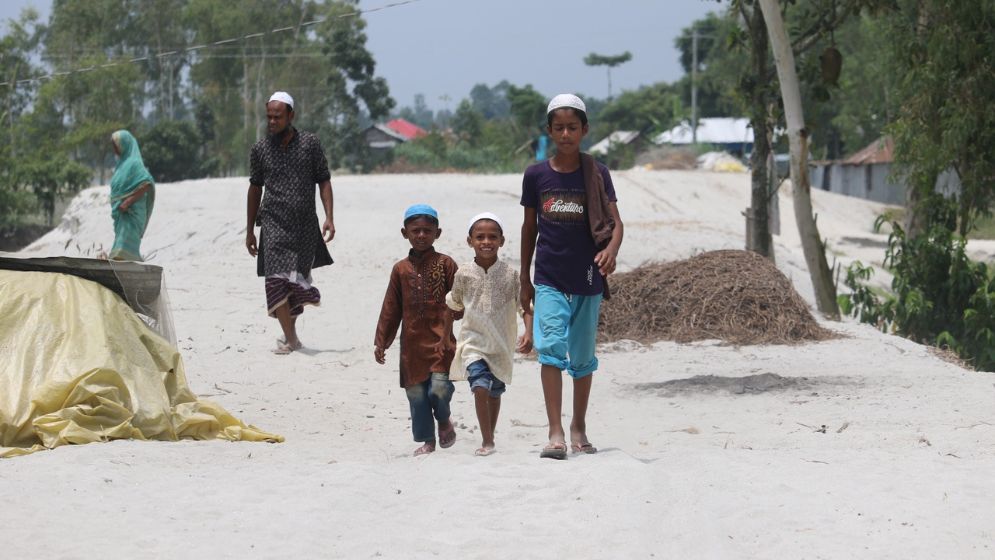
Photo: Daily Sun
On the morning of Eid-ul-Azha, while much of Bangladesh was preparing for prayers and sacrifice, Kabila Begum woke up to a much quieter day.
There was no cow in her yard, no excited children waiting for meat, no relatives dropping by with food. Instead, the domestic worker got ready for another ordinary day while many of the families she works for celebrated Eid.
"I spend Eid with chicken eggs," she said. It's a simple sentence, but it says a lot about how differently people experience the same festival across the Char area of Kurigram and other surrounded districts like Gaibandha.
Eid-ul-Azha is supposed to be a time of sacrifice, sharing and community. For many families, it is also one of the few occasions when everyone, regardless of income, is expected to have a place at the table. But that is not always how it works.
In the chars of Kurigram, Eid often arrives with a familiar reminder: many families simply cannot afford to take part in one of the festival's central traditions.
Life in the chars has never been easy. These river islands are constantly shaped and reshaped by floods and erosion. A good harvest can disappear in a few days. A family's land can disappear even faster. People grow potatoes, onions, corn and chilli, often with borrowed money, knowing there is no guarantee they will see a return.
-6a1ad0cdc35d6.jpg) Photo: Daily Sun
For many families, sacrificing a cow or goat is no longer realistic.
Asadul Islam, 34, from Rajarhat, remembers when Qurbani was a normal part of Eid in his family. His father and grandfather both sacrificed animals every year. Now he cannot afford to do the same.
"Due to poverty, I cannot offer sacrifices," he said.
Abdur Rauf Sheikh, a father of seven, said he managed to buy only half a kilogram of meat this Eid.
With seven children in the house, it did not go very far.
Yet poverty has not taken away their attachment to Eid. Families still attend prayers, visit neighbours and celebrate in whatever way they can. What many lack is the ability to put meat on the table, something most Bangladeshis associate closely with Eid-ul-Azha.
This year, some families received help.
Supreme Court lawyer Md Asaduzzaman Ansari and his wife, Advocate Noor Un Nahar Ansari, arranged for two cows to be sacrificed and distributed among more than 100 families in Begumganj Union. Alumni of Dhaka University's Department of Statistics organised a similar effort that reached more than 150 families in another char area.
-6a1ad0f49c6e2.jpg) Photo: Daily Sun
The amount each family received was modest, but the impact was clear.
Ambia Begum said she had thought she might not get any beef this Eid. Mujibar Rahman of Baladobar Char summed up the mood in a few words.
"It seems that Eid has become equal for everyone."
His comment captures something many people hope Eid can be, even if reality often falls short.
That contrast was visible elsewhere during the holiday.
In Rajshahi, sacrificial meat collected through door-to-door charity was later being sold on roadside vans. Much of it was selling for Tk750 to Tk800 per kilogram.
The sight raises difficult questions.
How does meat given as charity end up back in the market? Why are some people buying sacrificial meat while others struggle to receive any at all? And what does that say about how aid and charity are being distributed?
These questions are not really about religion. They are about who receives help, who misses out and how resources move through society.
At its heart, Qurbani is meant to encourage people to think beyond themselves and share with those who have less.
One of the brighter stories this Eid came from a government children's home in Gaibandha, where orphaned and abandoned children were served pulao, beef, chicken roast and soft drinks.
Seven-year-old Siam, who lost both of his parents, said he had never seen so much food at one meal. Nine-year-old Faridul was excited about the roast chicken. For a few hours, the children enjoyed the kind of Eid celebration many others take for granted.
For them, the day felt special.
There is no shortage of generosity in Bangladesh. The stories from Kurigram show that. Individuals, community groups and charities continue to step forward whenever they can.
The problem is that the need is much larger than any one group can handle.
A kilogram of beef can make a family's Eid happier. But it cannot solve river erosion, poverty, food insecurity or years of neglect. Those problems require something more than seasonal generosity.
The people living in the chars are not asking for luxury. Most are not asking for very much at all.
They want stability. They want opportunity. And like everyone else, they want to feel included.
This Eid, a kilogram of beef gave some families that feeling, if only for a day.
"It seems that Eid has become equal for everyone," one recipient said. The statement may not be entirely true. But it reflects something important: the feeling of being remembered.
For many of the people living on Bangladesh's chars, that can mean almost as much as the meat itself.