


 For all latest news, follow the Daily Sun's Google News channel.


Rare success at BMU as premature quintuplets return home healthy
Daily Sun Report, Dhaka
Published: 14 May 2026, 05:10 PM
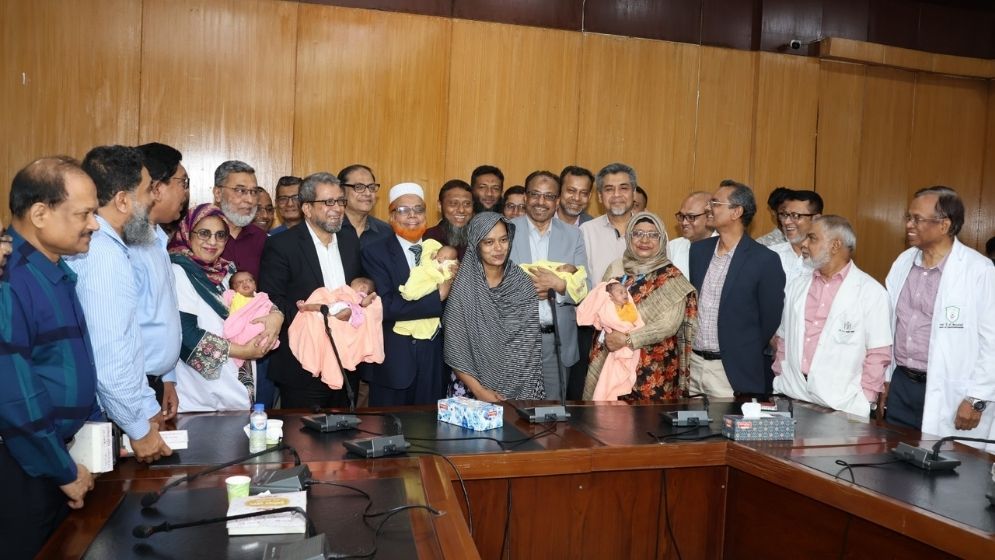
Photo: Courtesy
In a rare medical success in Bangladesh, five premature and low-birth-weight babies born together were discharged healthy from the Neonatal Intensive Care Unit (NICU) of Bangladesh Medical University (BMU) on Thursday after receiving intensive medical care.
The babies
-- two girls and three boys -- were
handed over to their parents and relatives at a programme held at the
university’s Shaheed Dr Milton Hall.
Vice-Chancellor Professor Dr FM Siddiqui
described the incident as a major success for the university and praised the
services and professionalism of doctors and nurses of the obstetrics and
gynaecology, fetomaternal medicine and neonatology departments.
Among others present were Pro-Vice Chancellor
(Research and Development) Professor Dr Md Mujibur Rahman, Treasurer Prof Dr
Nahreen Akhtar, Chairman of the Neonatology Department Prof Dr Md Abdul Mannan
and Chairman of the Fetomaternal Medicine Department Prof Dr Tabassum Parveen.
Prof Dr Md Abdul Mannan said the babies were
born through Caesarean section on 5 April to a 30-year-old mother at 33 weeks
of pregnancy.
He said the pregnancy had been considered
highly risky from the beginning due to multiple gestation. Soon after birth,
the babies were admitted to the NICU because of breathing difficulties and
premature conditions.
The babies weighed 1,420 grams, 1,250 grams,
1,410 grams, 985 grams and 1,625 grams respectively at birth, with some of them
categorised as extremely low-birth-weight newborns.
Doctors said the babies showed symptoms of
respiratory distress, including rapid breathing, chest retraction and grunting.
Prof Dr Md Abdul Mannan said the treatment
focused on early breastfeeding within one hour of birth, CPAP support,
infection prevention through regular handwashing, Kangaroo Mother Care (KMC)
and planned early discharge.
All five babies were placed on CPAP support
immediately after birth. Their breathing difficulties gradually improved within
a few days through close monitoring, temperature control, gradual feeding increase
and ensuring breast milk.
According to NICU sources, family members
were also trained by doctors and nurses on infection prevention measures, particularly
proper handwashing practices, which significantly reduced the risk of
infection.
Doctors said Kangaroo Mother Care was
introduced after the babies became stable. The skin-to-skin care method helped
improve weight gain, temperature regulation and bonding between the mother and
babies.
As part of the planned early discharge
programme, the babies were transferred to a private hospital on 9 April for
follow-up care.
At a 30-day follow-up, doctors found that all
five babies were healthy and gaining weight steadily. Their weights had
increased to 1,700 grams, 1,520 grams, 1,645 grams, 1,215 grams and 1,825 grams
respectively.
Doctors said the case demonstrated that even
in a resource-limited setting like Bangladesh, high-risk premature newborns can
recover successfully if timely NICU care, breastfeeding, CPAP management,
infection prevention and Kangaroo Mother Care are ensured.