


 For all latest news, follow the Daily Sun's Google News channel.


Stronger air capability might have prevented Rohingya crisis in Ctg: Army chief
Daily Sun Report, Dhaka
Published: 24 Apr 2026, 10:04 AM
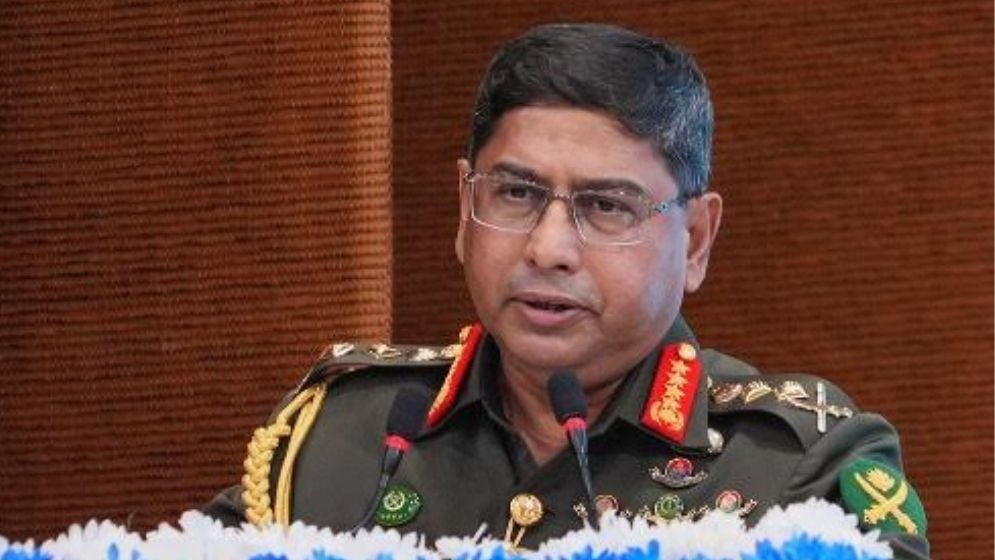
Photo: ISPR
Chief of Army Staff General Waker-Uz-Zaman has said the Rohingya crisis might not have emerged had there been stronger air power presence in Cox’s Bazar or Chattogram.
“If we had sufficient air defence capability
in the Cox’s Bazar or Chattogram region, perhaps the Rohingya crisis would not
have arisen,” he said, noting that Bangladesh had not procured multi-role combat
aircraft for a long time.
Speaking at the closing ceremony of the
‘Capstone Course 2026/1’ at the National Defence College on Thursday, the army
chief stressed that adequate military preparedness is essential even to avoid
war.
A total of 45 fellows took part in the
course, including five members of parliament, senior military and police
officials, academics, physicians, representatives of government and private
organisations, diplomats and corporate professionals.
As chief guest, General Waker-Uz-Zaman
encouraged participants to engage more with military affairs, including the
army, navy and air force, as these are national institutions whose capabilities
the public has the right to understand.
Highlighting maritime security, he said the
Bangladesh Navy remains crucial for safeguarding sea lines of communication,
given the country’s heavy reliance on imports and exports. However, he noted
limitations in naval capacity, including a shortage of offshore patrol vessels
(OPVs), forcing the use of smaller corvettes for patrol duties, which is not
cost-effective.
Referring to the Rohingya influx, he said
around 750,000 Rohingyas fled violence in Myanmar in August 2017 and entered
Bangladesh. The United Nations described the incident as a “textbook example of
ethnic cleansing”.
Since then, several more waves have arrived,
taking the total number of Rohingya refugees in camps in Ukhiya and Teknaf of
Cox’s Bazar to over 1.1 million—making it the world’s largest refugee
settlement. Their prolonged stay has created challenges for the local economy,
environment and regional security, while repatriation efforts have stalled due
to the situation in Myanmar.
The army chief said timely investment in
defence could prevent far greater losses in the future. “If you invest Tk1,000
crore today, you may be able to avoid losses of Tk50,000 crore later,” he said,
adding that military preparedness is aimed at deterring conflict, not provoking
it.
He also observed that effective foreign
policy cannot be implemented without a strong defence system, noting that the
two are complementary.
“We want to build a defence force that serves
as a credible deterrent to potential adversaries,” he said, adding that
accountability is essential for institutional growth.
Waker-Uz-Zaman also raised concerns over the
country’s energy security, referring to the recent fuel shortage. He expressed
frustration that even after more than five decades of independence, Bangladesh
has not developed adequate refining capacity.
“Currently, the Eastern Refinery Limited can
process only 10–15% of crude oil demand, forcing the country to import refined
fuel at higher prices. Despite cheaper crude oil being available globally,
including from Russia, Bangladesh cannot fully utilise it due to limited
refining capacity,” he said.
He stressed that energy security has a direct
impact on people’s daily lives, especially in the current global context.