


 For all latest news, follow the Daily Sun's Google News channel.


International Women’s Day
Advocacy dialogue held to promote girls’ education for equitable future
Daily Sun Report, Dhaka
Published: 09 Mar 2026, 02:48 PM
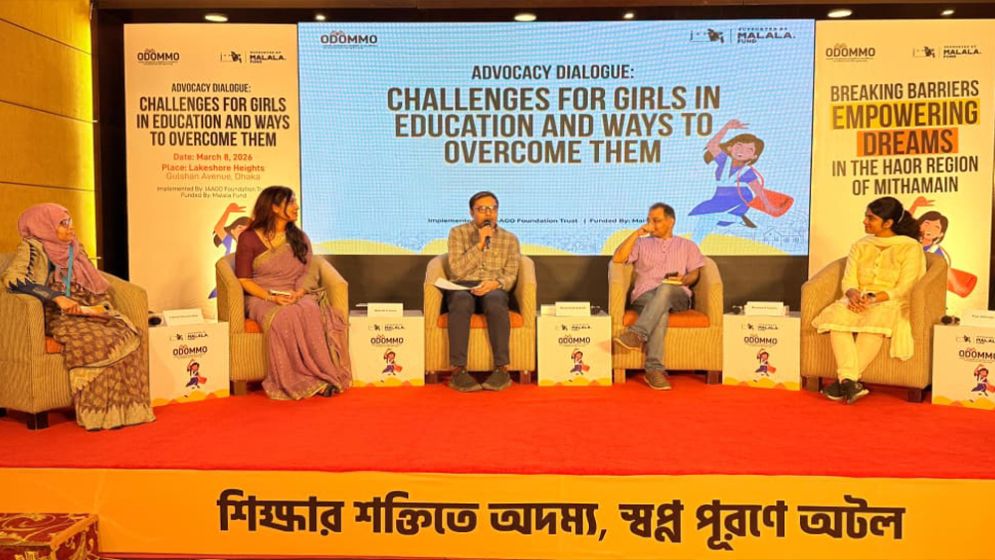
Marking International Women’s Day 2026, a special advocacy dialogue on removing barriers to girls’ education was held in the capital. Organized under the theme “Rights. Justice. Action. For all women & girls": Ensuring Rights and Protection for Women and Girls,” the event brought together experts and policymakers who called for developing new strategic frameworks to eliminate obstacles to girls’ education.
The dialogue was organized under the “ODOMMO” project, funded by the Malala Fund and implemented by JAAGO Foundation Trust. Held following the successful completion of the 40-month project in Mithamain Upazila of Kishoreganj District, a haor-surrounded region of Bangladesh, the event brought together representatives from government institutions, civil society organizations, development partners, education sector experts, women leaders, private sector stakeholders, and members of the Education Champion Network.
One of the key segments of the event was a panel discussion titled “Breaking Barriers: Empowering Girls to Overcome Educational Discrimination in Climate-Vulnerable Regions of Bangladesh – A Vision for a Brighter Future.”
During the discussion, Fatema Khairunnahar, Child Protection Officer at UNICEF Bangladesh, stated, “During climate-induced disasters, increased social and economic pressures often prevent families from maintaining girls’ educational continuity. As a result, risks such as child marriage, child labour, and school dropouts tend to increase.” She further emphasized that “community-based child protection mechanisms and coordinated social initiatives can play a vital role in ensuring girls’ education and safety in such contexts.”
Mosharof Tansen, Independent Consultant and Former Country Representative of Malala Fund, noted, “Climate change is not only an environmental crisis—it is also a matter of social justice that directly affects girls’ access to education. Addressing this challenge requires stronger coordination between climate adaptation strategies, education policies, and gender equality goals. Empowering local communities, strengthening institutional accountability, and integrating field-level evidence into policymaking will be critical to achieving sustainable change.”
Nishat Sultana, Director of Influencing, Campaigns and Communications at Plan International Bangladesh, said, “Women and girls are often the first to face barriers in times of crisis. To ensure girls’ education in climate-vulnerable countries, it is essential to prioritize this issue within national policies, budgets, and development plans. Long-term communication strategies and public engagement campaigns are also necessary to transform prevailing social norms.”
Puja Debnath, a student of the University of Dhaka, highlighted the need for stronger alignment between climate adaptation strategies and the goals of girls’ education and gender equality. She emphasized that integrating field-level data, research findings, and youth perspectives into policy discussions can help generate more practical and effective solutions.
The event aimed to identify social, economic, and environmental barriers affecting girls’ education in remote communities of Mithamain Upazila in Kishoreganj District, one of Bangladesh’s prominent haor regions, and to explore potential policy solutions.
Halima Begum Prema, Project Officer of the Ministry of Women and Children Affairs said, “The work that JAAGO Foundation Trust has carried out through the ODOMMO project is something that ideally should have been undertaken by the government. The Malala Fund stepped forward and supported this initiative, helping to create a meaningful impact. We hope that such efforts will continue in the future.”
Although Kishoreganj district is widely known for its diverse landscape and natural beauty, it continues to lag behind in several indicators related to girls’ education, child marriage, violence against women and children, and social inequality. To address these challenges, JAAGO Foundation Trust has been working in Mithamain through the ODOMMO project over the past several years.
At Haji Taiyeb Uddin High School in Mithamain, the dropout rate among girls has now dropped to zero. Meanwhile, at Ghaghra Abdul Gani High School, the dropout rate among girls decreased by 61 percent in 2025 compared to 2023. In addition, more than 15 previously dropped-out students have returned to school.
Kamrul Kibria Ayon, Education Champion of JAAGO Foundation Trust said, “We firmly believe that education is the most powerful tool for transforming the world. It not only empowers individuals but also lays the foundation for the progress of society as a whole. Our goal is to create an environment where every child—especially girls—can pursue their dreams without fear.”
Iftikhar Ul Karim, Senior Manager of the Program Implementation Department at JAAGO Foundation Trust, added, “Although access to quality education remains limited in remote areas like Mithamain, the ODOMMO project has played a crucial role in raising social awareness in support of girls’ education, promoting safe and inclusive learning environments, and strengthening advocacy for education-friendly policies.”
Participants at the event emphasized that ensuring safe, inclusive, and quality education for girls is essential for building a just and equitable society. They expressed hope that the experiences and achievements of the ODOMMO project will serve as an important model for social transformation and gender equality in Bangladesh.