


 For all latest news, follow the Daily Sun's Google News channel.


Experts call for sustainable financing to curb hypertension
Daily Sun Report, Dhaka
Published: 21 Jan 2026, 07:54 PM
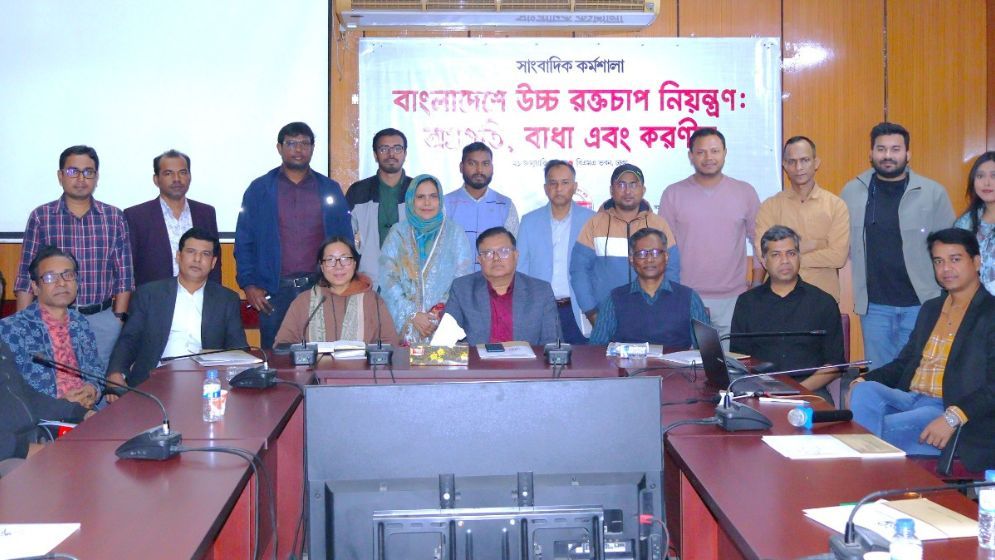
Photo: Courtesy
Health experts at a programme on Wednesday called for
sustainable financing to curb hypertension as the prevalence of hypertension
and other non-communicable diseases in Bangladesh is increasing at an alarming
rate.
The journalists’ workshop titled “Hypertension Control:
Progress, Barriers, and the Way Forward” was held at the BMA Bhaban in the
capital.
According to a report by the World Health Organization (WHO),
283,000 people died from cardiovascular diseases in Bangladesh in 2024, with
hypertension accounting for 52% of these deaths.
Ensuring the regular availability of anti-hypertensive
medicines at all Community Clinics and Upazila Health Complexes through
sustainable financing would enable effective control of hypertension and
hypertension-induced non-communicable diseases.
The workshop was organised by PROGGA (Knowledge for
Progress), with support from the Global Health Advocacy Incubator (GHAI). A
total of 26 journalists working in print, television, and online media
participated in the workshop.
At the workshop, it was informed that, according to World
Bank data, only 4.2% of Bangladesh’s health budget is allocated to the control
of non-communicable diseases. Due to inadequate budget allocation, the regular
supply of anti-hypertensive drugs at NCD corners of Community Clinics and
Upazila Health Complexes is being disrupted.
As a result, despite existing demand, free anti-hypertensive
drugs are not consistently available at the grassroots level.
Dr Geeta Rani Devi, medical officer of the Directorate
General of Health Services, said, “The government is making efforts to ensure
uninterrupted supply of anti-hypertensive medicines. We hope that all Community
Clinics and Upazila Health Complexes will soon come under the coverage of this
facility.”
Reaz Ahmad, editor, Dhaka Tribune, said, “Through the
publication of evidence-based and in-depth reporting, the media can play a
vital role in encouraging the public to prevent and control hypertension.”
Muhammad Ruhul Quddus, country lead, GHAI, and ABM Zubair, executive
director of PROGGA, were present at the workshop as discussants. A presentation
on hypertension control was delivered at the workshop by PROGGA’s Program
Officer Samiha Bintay Kamal.