


 For all latest news, follow the Daily Sun's Google News channel.


The End of a Political Chapter Marked by the Khaleda–Hasina Rivalry
Daily Sun Report, Dhaka
Published: 02 Jan 2026, 10:04 AM
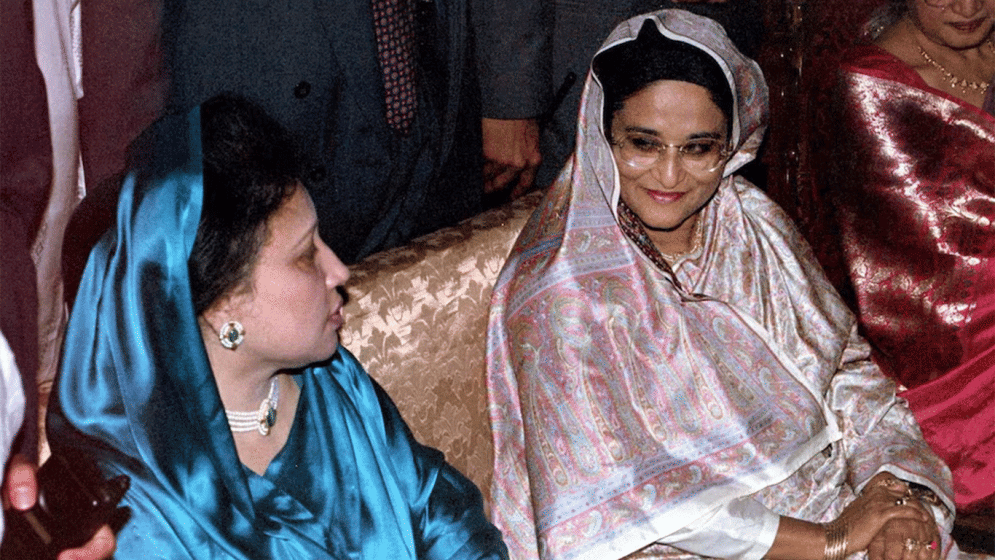
Photo: Collected
Aminul Islam, a retired government official, never actively participated in politics. Yet he joined the funeral prayers of Khaleda Zia.
Amid the sea of people on Manik Mia Avenue in Dhaka,
the 68-year-old Islam said he had developed deep sympathy for the BNP
chairperson and former prime minister because of her long imprisonment and
prolonged illness toward the end of her life. That was why, he explained, he
felt compelled to attend her janaza.
Political analysts believe that the massive,
cross-party participation in Khaleda Zia’s funeral has made history in
Bangladesh, BBC Bangla reported.
They note that Khaleda Zia entered politics
unexpectedly following the death of her husband, BNP founder Ziaur Rahman. Over
a colourful political career, she came to be known as an “uncompromising”
leader and established herself as a dominant force.
For more than four decades of her political life,
Khaleda Zia’s principal rival was Sheikh Hasina. For a long time, these two
leaders were the most influential figures in Bangladeshi politics, around whom
the entire political landscape revolved. They shaped—and controlled—the course
of politics.
After years of illness, Khaleda Zia has now departed
from the political stage. On the other hand, Sheikh Hasina was ousted from
power in a mass uprising about a year and a half ago and took refuge in India,
where she remains.
With Khaleda Zia’s death, a chapter in Bangladesh’s
political history has come to an end. The influential leader leaves behind the
BNP, a party she led for 41 years.
Under Khaleda Zia’s leadership, the BNP’s rivalry
with the Awami League, led by Sheikh Hasina, gradually turned into outright
hostility. Their face-to-face political confrontation continued for decades.
At various times, international media portrayed
Bangladesh’s politics as a “battle of the two Begums.”
Both leaders fought struggles in the name of
democracy and against authoritarianism. However, political analysts say that
during the tenures of both leaders, there were varying degrees of allegations
and criticism related to human rights and governance.
At the beginning of Khaleda Zia’s second full-term
government in 2001, numerous allegations emerged regarding attacks on
minorities in different parts of the country.
Within a year of that government, law and order
deteriorated sharply. To control the situation, a military-led anti-crime drive
known as “Operation Clean Heart” was launched in mid-October 2002.
During the 84-day operation, media reports said at
least 40 people died after being detained. After the operation, an ordinance
was issued granting indemnity, drawing strong criticism from human rights
organizations over alleged abuses.
During the BNP-led four-party alliance government,
the elite police unit Rapid Action Battalion (RAB) was formed. RAB too faced
allegations of extrajudicial killings and other human rights violations.
In comparison, analysts say Sheikh Hasina’s last
fifteen and a half years in power were marked by widespread repression of
opposition parties and dissenting voices.
From top leadership to grassroots levels, leaders
and activists of opposition parties, including the BNP, were overwhelmed by
legal cases and lived under constant fear of arrest. Even carrying out
political programs became a major challenge due to government restrictions.
Human rights activists say dissent was harshly
suppressed during Awami League rule. Even individual criticism on social media
often invited state action.
In attempting to build political resistance against
repression, BNP leader Khaleda Zia herself became a target of the Awami League
government’s wrath.
Analysts argue that under Sheikh Hasina’s prolonged
rule, politics of vengeance reached an extreme level. At one stage, Khaleda Zia
was imprisoned from February 2018 for two years.
In pursuit of continued power, three consecutive
controversial elections were held, effectively dismantling the electoral
system, analysts say. As a result, the Awami League government became
increasingly detached from the public, fueling anger that ultimately led to
Sheikh Hasina’s fall in a mass uprising.
Analysts also note that Khaleda Zia’s reserved
manner and tolerant behavior helped shape a distinct personal image in politics
and among the public. This allowed her to carve out a “separate” political
position. Notably, she never lost a personal election.
Following the political changes triggered by the
July 2024 uprising, discussions emerged about moving beyond two-party politics
and the possible rise of new political forces. However, analysts believe those
discussions have now stalled, and the traditional two-party framework
continues.
The change, they say, is that in the absence of the
ousted Awami League, BNP’s main rival has become its former ally, Jamaat-e-Islami.
Ahead of the February 12 election, other parties are divided into two camps
over seat-sharing arrangements involving BNP and Jamaat.
The fall of the Awami League introduced a new
political reality. Amid this, Khaleda Zia’s death is seen as the end of an era.
Yet analysts remain skeptical about whether Bangladesh can truly move beyond
its long-standing two-party political pattern.
Khaleda–Hasina: From Rivalry to Hostility
Khaleda Zia established her political standing
through the movement against military ruler General Ershad, during which she
earned her reputation as an “uncompromising” leader.
Later, however, she faced criticism for the BNP’s
alliance with Jamaat-e-Islami and accommodations with religion-based political
parties.
Following the assassination of BNP founder Ziaur
Rahman, Khaleda Zia took charge of a shattered party at the age of 36,
embarking on a 44-year political journey.
After assuming leadership of the BNP in 1982, she
led the party into the anti-Ershad movement, forming the seven-party alliance
and positioning herself at the forefront.
Meanwhile, Sheikh Hasina returned from exile in
1981—six years after the assassination of Bangladesh’s founding president
Sheikh Mujibur Rahman—to take charge of the Awami League. Under her leadership,
the Awami League formed an eight-party alliance and joined the anti-Ershad
movement. A separate five-party leftist alliance was also active at the time.
Though the three alliances coordinated programs
separately, their combined movements led to the mass uprising that toppled
Ershad’s regime.
Khaleda Zia and Sheikh Hasina emerged as the
principal driving forces of that movement, becoming known as the “two leaders.”
While their parties maintained competitive relations, there was a degree of
tolerance during that period.
Writer and analyst Mohiuddin Ahmad told BBC Bangla
that although rivalry existed during the anti-Ershad movement, relations had
not yet turned hostile. Hostility intensified later, centered on the struggle
for power.
Analysts believe that the first two governments
under the two leaders also operated in relatively tolerant environments.
After Ershad’s fall, the BNP formed the government
following the February 27, 1991 election under Khaleda Zia’s leadership. Toward
the end of that government, the Awami League led a movement demanding a
caretaker government, culminating in the controversial February 15, 1996
election boycotted by major opposition parties.
That BNP government lasted only about two months.
Under pressure, the 13th constitutional amendment was passed to introduce a
caretaker government system, leading to fresh elections. Under that system, the
Awami League, led by Sheikh Hasina, came to power in 1996—its first government
in 21 years.
Although tensions rose over the caretaker government
movement, analysts say relations did not yet reach extreme bitterness.
Political polarization deepened in the late 1990s,
however, and hostility intensified after the BNP-led four-party alliance won
the 2001 election. The August 21, 2004 grenade attack on Sheikh Hasina’s rally,
which killed at least 24 people, marked a turning point, pushing relations into
deep enmity.
Subsequent events—such as Khaleda Zia’s eviction
from her cantonment residence in 2010 and the imprisonment of both leaders
during the military-backed caretaker government of 2007–08—further entrenched a
politics of vengeance.
During that caretaker period, efforts to sideline
both leaders—the so-called “minus two” formula—ultimately failed. The BNP,
however, suffered greater repression, with Khaleda Zia and her sons Tarique
Rahman and Arafat Rahman arrested.
Tarique Rahman later went into exile in London and
returned to Bangladesh on December 25, ending 17 years abroad—just days before
Khaleda Zia’s death.
Despite repeated attempts to split the BNP, Khaleda
Zia managed to keep the party united and influential. She led the country for
ten years as prime minister and twice served as leader of the opposition,
though she spent the last two decades largely outside power.
From February 2018, she remained imprisoned for two
years, followed by years of illness and political inactivity.
BNP has long blamed the Awami League government for
Khaleda Zia’s deteriorating health and eventual death, citing her imprisonment
and denial of proper care. The Awami League, meanwhile, has accused BNP of
responsibility for the August 21 grenade attack aimed at Sheikh Hasina.
Analyst Professor Mahbub Ullah says that even amid
hostility and revenge-driven politics, Khaleda Zia maintained a tolerant
demeanor, earning her a guardian-like stature among other parties.
Another analyst, Mohiuddin Ahmad, believes her death
marks the end of a political chapter. Mahbub Ullah, however, argues that the
BNP she left behind has become even more important, ensuring her continued
relevance in politics.
Whether Bangladesh will move beyond two-party
politics, analysts conclude, will depend on the upcoming election and the
political developments that follow.