


 For all latest news, follow the Daily Sun's Google News channel.


Sharp rise in adolescent marriage, pregnancy despite gains in maternal health
Daily Sun Report, Dhaka
Published: 19 Nov 2025, 07:56 PM
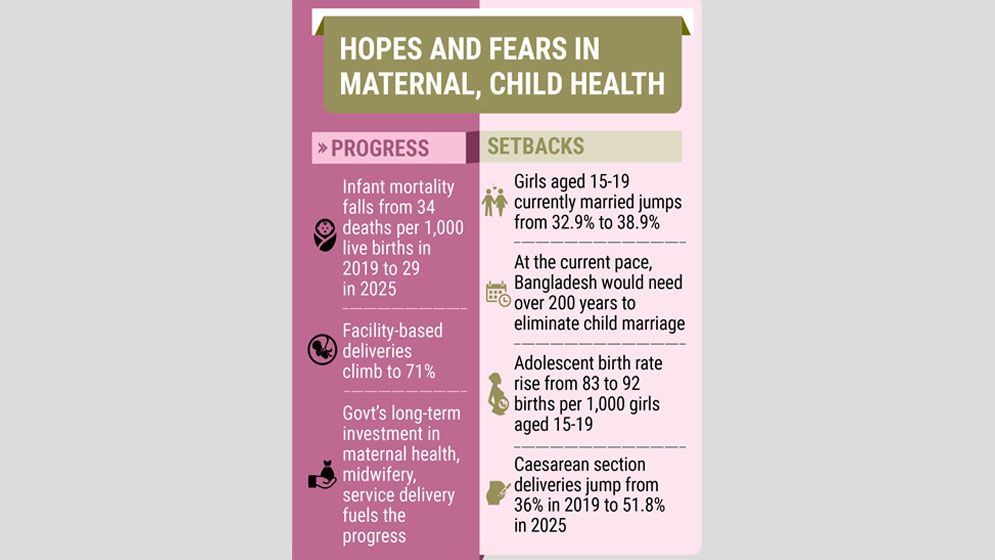
Bangladesh has made notable progress in reducing infant deaths and expanding access to skilled maternal care, but a sharp rise in adolescent marriage and pregnancy is threatening to undermine these gains, the United Nations Population Fund (UNFPA) said on Wednesday.
The warning comes as UNFPA
welcomed the preliminary findings of the 2025 Multiple Indicator Cluster Survey
(MICS), released by the Bangladesh Bureau of Statistics with technical support
from UNICEF.
The national survey tracks 172
indicators, including 27 linked to the Sustainable Development Goals, offering
one of the clearest snapshots of women’s and children’s wellbeing in the country.
The report highlights
encouraging improvements. Infant mortality has fallen from 34 deaths per 1,000
live births in 2019 to 29 in 2025. Facility-based deliveries have climbed to 71%, while 77% of births are now attended by
skilled professionals. UNFPA credited the government’s long-term investment in
maternal health, midwifery, and service delivery for the progress.
However, the same dataset reveals troubling setbacks.
Although marriage of women
aged 20–24 has declined modestly, from 51.4% in 2019 to 47.2% in 2025, the
share of girls aged 15–19 who are currently married has jumped from 32.9% to
38.9%. UNFPA estimates that at the current pace, Bangladesh would need over 200
years to eliminate child marriage.
Alongside these trends, the
adolescent birth rate has risen from 83 to 92 births per 1,000 girls aged
15–19—underscoring how early marriage continues to drive early childbearing,
with lasting physical, mental, and social consequences.
Shifts in fertility patterns
also point to wider systemic gaps. The country’s total fertility rate has edged
upward, partly due to disrupted family planning services during the COVID-19
pandemic and a decline in contraceptive prevalence to 58.2%. Access to modern
contraception remains uneven, limiting women’s ability to make informed,
rights-based decisions.
Another red flag is the steep
rise in Caesarean section deliveries, up from 36% in 2019 to 51.8%. The spike is concentrated in under-regulated
private facilities, raising concerns about unnecessary surgeries, safety risks,
and financial strain on poorer families. UNFPA stressed the need for more
trained midwives, stronger clinical governance, and expanded emergency
obstetric care in public facilities.
The survey also points to gaps
in managing high-risk pregnancies and delivering quality care during and after
childbirth, with worrying figures related to eclampsia, haemorrhage, prolonged
labour, and delayed breastfeeding initiation.
UNFPA said Bangladesh now needs
a decisive push for ensuring the
provision of stronger family planning services, uninterrupted contraceptive
supplies, more midwives at public facilities, and a national effort to delay
marriage and prevent adolescent pregnancy.
“There is no pathway to national
progress without investing in the health, rights, and education of women and
girls,” said Catherine Breen Kamkong, UNFPA’s Representative in Bangladesh.
UNFPA reaffirmed its commitment
to supporting the government as it works to protect women, adolescents, and
young people—and safeguard the country’s long-term development goals.
The reporter can be reached at [email protected]