



 For all latest news, follow the Daily Sun's Google News channel.


When a giant tunnel boring machine disappears beneath a city, the visible achievement is a tunnel. Less visible, but equally important, are the technology, engineering expertise and institutional capacity required to build, operate and maintain it.
That distinction is becoming increasingly relevant to Bangladesh as Chinese companies deepen their involvement in the country’s transport infrastructure.
Since the establishment of diplomatic relations in 1975, Bangladesh and China have expanded cooperation across a range of sectors. Infrastructure has increasingly become one of the most visible areas of that partnership, with Chinese companies involved in major railway and transport projects, equipment supplies and proposals for future high-speed and electric rail networks.
From the Padma Bridge Rail Link to proposals for high-speed and electric services on the Dhaka-Chattogram corridor, Chinese engineering and technology are becoming an important part of Bangladesh’s infrastructure landscape.
The question now is whether Bangladesh will simply acquire Chinese-built infrastructure or use these projects to develop the technical expertise needed to operate, maintain and eventually upgrade such systems independently.
The issue was highlighted during a visit by this correspondent to an ongoing metro project of China Railway 11th Bureau Group Co., Ltd (CRCC11) in Guangzhou.
Technology behind the infrastructure
CRCC11, a major subsidiary of China Railway Construction Corporation (CRCC), is involved in the construction of a 40-kilometre metro line in Guangzhou.
At one sub-project, journalists inspected a 1.8-kilometre tunnel being constructed at a cost of about RMB700 million. The project is expected to be completed within a year.
Despite its scale, the construction site operates with a relatively small workforce, comprising around 15 management officials and 150 workers. The project demonstrates how advanced machinery, engineering systems and project management can increase construction productivity.
The experience also provides an insight into the technological environment from which Bangladesh is increasingly seeking infrastructure expertise.
From railway builder to global infrastructure company
Founded in 1948, CRCC11 has evolved through decades of institutional reform and technological development. Its parent company, CRCC, ranked 51st in the 2025 Fortune Global 500.
CRCC11 reported operating revenue of RMB95.7 billion and new contracts worth RMB193.2 billion in 2024. It has topped performance assessments among CRCC’s 38 subsidiaries for three consecutive years.
The company currently manages more than 1,000 domestic projects and 34 overseas ventures, with ongoing contracts valued at about RMB280 billion. Its international operations extend across 19 countries, including Singapore, Thailand, Indonesia, Malaysia, Serbia, Liberia, Morocco and Kyrgyzstan.
Over the past five years, it has secured overseas projects worth about US$4.13 billion, employing nearly 1,700 Chinese staff and around 3,000 local employees.
Its technological capacity is a significant part of that expansion.
CRCC11 has 19 national and provincial scientific research platforms, an academician workstation and a postdoctoral research centre. Its technical workforce includes 117 senior engineers and 42 PhD holders. The company says its researchers and engineers have contributed to more than 235 provincial and ministerial scientific awards and six national-level recognitions.
The company has extensive experience in shield tunnelling, having participated in metro projects in 41 of the 44 Chinese cities currently developing urban rail systems.
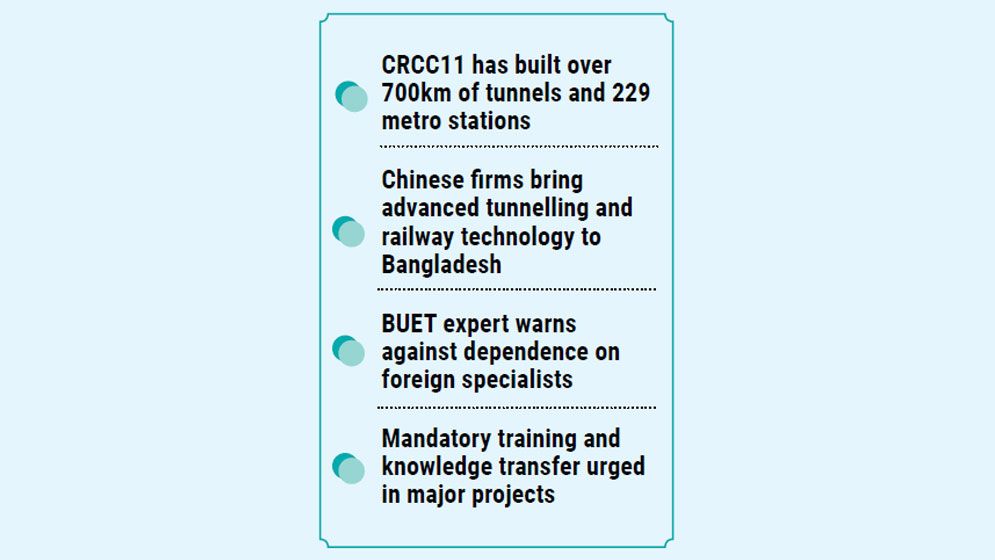
It has constructed more than 700 kilometres of tunnels and 229 metro stations, with a combined project value exceeding RMB42 billion.
CRCC11 operates 63 tunnel boring machines, ranging from 1.2 metres to 15 metres in diameter, including vertical, rectangular and micro TBMs. Its production bases in Wuhan, Chongqing, Zhoushan and Inner Mongolia manufacture tunnel segments designed for service lives of up to 100 years.
For a rapidly urbanising country such as Bangladesh, these capabilities have clear relevance as Dhaka and other major cities face growing congestion and demand for more sophisticated mass-transit systems.
The Bangladesh question: Who owns the knowledge?
Bangladesh has already entered a new phase of cooperation with Chinese railway companies.
The 170-kilometre Padma Bridge Rail Link Project, connecting Dhaka with Jashore, is among the most significant examples of Chinese involvement in Bangladesh’s railway infrastructure. The project entered commercial operation in 2024 and has significantly reduced travel time between Dhaka and the country’s south-western region.
Meanwhile, discussions and proposals involving Chinese expertise have emerged around high-speed and electric railway services, particularly on the Dhaka-Chattogram corridor.
Such projects could introduce technologies and operating systems considerably more advanced than those traditionally used in Bangladesh’s railway sector.
The challenge, however, extends beyond acquiring the technology.
Kazi Md Shifun Newaz, assistant professor at the Accident Research Institute (ARI), Bangladesh University of Engineering and Technology (BUET), said China was far ahead in science, technology and engineering, with significant advances in its products and technologies.
He said Bangladesh should ensure that knowledge-sharing accompanies technology transfer, particularly by making maintenance and technical training integral parts of major infrastructure projects.
“If Bangladesh can ensure knowledge sharing alongside technology transfer, particularly by making maintenance and technical knowledge-sharing an integral part of projects, it will enable our engineers to address minor faults and technical problems themselves,” he said.
Newaz said Bangladesh should avoid becoming dependent on foreign specialists whenever technical problems arise.
“Bangladesh should not simply pay for advanced technology and then remain dependent on foreign specialists whenever something goes wrong,” he said. “If Bangladesh buys an advanced system, it should also receive the capacity to understand, operate, maintain and eventually upgrade that system.”
He also suggested that major projects should include formal training programmes capable of creating a pool of local trainers.
“Without local expertise, even a relatively minor technical failure could create dependence on the original foreign supplier,” he said. “Projects should include a requirement to train 10, 20 or 50 people who can become trainers themselves, so that we can solve our own problems when something goes wrong.”
Building capacity beyond the project
The importance of knowledge transfer becomes greater when the lifespan of railway infrastructure is considered.
A railway project can operate for decades, while the engineers trained during its construction can go on to design, operate and maintain future systems. Training local personnel can therefore create benefits well beyond the original project.
A Chinese-built railway could consequently become more than a piece of infrastructure if it leaves behind a generation of Bangladeshi engineers capable of understanding, maintaining and improving the technology.
The alternative is a familiar pattern in large infrastructure projects: foreign contractors build the system, foreign specialists provide technical supervision, while local personnel remain confined to limited operational roles.
Such an approach can deliver infrastructure without necessarily developing technological capacity.
China’s capability and Bangladesh’s responsibility
China’s large domestic market has enabled its engineering companies to test, refine and deploy infrastructure technologies on a scale few countries can match. Chinese companies can therefore offer Bangladesh access to extensive experience in large-scale railway and urban infrastructure development.
For Bangladesh, the principle should be to select technology based on quality, reliability, affordability and long-term value, regardless of its country of origin.
But the same principle should apply to knowledge.
If Bangladesh is paying for advanced technology, its contracts should address not only construction, equipment and systems, but also technical training, documentation, maintenance capability and knowledge transfer.
The success of future infrastructure projects should therefore be measured not only by kilometres of railway built, tunnels completed or stations opened, but also by the technical capacity left behind.
CRCC11’s experience in Guangzhou illustrates what can be achieved when advanced engineering, machinery, research and project management operate together.
For Bangladesh, the challenge is to ensure that such projects do more than connect cities. They should also build the knowledge and expertise needed to operate, maintain and develop the country’s railway systems for decades to come.