



 For all latest news, follow the Daily Sun's Google News channel.


Mideast tensions going from bad to worse
Qatar PM terms war economic fallout as ‘an earthquake’
Agencies, Tehran/Washington
Published: 22 Sep 2026, 12:00 AM
Middle East tensions have accelerated to unprecedented levels recently, following a massive shift from regional proxy conflicts to direct, large-scale state warfare.
As world leaders prepare to gather in New York for the United Nations General Assembly this week, a growing number of flashpoints across the Middle East were raising concerns about a wider regional escalation, from renewed fighting between Saudi Arabia and the Iran-backed Houthi rebels in Yemen to fresh warnings exchanged between Washington and Tehran.
Despite short-lived attempts at a ceasefire, hostilities have flared up with devastating effects on global shipping, regional sovereignty, and energy infrastructure. The conflict has reached its most dangerous inflection point in months, with the ongoing US-Iran war rapidly expanding to engulf new regional fronts.
While the Houthis previously stayed largely on the sidelines of the seven-month-old war ignited by US-Israeli strikes on Iran, they have now entered the conflict in full force.
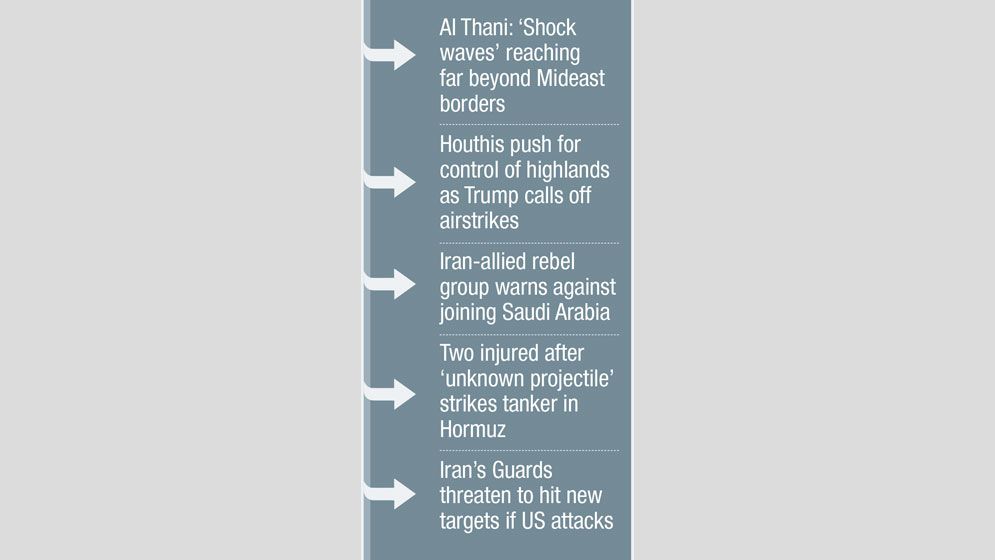
Houthi fighters were pushing to seize strategic heights in Yemen on Monday to cut off the Red Sea coast from remaining areas held by Saudi-backed forces, after a report that US President Donald Trump had called off US strikes on the group at the last minute.
The lightning advance by the Iran-backed group this month has extended the wider Middle East conflict to a new theatre and further threatened global energy supplies.
Washington has so far rebuffed repeated pleas from Saudi Arabia's Crown Prince Mohammed bin Salman to join the fight in Yemen. The Houthis said on Saturday they had fired on Riyadh, where loud booms were followed by columns of smoke visible near the airport.
Saudi Arabia has not commented on the first apparent strikes on the capital since the escalation began.
The New York Times reported that the Trump administration had prepared on Sunday to launch airstrikes against the Houthis after fresh pleas from the Saudi crown prince. But the newspaper said Trump called off the airstrikes at the last minute, even as troops were loading bombs onto aircraft.
The Houthis, who have controlled Yemen's capital since 2014, seized the country's Red
Sea coast this month in a lightning advance that routed forces of an internationally recognised Yemeni government, which is backed by Saudi Arabia and based in the south.
Saudi Arabia has launched hundreds of strikes in recent days on the fighters' positions in the highlands, according to the Houthis. But the air power advantage has so far done little to slow the advance of the fighters as Saudi-backed government forces have melted away.
Qatar's Prime Minister and Foreign Minister Sheikh Mohammed bin Abdulrahman Al Thani called on Sunday for a regional security framework bringing Gulf countries and Iran together, saying the recent war should serve as a "wake-up call" for the region.
Al Thani described the economic fallout from the US-Israel war on Iran as “an earthquake” with “its shock waves” reaching far beyond the borders of the Middle East, “challenging assumptions about security and stability”.
According to the United Nations, nearly 700 people have been killed and thousands injured in the flare-up in fighting. More than 120,000 Yemenis have fled homes within Yemen, and thousands more have fled by boat across the Red Sea to Africa.
Five Yemeni military sources told Reuters the Houthis were now seeking to seize strategic heights, known as the Kahboub Mountains, in two provinces, Taiz and Lahij, which separate the Red Sea coast from the government-held south.
Mohamed al-Bukhaiti, a member of the Houthis’ political bureau, warned countries against joining Saudi Arabia in Yemen’s revived civil war, telling The Associated Press on Sunday that his group has assured the Trump administration that it won’t attack US vessels in the Red Sea.
“We confirmed that we are not targeting the United States, or any other nation, in the strait, with the sole exception of the Saudi enemy,” he told the AP in a Zoom interview from the rebel-held Yemeni capital, Sanaa. “That remains the case.”
Al-Bukhaiti said the rebels have the capacity to fight a war on multiple fronts “should any nation become implicated in the aggression against Yemen alongside Saudi Arabia.”
Meanwhile, two crew members were injured after an "unknown projectile" hit their tanker in the Strait of Hormuz Monday, a British maritime agency said, where vessels have come under repeated attack amid the Middle East war.
Iran's Revolutionary Guards on Monday warned they would attack new targets and deploy new weapons if the US launches further attacks on the country.
In a statement, a spokesman for the Islamic Revolutionary Guards Corps, the ideological arm of Iran's military, said "there will certainly be significant changes in our defence and our counteroffensive" in the event of a new US attack.