


 For all latest news, follow the Daily Sun's Google News channel.


The last generation keeping the keys alive
Dhaka’s ageing typists hold on to a fading profession in the digital era

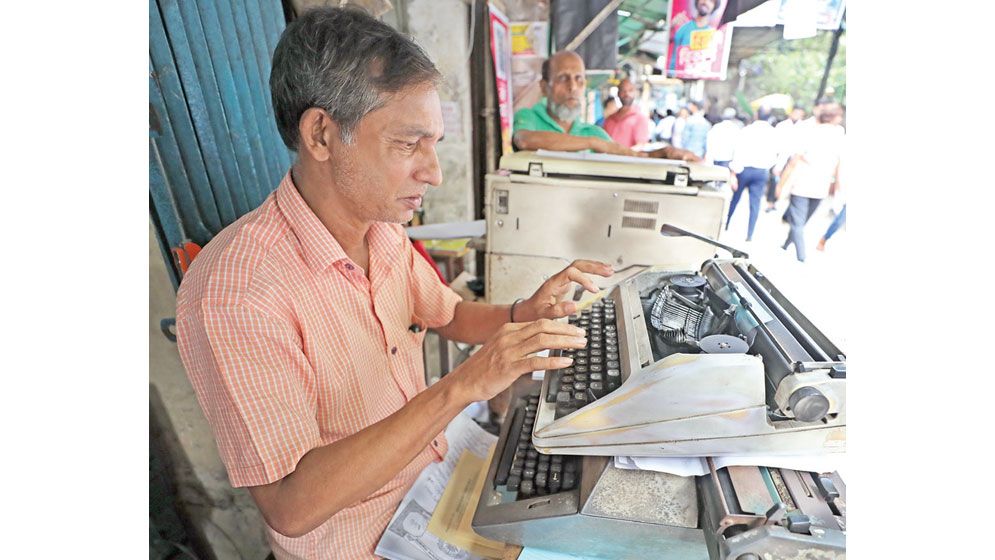
Dhiman Pal, who learned the craft of typing from his father, is one of the few typists still working on an old typewriter in Dhaka’s court area. The photo was taken recently. - KAMRUL ISLAM RATAN
Sekandar Ali, 65, sits on a tiny stool behind a small table in the Dhaka Judge Court area, his fingers moving swiftly across the keys of a decades-old typewriter.
The familiar clatter of the machine, once a common sound around court premises, is now fading into the background as computers have replaced typewriters in almost every sphere of office work.
Sekandar began working as a typist at the Dhaka Judge Court in 1975. At the time, piles of documents would accumulate on his table as people queued up to have deeds, contracts, mortgage documents, transfer deeds and other legal papers typed.
Those crowds have long disappeared, as has the steady flow of documents. Yet Sekandar continues to sit at his small, crowded desk, sustained by a limited amount of work that still requires typewritten documents.
“Some applications, government forms and certain court-related work still require an electric typewriter. Affidavits, marriage documents and divorce deeds—such work is still done,” Sekandar said.
According to him, the profession had its golden era decades ago, when his predecessors began working as typists during the Pakistan period.
“Many educated people also took up this work after their retirement or after office hours,” he said.
“When we started, there was a lot of work as there was no alternative, and sometimes we couldn’t complete even half of it. Though the earnings were low, we were still able to lead a better life,” Sekandar recalled.
Now, however, the profession is struggling to survive.
Another typist, Dhiman Pal, inherited the profession from his father and started working in 1990. He said a small amount of work connected with court proceedings still keeps the profession alive.
“It is simple: nobody will stick to outdated machines when they have modern technology at hand,” Dhiman said.
The machines themselves have also become increasingly difficult to maintain. Spare parts and ribbons are now hard to find, while obtaining a new typewriter can take weeks.
“It can take even a month when we order new machines,” Dhiman said.
The shortage of skilled repairers poses another major threat to the profession.
Dhiman recalled that typewriter repair workshops once operated in different parts of Dhaka. Most have now disappeared, leaving only a handful of people capable of repairing the ageing machines.
“Only one or two repairers are available now. We have to wait for them to come and repair the machines. They have also aged and are thinking about giving up the work. Without repairers, it’s over,” he said.
The decline of the profession is also reflected in the shrinking number of typists working around the Dhaka court area.
According to Dhiman and Sekandar, more than 30 people were once engaged in the profession there. Today, only four remain. Apart from Sekandar and Dhiman, the other two are Poran and Babul.
The four continue to work as computers have steadily pushed typewriters towards obsolescence.
For Dhiman, however, the future looks bleak.
“I don’t want my child to come into this profession now. In fact, nobody will want to amid the modern wave. Technology has gone far beyond what it was in the ’90s,” he said.
The profession has also lost the ecosystem that once supported it. As the demand for typewritten documents declined, repair shops disappeared, spare parts became scarce and fewer people learned the skills needed to operate and maintain the machines.
The typists say they are now the last generation keeping the profession alive.
“This profession will be gone after our generation, as our sons, or their sons—no one will take it up. How will it continue?” they asked.
For now, the machines still clatter occasionally in the court premises, their keys pressed by a handful of ageing typists who have spent decades behind them.
But with computers now firmly entrenched in modern workplaces, the familiar sound of typewriter keys may soon become only a memory.