



 For all latest news, follow the Daily Sun's Google News channel.


At cattle markets across the country’s cities and villages ahead of Eid-ul-Azha, the scene has long been familiar – a seasoned hand pressing against an animal’s ribs, belly and back to gauge its meat yield, followed by the theatre of prolonged bargaining between buyers and sellers.
That centuries-old tradition is now undergoing a digital transformation.
For generations, cattle trading relied heavily on the seller’s experience and the buyer’s trust. Growing consumer awareness and wider access to technology, however, are rapidly transforming the country’s cattle markets through the introduction of “live weight” trading, a system in which sacrificial animals are sold according to their measured body weight.
Industry insiders say the rise of online cattle markets during the COVID-19 pandemic in 2020 accelerated the shift towards live-weight trading.
The “Digital Haat” platform, launched jointly by Dhaka North City Corporation, the ICT Division, e-CAB and the Bangladesh Dairy Farmers Association, played a key role in popularising live-weight cattle sales nationwide.
Like many other parts of the country, farms and cattle markets in Chattogram are increasingly using digital weighing machines directly at market sites.
Farmers in the district said local cattle are currently selling for Tk450 to Tk500 per kilogramme of live weight, while Sahiwal breeds are fetching around Tk450 per kilogramme.
Private bank official Asif Rahman said he has been purchasing sacrificial cattle through the live-weight system for the past three years.“Those of us who grew up in cities often lack experience in cattle markets and can easily be misled,” he told the Daily Sun.
“When I buy based on live weight, I at least have peace of mind knowing I was not cheated on the weight. This use of technology is a huge relief for working people like me.”
Modern cattle farmers also say they increasingly prefer the system because it ensures fair pricing.
“After raising cattle scientifically throughout the year, many farmers fail to receive fair prices in traditional markets because of middlemen,” said Mohammad Hossain Zaki, owner of Shah Amanat Agro.
Tanvir Kamal, owner of Ozi Agro, said many urban residents lack the space to keep sacrificial animals after purchase.
“So even if customers buy cattle through live weight before Eid, we continue caring for the animals until the sacrifice. In many cases, the qurbani is also performed at our farm, and customers simply collect the meat on Eid day,” he said.
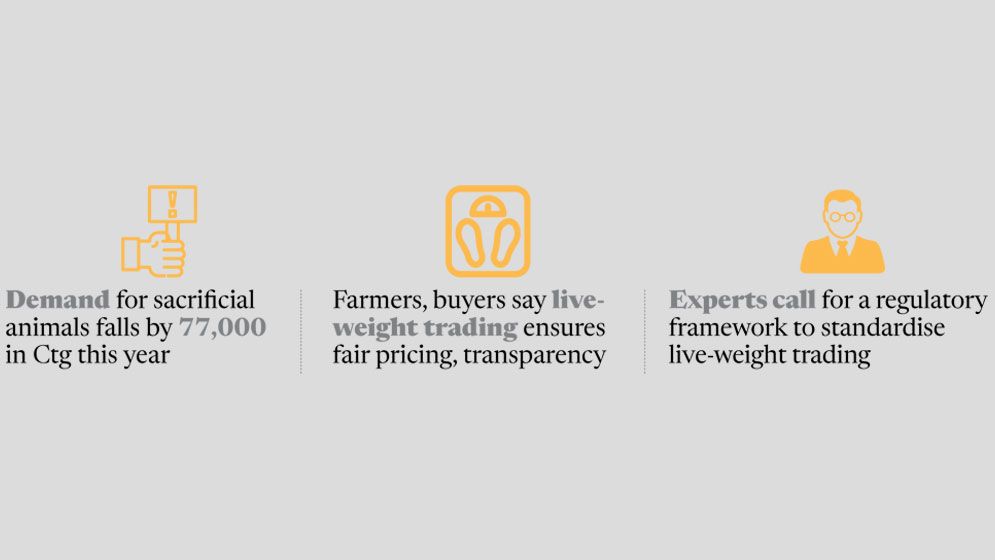
Livestock experts say live-weight trading is internationally recognised and offers greater transparency than conventional estimation-based systems.
Professor Md Monirul Islam of Chittagong Veterinary and Animal Sciences University said, “Live-weight trading is an internationally accepted and modern system. However, Bangladesh needs a specific standard and regulatory framework to ensure its successful implementation.”
“Generally, 55 to 60% of a healthy cow’s live weight converts into meat. Buyers should be made aware of the ratio between meat and bone so that expectations remain realistic,” he added.
Demand for sacrificial animals declines in Chattogram
According to the Department of Livestock Services in Chattogram, demand for sacrificial animals in the district has been estimated at 818,681 this year.
Against that demand, local farmers have prepared 783,151 cattle, buffaloes, goats, sheep and other sacrificial animals, leaving a shortfall of around 35,520 animals.
Officials, however, believe the deficit will be met through supplies from neighbouring upazilas and other districts, as in previous years.
Chattogram District Livestock Officer Dr Md Alamgir said demand has fallen by more than 77,000 animals compared with last year’s figure of 896,269.
“We obtained the data through field-level surveys. The reduction in demand is largely driven by the current financial condition of the people,” he said.
Industry stakeholders, however, warned that prices may rise this year due to higher feed costs, increased labour wages and fuel-related expenses linked to instability in the Middle East.
The district administration has approved six temporary cattle markets in Chattogram city for Eid-ul-Azha this year. Alongside three permanent markets, a total of nine major cattle markets will operate in the city.
In addition, at least 500 smaller markets and more than 350 farms across the district are expected to participate in sacrificial animal trading.