




 For all latest news, follow the Daily Sun's Google News channel.


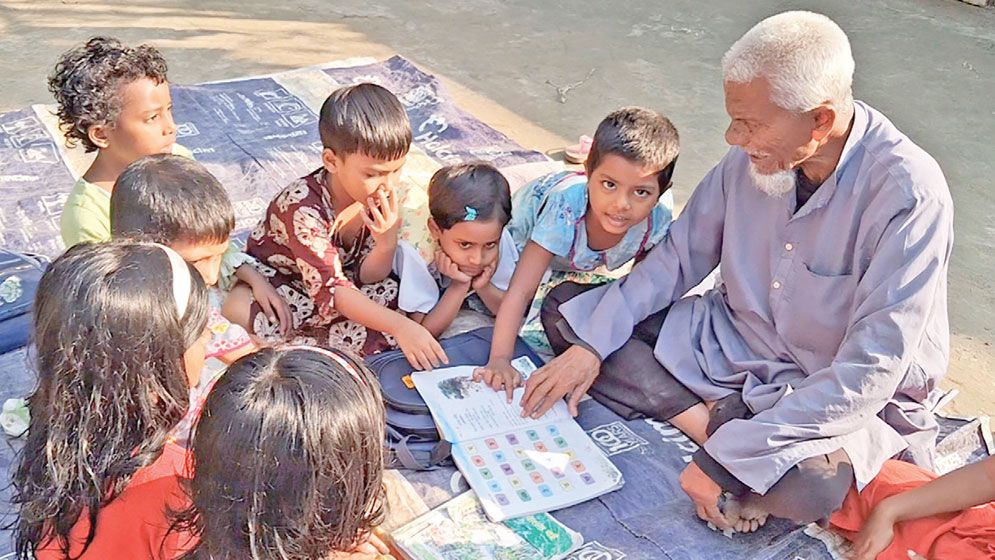
Every afternoon across the remote riverbank villages of Gaibandha, groups of children gather in village courtyards, waiting for a frail, 78-year-old man on a bicycle.
When Lutfar Rahman arrives, lessons begin on the bare ground.
After two hours of reciting poetry and reviewing schoolwork, each child quietly hands him a single coin.
For over five decades, Lutfar has been known across these northern communities as the “one-taka tutor”.
While modern private tutors charge thousands, his fee has remained unchanged since the 1970s.
Born into wealth in Fulchhari upazila, Lutfar’s life took a drastic turn when the devastating Brahmaputra river erosion of 1974 devoured his family’s property, leaving them destitute.
Forced to abandon his own educational aspirations after matriculating in 1972, he chose an unconventional path: teaching underprivileged children along the shifting riverbanks.
Back then, a handful of coins bought daily groceries. Today, the fee is entirely symbolic, a steadfast refusal to let inflation dictate a child’s future. In villages like Madaner Para and Baguria in Gaibandha Sadar upazila, he is the only bridge between poverty and literacy.
“My children studied under him, and now my grandchildren do too,” says Marzina Bewa, a local guardian. “Everyone’s lives improved, except the teacher’s own.”
Another parent, Nazma Begum, recalls how Lutfar tutored her six daughters during severe financial hardships.
“One of my daughters is now a schoolteacher and another works at a private bank,” she says, adding, “Many successful people from this area were once his students.”
Indeed, his alumni include doctors, engineers, and lawyers.
Ashraful Islam, 40, a former student, notes, “Thousands became established in life because of him. But Sir never thought about himself.”
This altruism, however, came at a heavy personal cost. His eldest son, Lablu Mia, recalls years of domestic hardship.
“There were days when we struggled to eat because he refused to think about income,” he says.
“Even now, although we earn enough and ask him to stop, he continues. It has become his passion.”
Age has bent Lutfar’s posture and weakened his voice, but not his resolve. He remains particularly committed to female literacy.
“I don’t teach for money,” Lutfatfar says softly.
“An educated child can never remain poor forever. Education brings dignity... An educated girl is the future of a nation. If a girl becomes educated, the family becomes enlightened. And when families are enlightened, the country progresses.”
Lutfar’s profound impact on rural education is widely recognised.
Md Harun-or-Rashid, chairman of Gidari union parishad, observes, “People like him are extremely rare. He sacrificed his own comfort for society.”
Local college teacher Harun Or Rashid echoes this sentiment, describing Lutfar as a “selfless light-bearer” who has spent a lifetime transforming the fortunes of generations of disadvantaged children.