




 For all latest news, follow the Daily Sun's Google News channel.


Banking sector faces concentration risk from 6 large conglomerates: BB report
Daily Sun Report, Dhaka
Published: 05 May 2026, 12:00 AM
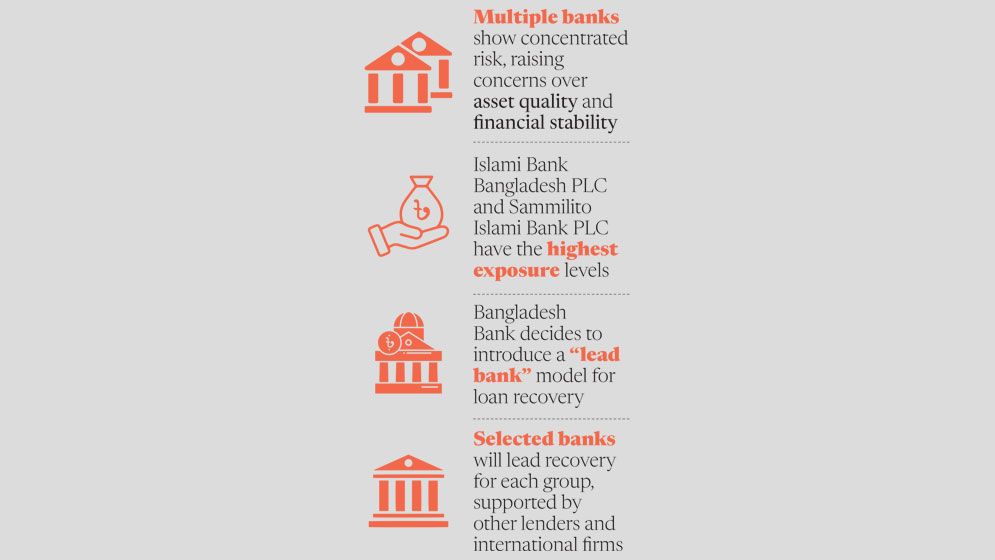
An internal assessment by Bangladesh Bank (BB) has found that the country’s banking sector faces significant exposure to defaulted loans linked to six major business groups, prompting the central bank to initiate a coordinated recovery strategy involving selected “lead banks” and international firms.
The confidential document, titled “Selected Lead Banks, Impacted by Six Groups,” highlights widespread vulnerabilities across multiple banks and raises fresh concerns over asset quality, concentration risk and overall financial stability.
According to the analysis, several banks have substantial exposure to loans associated with six groups or individuals: Saifuzzaman Chowdhury, S Alam Group, Beximco Group, Sikder Group, Nassa Group and Orion Group.
Islami Bank Bangladesh PLC appears in five of the six exposure categories, indicating significant involvement in high-risk portfolios. Meanwhile, the newly consolidated Sammilito Islami Bank PLC is listed under all six groups, reflecting a heavy burden of inherited non-performing loans following recent mergers of weaker banks.
Several other banks also feature repeatedly across the exposure lists, including First Security Islami Bank, Social Islami Bank, Union Bank, IFIC Bank, United Commercial Bank, AB Bank, NRB Commercial Bank, Bank Asia, SBAC Bank, Southeast Bank, Premier Bank, Mercantile Bank, Bangladesh Commerce Bank, National Bank, Padma Bank, Dutch-Bangla Bank, Pubali Bank, Standard Bank, Meghna Bank and Al-Arafah Islami Bank. State-owned banks such as Sonali Bank, Janata Bank, Rupali Bank, BASIC Bank and Agrani Bank are also shown to have notable exposure.
Lead bank model for recovery
In response, Bangladesh Bank has decided to assign specific institutions as “lead banks” for each group to coordinate recovery efforts. The initiative marks a shift towards a more structured and collaborative approach, including potential engagement with international firms experienced in complex asset recovery and restructuring.
Under the plan, each group will have at least two banks involved, with one designated as the lead. No bank will be permitted to lead more than two groups.
For the Saifuzzaman Chowdhury group, United Commercial Bank PLC will act as the lead bank, alongside Islami Bank Bangladesh PLC and Al-Arafah Islami Bank PLC.
For the S Alam Group, Islami Bank Bangladesh PLC has been assigned as the lead bank, with Janata Bank PLC and Sammilito Islami Bank PLC as participating banks.
In the case of the Beximco Group, National Bank PLC will serve as the lead bank, supported by Janata Bank PLC.
For the Sikder Group, IFIC Bank PLC has been selected as the lead bank, with Sammilito Islami Bank PLC and Agrani Bank PLC involved.
For the Nassa Group, National Bank PLC will act as the lead bank, in coordination with IFIC Bank PLC and Al-Arafah Islami Bank PLC.
Finally, for the Orion Group, United Commercial Bank PLC has been designated as the lead bank, with Agrani Bank PLC as the supporting bank.
Selection criteria and policy conditions
Officials said the selection of lead banks prioritises institutions with prior experience in handling international non-disclosure agreements (NDAs), as such experience is considered crucial for managing sensitive negotiations and recovery processes with external partners.
Banks currently undergoing or scheduled for mergers have been excluded from serving as lead banks, reflecting Bangladesh Bank’s effort to avoid additional operational strain on already weak institutions.
In cases where the most exposed banks are state-owned, private commercial banks with comparatively lower exposure but stronger operational capacity may be included to ensure effective leadership and execution.
The latest findings come against a backdrop of persistent concerns over loan concentration among a handful of large business groups — a structural weakness that has long affected Bangladesh’s banking sector.
Analysts say that over the past decade, aggressive lending, governance shortcomings and alleged irregularities in some banks have contributed to a steady rise in non-performing loans (NPLs). Several banks, particularly those later merged into stronger entities, accumulated significant bad assets linked to large corporate borrowers.
They add that recent consolidation efforts, including the formation of Sammilito Islami Bank through the merger of weaker Islamic banks, have transferred a large volume of these distressed assets onto a single balance sheet, amplifying systemic risks.
Shift towards coordinated and external recovery
Bangladesh Bank officials said the new lead bank framework signals a more proactive stance in tackling defaulted loans. By assigning clear responsibility to specific banks and leveraging international expertise, the central bank aims to accelerate recovery, improve accountability and reduce prolonged legal and financial bottlenecks.
The move also reflects growing recognition that traditional recovery methods, often limited to litigation and restructuring, have been insufficient in resolving large, complex default cases.
While the initiative is expected to bring greater coordination to loan recovery efforts, significant challenges remain. These include legal complexities, cross-border asset tracing and ensuring cooperation among multiple lenders.
Analysts say the success of the strategy will depend on transparency, strong governance and the ability of lead banks to effectively coordinate with both domestic and international stakeholders in pursuing recovery from influential business groups.