


 For all latest news, follow the Daily Sun's Google News channel.


Agro-food exports grow, but foundations look fragile
Ariful Islam, Dhaka
Published: 30 Dec 2025, 12:00 AM
Bangladesh’s agro and processed food industry has quietly become one of the country’s most important economic pillars, underpinning food security, rural employment and export earnings.
But as headline figures point to growth, a closer look reveals a sector struggling with structural weaknesses, rising costs and an overreliance on a narrow set of markets – vulnerabilities that could intensify as the country prepares to graduate from Least Developed Country (LDC) status in 2026.
Over the past two decades, Bangladesh’s domestic processed food market has expanded rapidly, now exceeding US$8 billion – more than Tk1 lakh crore – driven by urbanisation, changing diets and demand for convenience foods.
Nearly 1,000 food processing companies operate across the country, providing direct and indirect employment to hundreds of thousands of people.
Exports have followed a similar upward trajectory. Agro and processed food products now rank among Bangladesh’s top five export earners.
In the 2024-25 fiscal year, the sector generated close to $1 billion in export revenue, with processed foods alone contributing about $400 million – a 16.6% increase year on year. Around half a million people are estimated to depend on the sector for their livelihoods.
Yet industry insiders and economists warn that these gains rest on fragile foundations. Export markets remain highly concentrated, production and logistics costs are climbing sharply, quality infrastructure lags behind regional competitors and policy support is shifting as LDC privileges are phased out.
Without coordinated reforms, analysts say, the sector risks losing momentum at a critical juncture.
Growth with limits
Bangladesh exports around 63 categories of processed food and nearly 700 agricultural products, according to the Bangladesh Agro-Processors Association (BAPA).
Yet despite this apparent diversity, export activity remains concentrated in relatively few hands. Of the roughly 1,000 food processing firms operating nationwide, only about 250 export at all, while just 20 large and medium-sized companies generate most export earnings.
Data from the Export Promotion Bureau (EPB) shows that agro and processed food exports crossed the 1 billion dollar mark for the first time in the FY21, peaking at $1.28 billion.
Since then, earnings have fluctuated amid global shocks and domestic constraints, slipping to $988.6 million in FY25.
While this reflects resilience in a difficult global environment, it also signals stagnation rather than sustained expansion.
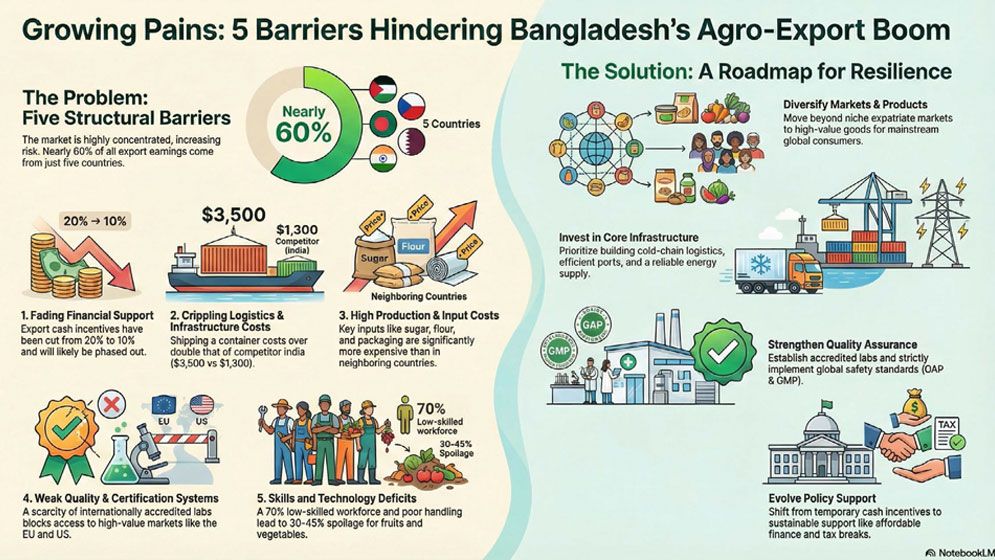
Export destinations are similarly narrow. Nearly 60% of earnings come from five countries – the United Arab Emirates, Saudi Arabia, India, the United Kingdom and the United States – with the remaining 40% spread thinly across more than 100 markets, including Malaysia, Singapore, Canada, the Netherlands, Oman and Qatar.
Product concentration adds to the risk. Around 10 items dominate exports, led by biscuits at $88.5 million, noodles at 38.6 million, fruit and cocktail drinks at $28.4 million, paratha at $27.4 million and chanachur at $21.5 million.
Many other products generate little more than 1 million annually, underlining Bangladesh’s reliance on low-value, high-volume goods.
Five pressures squeezing competitiveness
Industry stakeholders point to a cluster of interlinked constraints undermining competitiveness. Export incentives, once as high as 20%, have been reduced to a maximum of 10% in the financial year 2024-25 and are expected to be phased out entirely as Bangladesh graduates from Least Developed Country status in 2026 – a shift that threatens the pricing models of many exporters, particularly small and medium-sized firms.
Logistics costs have also surged. Shipping a container to the Middle East now costs between $3,000 and $3,500, compared with $1,200 to $1,300 from India.
Disruptions to Red Sea routes have added 15-30 days to delivery times, while port congestion, slow clearance procedures and limited refrigerated logistics further delay shipments and increase spoilage.
High production costs continue to erode margins. Bangladesh imports nearly 80% of its packaging materials, while key inputs such as sugar, flour and edible oils are significantly more expensive than in India, Vietnam or Thailand.
Elevated energy prices and frequent power cuts – lasting up to 10-12 hours a day in some areas – disrupt production and weaken cold-chain systems.
Quality infrastructure remains another bottleneck. Internationally accredited testing laboratories are scarce, forcing exporters to rely on costly overseas testing, while gaps in traceability and inconsistent application of Good Agricultural Practices and Good Manufacturing Practices limit access to advanced markets.
Skills and technology deficits persist, with around 70% of the workforce considered low-skilled. Poor post-harvest handling contributes to spoilage rates of 30%-45% for fruits and vegetables, sharply reducing export potential.
“Our production costs are higher than those in neighbouring countries,” said Kamruzzaman Kamal, director (marketing) at PRAN-RFL Group.
“Container and freight charges have doubled, and port facilities are inadequate, delaying shipments. Raw materials like sugar and flour cost nearly twice as much as in India. Without sustained export incentives and long-term government investment, the industry’s competitiveness is at risk.”
Quality gaps and missed markets
Academics argue that technology and food safety lie at the heart of the problem. Dr Mohammad Jahangir Alam, professor of agribusiness and marketing at Bangladesh Agricultural University, said many domestic processors struggle to meet international standards.
“Bangladesh needs to adopt world-class technology and strengthen food safety systems to compete globally,” he said.
“Compared to competitor countries, input costs are higher, and exporters face obstacles such as insufficient testing laboratories, limited availability of high-quality raw materials, difficulties obtaining phytosanitary certificates and weak packaging standards.
Expanding exports of processed agricultural products requires strict implementation of Good Agricultural Practices and Good Manufacturing Practices, alongside improving product traceability and identification systems.”
Export demand also remains narrowly defined.
Anup Kumar Saha, adviser to Akij Bakers, said most products are tailored to expatriate consumers.
“Bangladeshi products are largely tailored to domestic tastes and expatriate consumers abroad. That is why demand remains niche,” he said, adding that international food fairs and sustained branding support could help diversify markets with strong government backing.
Economists warn the risks are growing. “Policy shifts, inflation, or demand shocks in one major market could have outsized impacts on total exports,” said Dr Khondaker Golam Moazzem, research director at the Centre for Policy Dialogue.
“Diversification – by product and by destination – is no longer optional,” he added.
LDC graduation: cliff edge or catalyst?
The withdrawal of LDC privileges threatens to squeeze margins, particularly for small and medium-sized enterprises. Yet analysts also see opportunity, pointing to rising domestic demand for branded, ready-to-eat foods and greater potential to attract foreign investment.
Kamal argues policy support must adapt. “Low-interest loans for farmers and processors, duty concessions on machinery and inputs, transport subsidies and faster port clearance – reducing logistics and compliance costs is far more sustainable than short-term cash incentives,” he said.
Falling behind regional rivals
Regional competitors including India, Vietnam, Thailand and Sri Lanka are moving rapidly into higher-value exports such as freeze-dried fruits, premium snacks and ready meals. Bangladesh, by contrast, remains focused on traditional products, with high-potential items like jackfruit chips and dried mango still underdeveloped.
“While Bangladesh crossed the 1 billion dollar export mark, it failed to sustain momentum due to external shocks – from the pandemic to the Russia–Ukraine war – and internal bottlenecks,” said Md Iqtadul Hoque, former general secretary of BAPA. “Small and medium-sized enterprises will face the greatest risk post-LDC if structural reforms are delayed.”
The coordination problem
Exporters also cite weak coordination among regulators, with food safety, certification and licensing spread across multiple agencies.
Calls are growing for a digital one-stop service under the Bangladesh Investment Development Authority and an internationally accredited national testing laboratory.
“Boosting agro exports starts with boosting agricultural productivity – better seeds, mechanisation and efficient land use – while processors must add value and diversify products in line with global demand,” Dr Jahangir Alam said.
A narrow window for reform
There is broad agreement among experts that piecemeal interventions will not be enough. A coherent reform agenda is needed – one that prioritises diversification, infrastructure, quality assurance and skills.
Moving beyond reliance on expatriate consumers will require products designed for mainstream global markets, with competitive packaging, branding and safety standards. Investment in cold-chain logistics, port efficiency and reliable energy could sharply reduce losses and costs.
Internationally accredited laboratories and enforceable standards would help build trust with global buyers. And targeted training and technology support could enable SMEs to climb the value chain.
The reporter can be reached at: [email protected]
Edited by M Munir Hossain
Read More