



 For all latest news, follow the Daily Sun's Google News channel.


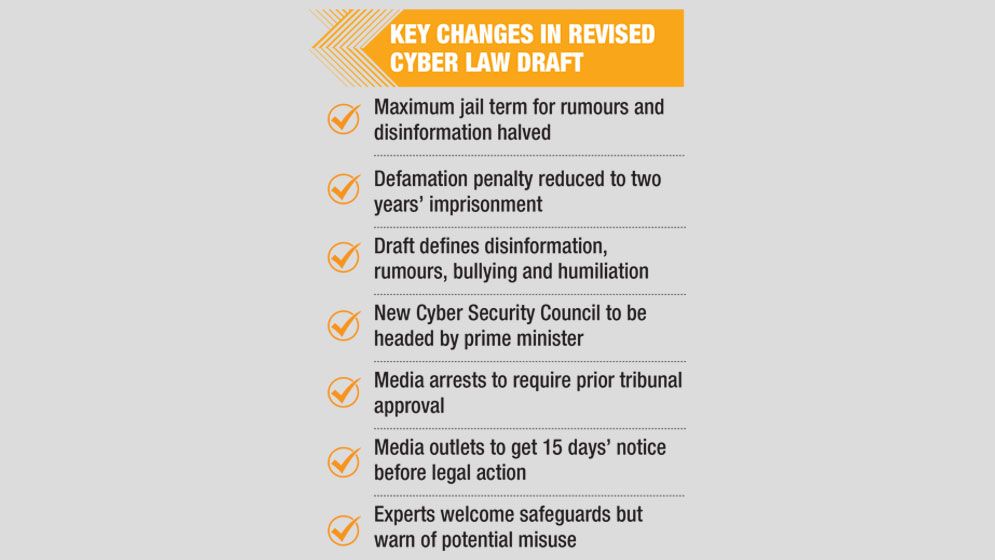
The government has published a fresh draft of the Cyber Security Law proposing reduced penalties for defamation, rumours and disinformation, while introducing safeguards for registered media outlets and revising definitions of several cyber offences.
Published on the ICT Division website on 10 November, less than two months after an earlier draft in mid-September, the proposed amendments are open to public feedback until 25 November.
Introduced in 2018 as the Digital Security Act, the law faced widespread criticism and allegations of misuse under the Awami League government, which repealed it and replaced it with the Cyber Security Act, 2023, retaining most of its provisions. After the government’s fall, the interim administration repealed the 2023 Act and introduced the Cyber Security Ordinance, 2025, which Parliament passed in April 2026. The current government has now moved to amend it again. If finalised, the draft may be placed before Parliament as a bill during its January 2027 session.
Defamation, rumours and disinformation remain criminalised
The draft proposes cutting the maximum prison term for spreading rumours and disinformation from 10 years to five years and the maximum fine from Tk40 lakh to Tk10 lakh. For defamation, the maximum prison term would fall from five years to two years and the fine from Tk20 lakh to Tk5 lakh.
It also grants immunity from civil and criminal proceedings to the chairperson and members of the National Cyber Security Council and authorised officers and employees for acts performed in good faith while discharging their duties.
Draft defines cyber offences, proposes new council
The draft defines disinformation as false or distorted information intentionally created, published or disseminated to deceive or harm individuals, the public, organisations or the state. Rumours are similarly defined as false or distorted information intended to cause panic, excitement or social unrest.
Bullying means intentional, planned and repeated behaviour involving actual or perceived power, influence or dominance, through physical, verbal, social, digital or other means, causing physical or mental harm, distress, fear, exclusion, isolation or loneliness.
Defamation is defined under Section 499 of the Penal Code, 1860. Humiliation covers acts beyond professional assessment or constructive criticism that use words, behaviour, publications, insinuations, gestures or actions to insult, ridicule or show contempt for someone, intending to hurt their dignity and self-respect.
The draft proposes a Cyber Security Council headed by the prime minister, with five government ministers, officials from various administrative levels and two private-sector experts nominated by the government.
Media safeguards proposed
Section 46A requires prior tribunal approval before anyone can be arrested over news reports, opinion pieces, photographs or cartoons published by registered media outlets.
The proviso to Section 29 requires at least 15 days’ prior written notice before any case or legal proceedings are initiated against a registered media outlet or its operating organisation, along with a reasonable opportunity for them to defend themselves.
Broad grounds for content blocking
Section 8 allows online content to be blocked on grounds including threats to national sovereignty, dignity, security and public order; religious hatred; incitement to violence; defamation; blackmail; revenge porn; digital child sexual abuse material; and sexual harassment.
Anyone aggrieved by the removal or blocking of information or data may seek its restoration from the agency. After hearing the government or concerned party, the agency must decide the application within 15 days.
Experts Welcome Media Safeguards, Warn of Misuse
Experts welcomed safeguards for media outlets but called for wider consultation, clearer provisions and balanced enforcement, warning that vague definitions and content-blocking powers could be misused.
Dr Shah Md Nister Jahan Kabir, a professor of Mass Communication and Journalism at Jagannath University, welcomed prior notice before legal action against media outlets, saying it would allow them to defend themselves.
However, he warned that content-blocking and removal provisions could be abused. “Sometimes, even truthful content may be considered defamatory. The question, therefore, is what threshold will be used to determine this.” Defamatory, disinformative and abusive content should be restricted, he said, stressing responsible behaviour from both journalists and the government.
Prof Dr M Jafar Ullah Talukder, dean of the Faculty of Law at the University of Chittagong, called for wider stakeholder consultation, clear provisions and careful enforcement to protect the public interest.
“Positive aspects that serve the greater public interest should be incorporated, while negative ones should be avoided to ensure a comprehensive and public-welfare-oriented law,” he said.
On freedom of expression, he said the right was not absolute and remained subject to constitutional restrictions and limitations.
“Public officials’ actions and decisions must be open to criticism, but I do not support spreading hatred against individuals. Criticising someone’s actions is acceptable, but making insulting remarks against them is not,” he said.
He said defamation provisions might have been included despite their existence in the Penal Code because cases under the latter often involve lengthy legal processes. Their inclusion in the cyber law could provide quicker remedies for offences committed online, he suggested.
Even well-intentioned laws could produce adverse outcomes if improperly implemented, he added, stressing that much would depend on enforcement.
Meanwhile, Transparency International Bangladesh (TIB), commenting on the earlier draft, expressed deep concern over provisions it said threatened fundamental human rights, freedom of speech and freedom of expression.
In a statement, it said the draft combined three complex and distinct issues – cybercrime, cybersecurity and people’s right to freedom of expression – without adequately addressing any of them.
Instead, it created scope for risky and deliberate misinterpretation and misuse in all three areas, raising the prospect of human rights violations, it said.