



 For all latest news, follow the Daily Sun's Google News channel.


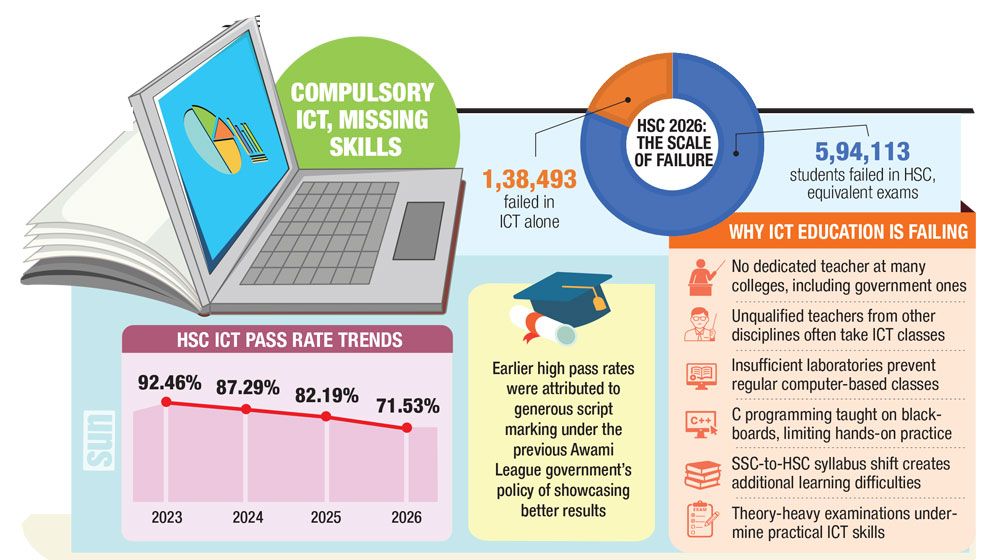
Introduced as a compulsory subject to prepare students for a technology-driven world, Information and Communication Technology (ICT) education has failed to deliver on its promise, with shortages of qualified teachers, inadequate laboratories and limited hands-on learning leaving students ill-equipped with practical skills.
The shortcomings were reflected in this year’s Higher Secondary Certificate (HSC) examinations, in which 138,493 students failed ICT. The pass rate fell to 71.53%, from 92.46% in 2023, exposing persistent weaknesses in teaching a subject that is supposed to equip students for the digital age.
Despite its practical nature, ICT is taught largely through theoretical lessons in many institutions. Students are expected to learn programming and other technical skills without adequate access to computers or opportunities to practise.
A major obstacle is the absence of dedicated ICT teachers.
Many government schools and colleges have no subject-specific teaching posts, forcing them to assign classes to teachers of other disciplines, often without relevant qualifications.
Laboratory facilities are also inadequate, with many institutions lacking enough computers to accommodate their students.
Mohammad Siam, a student of Dhaka City College, said the significant differences between the SSC and HSC ICT syllabuses made the transition difficult.
The HSC syllabus is also extensive, adding to students’ academic burden. Although it includes practical components such as coding, he questioned whether institutions had the facilities to provide proper hands-on training.
The situation is particularly acute in government colleges. Koyra Government Women’s College, with around 250 HSC students, has no ICT teacher, and a political science lecturer takes the classes.
At Shariatpur Government College, which admits around 1,200-1,400 students annually, the ICT laboratory has only 16 laptops. The shortage makes practical classes difficult, forcing teachers to explain programming languages such as C on blackboards. Students consequently memorise coding procedures without actually writing or running programmes on computers.
Md Sazzad Hossain Khan, an ICT lecturer at Kabi Nazrul Government College, said inadequate laboratory facilities were a major obstacle to effective ICT education.
“In many institutions, the number of computers and laptops is far below the student demand, depriving students of hands-on learning opportunities,” he said.
Teachers often demonstrate coding on their own computers through classroom projectors, allowing students to watch but not practise, he added.
However, he welcomed the inclusion of Python programming in the syllabus, saying it would help students understand emerging fields such as artificial intelligence.
The latest textbook edition has also corrected some errors and expanded certain topics, which he hopes will improve learning.
Professor Md Abul Hashem, principal of Satkhira Government College, said the shortage of ICT teachers had persisted since the subject was introduced, disrupting classroom instruction.
“Students could learn the subject more effectively if qualified, subject-specific teachers were appointed. However, teacher recruitment depends on policy decisions at the highest level of government,” he told the Daily Sun.
HSC results expose declining performance
The ICT pass rate has fallen steadily over the past four years, from 92.46% in 2023 to 87.29% in 2024 and 82.19% in 2025, before dropping to 71.53% this year — a decline of 20.93 percentage points.
Board-wise results also reveal persistent weaknesses. The Mymensingh Education Board recorded an ICT pass rate of around 70% in each of the years under review, while results in other boards fluctuated.
The declining performance has raised questions about the effectiveness of making ICT compulsory without first ensuring the necessary teaching capacity and infrastructure.
Some guardians have also questioned the existing approach, arguing that students should be assessed on their ability to apply technological knowledge rather than merely reproduce textbook material.
Md Eusuf Ali, a former teacher, said in a Facebook post that practical applications, rather than theory-based lessons, would help students perform better. Many struggle to reproduce theoretical knowledge in examinations, while rote learning prevents them from developing practical skills, he observed.
Policy gaps undermine ICT education
Dr Md Abdus Salam, a professor at the Institute of Education and Research (IER) of Dhaka University, blamed policy gaps and inadequate government initiatives for the failure to make ICT education effective.
“Although ICT was made compulsory from Class VI to XII following the declaration of Digital Bangladesh, no dedicated teacher posts were created at the secondary and higher secondary levels,” he said.
Consequently, institutions have to assign teachers from other disciplines to teach ICT. Even government secondary schools lack designated posts for the subject, he added.
The government has also failed to ensure quality laboratories and adequate practical facilities, depriving students of opportunities to acquire essential technological skills.
Dr Abdus Salam said the government must appoint subject-specific teachers and equip educational institutions with proper laboratories to make ICT education meaningful. Without these basic arrangements, making the subject compulsory alone will not equip students with the practical skills they need.