



 For all latest news, follow the Daily Sun's Google News channel.


Dengue spreads to villages as death toll hits 377
Experts want entomologist-led, scientifically tested mosquito control

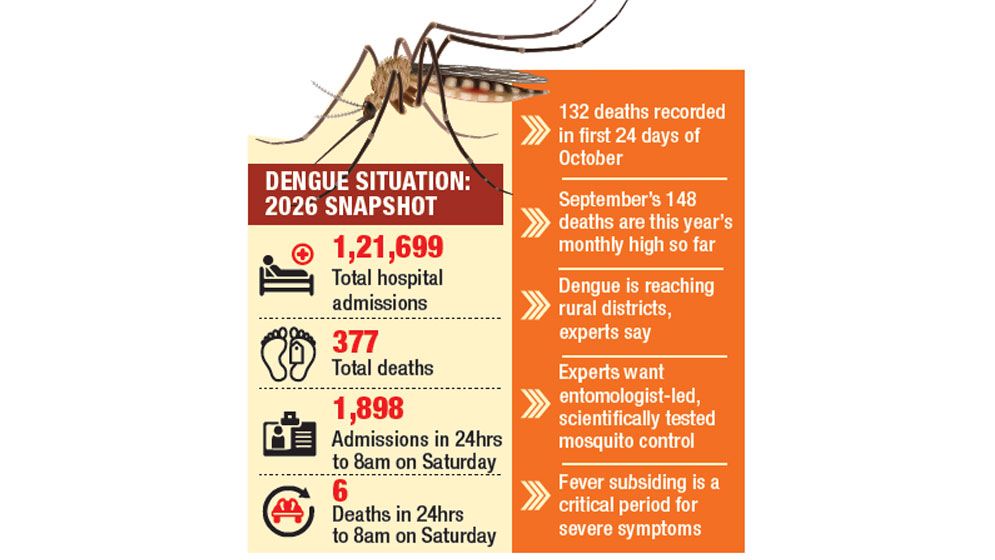
Dengue has killed 377 people across the country this year, 132 of them in the first 24 days of October, according to the Directorate General of Health Services (DGHS), as public health experts say the disease is spreading from cities into districts and rural communities where local authorities lack the capacity to control mosquitoes.
Six people died in the 24 hours to 8am on Saturday, while 1,898 patients were admitted to hospitals during the period. Cumulative admissions since 1 January have reached 1,21,699.
Two of the latest victims were from Chattogram division, and one each from Dhaka South City Corporation, Khulna division, Mymensingh and Rajshahi division.
Dengue claimed 43 lives in August and 148 in September, the highest monthly figure this year, before October’s 132 deaths. Dhaka division, including the two city corporations, has recorded 180 deaths, followed by Khulna (67), Chattogram (37), Mymensingh (31), Barishal (28), Rajshahi (24), Rangpur (7) and Sylhet (3). The DGHS recorded 413 dengue deaths in 2025.
Public health experts say the disease is no longer confined to Dhaka and other cities.
Prof Dr Be-Nazir Ahmed, public health strategist and former director of Disease Control at Directorate General of Health Services, told the Daily Sun that dengue, once regarded as primarily urban, is becoming established in rural areas.
He cited the presence of aedes mosquitoes there and widespread domestic travel, which carries the virus to new areas as infected people move around the country.
“Dengue will remain a risk for Bangladesh in the coming days. I believe it will pose an even greater challenge. In particular, it could become a devastating disease in rural areas,” he said.
He said union parishads struggle to carry out effective mosquito-control operations, while many municipalities lack the necessary manpower, equipment and institutional capacity.
Prevention measures must be set up at union, upazila and municipal levels as well as in major cities, he said, or rising rural infections could become increasingly difficult to manage.
Dr Mushtuq Husain, public health expert and advisor to Institute of Epidemiology Disease Control and Research, said dengue has been a major challenge since 2020, with a severe outbreak in 2023. It has now reached remote districts such as Barguna and Satkhira, he said, with human movement carrying the virus to areas where aedes mosquitoes allow local transmission.
Be-Nazir Ahmed said aedes mosquitoes generally breed in stagnant clean water around homes, including on rooftops and balconies and in flowerpots, water containers, construction sites and abandoned properties. Water collecting in potholes and open spaces, and poor waste management, also create favourable conditions.
Spraying insecticide alone cannot control dengue without addressing these causes, he said, adding that authorities need to identify breeding sites and high-infection areas and base strategies on reliable data. In many areas, mosquito-control drives are held but stagnant water is not regularly removed, he noted.
Dr Mushtuq urged authorities to involve entomologists in mosquito-control programmes, saying decisions on which insecticides to use, and how and where to apply them, should rest on scientific assessment. Control workers need proper training, he said, and insecticides should be tested regularly.
Authorities must also evaluate whether operations are reducing mosquito populations and transmission, rather than focusing on visible campaigns and publicity.
Criticising the government’s approach, he said, “If you tie a horse to a post and whip it, it will run with all its might, but it will not move an inch forward. The government’s approach is much the same.”
DGHS age-specific data show that 17,409 patients this year were aged 21 to 25, the highest among the five-year age groups. Another 17,200 were aged 26 to 30 and 16,446 were aged 16 to 20. More than 6,200 children under five were also affected.
Dr Mushtuq said young people may be more exposed to aedes mosquitoes because they spend more time outside the home for work and education. Be-Nazir Ahmed pointed to prior infections. There are four main dengue serotypes, and infection with one does not necessarily protect against the others. A later infection with a different serotype can increase the risk of severe dengue in some cases. Older people may have developed immunity to all four through earlier infections, unlike younger people, he said.
Most patients recover with appropriate care, but some develop complications, including plasma leakage, low blood pressure, severe bleeding and impaired organ function. Health experts said the period when fever subsides is particularly critical, as severe symptoms can develop within 24 to 48 hours. Warning signs include severe abdominal pain, persistent vomiting, bleeding from the nose or gums, unusual weakness, restlessness, breathing difficulties, cold hands and feet, and reduced urine output. Anyone with these symptoms should seek urgent medical attention. Many patients initially mistake dengue for ordinary fever and delay seeking care.
Treatment requires fluid management based on the patient’s condition, monitoring of blood pressure and urine output, and necessary tests. Patients should not take excessive fluids or intravenous saline on their own, experts said. Paracetamol may be used for fever under medical guidance, but aspirin, ibuprofen and certain other non-steroidal anti-inflammatory drugs can increase the risk of bleeding and should be avoided unless a qualified physician advises otherwise.
Experts said adding beds is not enough. Hospitals must also be able to identify patients whose condition is deteriorating rapidly, through complete blood count tests, haematocrit monitoring, assessment of fluid intake and urine output, and intensive care for severe cases. Not every patient needs admission, they said, as the decision should rest on symptoms and a physician’s assessment, though patients with warning signs need prompt attention.
They also called for coordination between public and private hospitals, adequate staffing, access to diagnostic tests, stronger emergency capacity and regularly updated infection and mortality data.
Seasonal campaigns alone cannot control dengue, the experts said, calling for year-round efforts to eliminate breeding sites, strengthen surveillance, improve waste management and raise public awareness, even when cases are low.
Unless local capacity is strengthened from cities to villages, mosquito control becomes more scientific and patients receive timely treatment, dengue is likely to remain a major public health threat in Bangladesh, they said.