


 For all latest news, follow the Daily Sun's Google News channel.


Rising prices of essential goods and energy, along with persistent inflation, are putting pressure on household budgets and forcing consumers to cut back on nutritious food. Economists warn that inadequate protein intake could undermine people's health and reduce their ability to work.
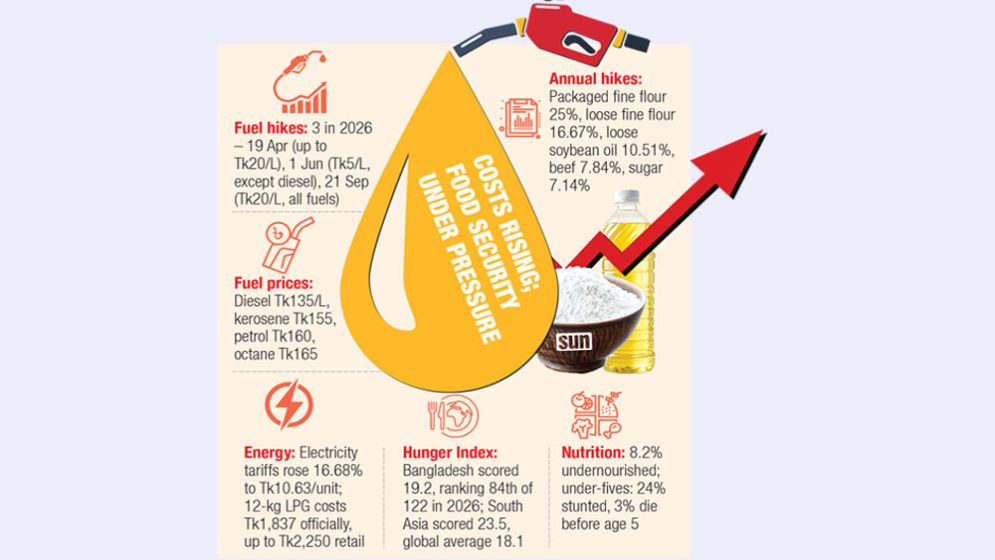
Bangladesh hiked fuel prices three times in 2026 amid global market volatility caused by the Middle East and Russia-Ukraine wars: on 19 April, by up to Tk20 per litre; on 1 June, by Tk5 per litre for all fuels except diesel; and on 21 September, by Tk20 per litre across all categories. Current prices are Tk135 per litre for diesel, Tk155 for kerosene, Tk160 for petrol and Tk165 for octane. Retail electricity tariffs rose 16.68% to Tk10.63 per unit in June, while 12kg LPG cylinders reached an official Tk1,837, retailing at up to Tk2,250 after multiple hikes throughout the year.
Global market volatility and supply-chain disruptions have raised prices of essential foods and imported goods, while high inflation, rising energy costs and weakening consumer sentiment have intensified financial pressure on households, economists said.
Bangladesh’s latest Global Hunger Index (GHI) score highlights the country’s continuing nutritional challenges despite improvements in some key indicators.
Bangladesh scored 19.2 in the 2026 Global Hunger Index (GHI), ranking 84th among 122 countries with sufficient data and remaining in the moderate hunger category despite improvements in some indicators. The index measures undernourishment, child wasting, child stunting and under-five mortality. In Bangladesh, 8.2% of the population is undernourished; among under-fives, 24% are stunted, 12.9% wasted and 3% die before age five.
Bangladesh’s GHI score of 19.2 is below South Asia’s 23.5 but above the global 18.1, highlighting persistent hunger and undernutrition. Child stunting fell from 25.4% in 2023 to 24.8% in 2024, 24.4% in 2025 and 24% in 2026. Persistent malnutrition shows that increased food production and economic development do not ensure adequate nutrition for every household.
Ensuring protein-rich food is essential
Economist and researcher Dr Jahangir Alam told the Daily Sun that unaffordable eggs, milk, flour, edible oil and meat limit consumers’ access to nutritious food, reducing their health and work capacity.
He said that although Bangladesh has largely addressed cereal shortages and increased production of milk, fish, meat and eggs, high prices prevent consumption from rising accordingly, mainly because of high production costs and inefficiency.
He stressed the need for modern technology, innovation, improved breeds, better feed and management to boost efficient production, while reducing the market influence of middlemen, marketing costs and profit margins through modernised production systems.
Prices of essentials soar
According to the Trading Corporation of Bangladesh (TCB) as of Friday (16 October), the prices of loose white flour increased by 2.04% in a month and 3.09% in a year, packaged flour increased by 8.00% in a month and 12.50% in a year, loose fine flour increased by 3.70% in a month and 16.67% in a year; and packaged fine flour increased by 9.38% in a month and 25.00% in a year.
The price of loose soybean oil increased by 2.10% in a month and 10.51% in a year, one-litre bottled soybean oil increased by 1.24% in a month and 6.53% in a year, two-litre bottled soybean oil increased by 1.49% in a month and 7.89% in a year, five-litre bottled soybean oil increased by 1.27% in a month and 9.29% in a year, loose palm oil increased by 1.48% in a month and 8.89% in a year, loose super palm oil increased by 2.01% in a month and 9.91% in a year; and five-litre bottled rice bran oil increased by 3.00% in a month and 5.92% in a year, according to TCB.
The price of chickpeas increased by 7.14% in a month and 7.14% in a year, while potatoes remained unchanged in a month but increased by 22.22% in a year, according to TCB.
The price of imported garlic increased by 8.33% in a month and 18.18% in a year, while local garlic increased by 9.09% in a month but remained unchanged in a year, and local onions increased by 4.76% in a month but decreased by 29.03% in a year, according to TCB.
The price of imported ginger increased by 17.24% in a month but decreased by 10.53% in a year, green chillies increased by 16.67% in a month but decreased by 33.33% in a year, and cucumbers increased by 7.69% in a month and 7.69% in a year, according to TCB.
The price of beef increased by 1.23% in a month and 7.84% in a year, while mutton remained unchanged in a month but increased by 15.91% in a year, according to TCB.
The price of local chicken remained unchanged in a month but increased by 12.50% in a year, broiler chicken decreased by 2.63% in a month but increased by 4.23% in a year, while farm eggs decreased by 1.02% in a month but increased by 2.11% in a year, according to TCB.
The price of one-kilogram packs of Dano powdered milk increased by 1.12% in a month and 13.92% in a year, one-kilogram packs of Diploma powdered milk remained unchanged in a month but increased by 4.52% in a year, one-kilogram packs of Fresh powdered milk remained unchanged in a month but increased by 5.81% in a year, while one-kilogram packs of Marks powdered milk remained unchanged in a month but increased by 5.78% in a year, according to TCB.
The price of sugar remained unchanged in a month but increased by 7.14% in a year, according to TCB.
The reporter can be reached at [email protected]