



 For all latest news, follow the Daily Sun's Google News channel.


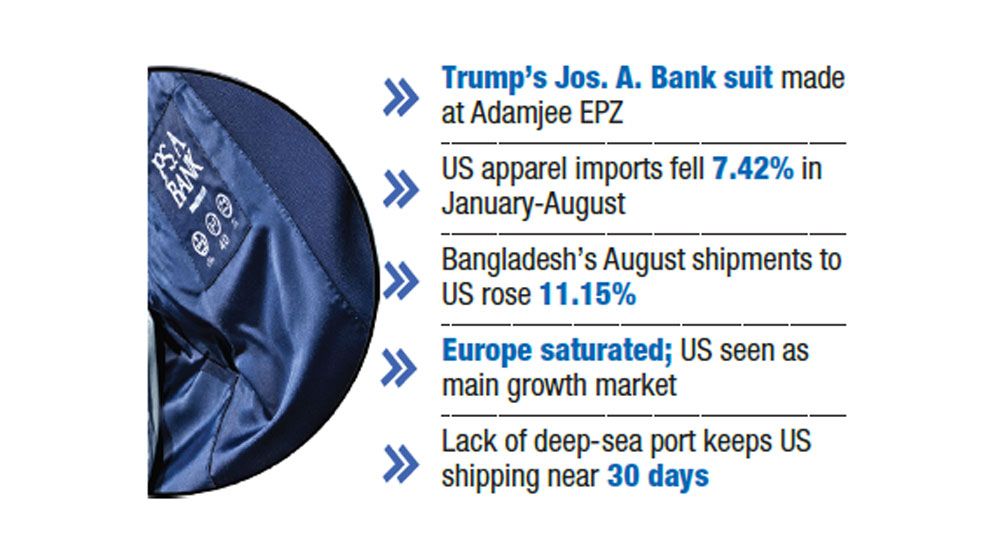
A navy-blue suit worn by US President Donald Trump at a rally in Nebraska last week was made at the Adamjee Export Processing Zone (EPZ) in Narayanganj, the factory’s managing director has told Daily Sun, as Bangladeshi manufacturers look to the United States for future growth despite a fall in American apparel imports this year.
The suit, from the US brand Jos. A. Bank, was manufactured by Universal Menswear Ltd, said Sharif Zahir, its managing director. Trump wore it at a “Make America Great Again” rally in Grand Island on 5 October. After the brand became known, questions arose over where it was made. CNN reported on Thursday that it was likely produced in either Bangladesh or China.
Sharif Zahir, who is also managing director of Ananta Group and a former director of the Bangladesh Garment Manufacturers and Exporters Association (BGMEA), called it a moment of pride for the company’s skilled workers and the country’s garment industry.
He said seeing a wealthy US president in an affordable Bangladeshi-made suit reflected the country’s technical skills and cost-effective manufacturing.
Universal Menswear makes suits, blazers, jackets and trousers for international markets.
Its factory covers more than 500,000 square feet and, according to the company’s website, has automated fabric cutting, specialised sewing and pressing machinery, and a conveyor-based system for moving products to production and storage areas.
Europe saturated, US the opportunity
Europe is the company’s biggest market at present but has reached saturation for Bangladeshi suppliers, Zahir said.
“US to drive future growth for Bangladeshi apparel, as the European market nears saturation,” he said, adding that the company also produces denim, sweaters, women’s and men’s wear, and activewear across several units.
He said the tariff structure under the Trump administration also offers an opening. Bangladesh’s rate is only about one percentage point higher than that of Vietnam, a major competitor, so it can still compete, though structural weaknesses must be fixed to make the most of the chance.
He urged greater focus on polyester and nylon, which require fabric mills, and called on large investors to enter the sector.
Bangladesh has no deep-sea port, so shipments take about 30 days to reach the US, with clearance taking additional time, he said.
“Competitors such as Vietnam and Egypt can ship to the US much faster. Cutting lead times is therefore very important,” he noted.
On order timing, Zahir said autumn orders have been completed and the company is now taking orders for spring and then summer. He said most of its future growth is expected to come from the US.
Import data
US apparel imports fell in the first eight months of 2026, but Bangladesh weathered the slowdown better than several major suppliers and posted strong growth in August, according to the US Office of Textiles and Apparel (OTEXA).
The US imported $49.08 billion of apparel in January-August, down 7.42% year-on-year. Volume fell 8.98% in square metre equivalent, while the average unit price rose 1.71%.
Bangladesh’s apparel exports to the US fell 4.43% to $5.39 billion over the period, but shipments rose 11.15% year-on-year in August alone.
Mohiuddin Rubel, founder and chief executive of Bangladesh Apparel Voice, said Bangladesh’s comparatively favourable tariff position was supporting its performance.
“The tariff differential with competitors such as China could influence buyers’ sourcing decisions,” he said, adding, “Compared with our competitors, Bangladesh’s tariff structure is better. Naturally, buyers will want to take advantage of that.”