




 For all latest news, follow the Daily Sun's Google News channel.


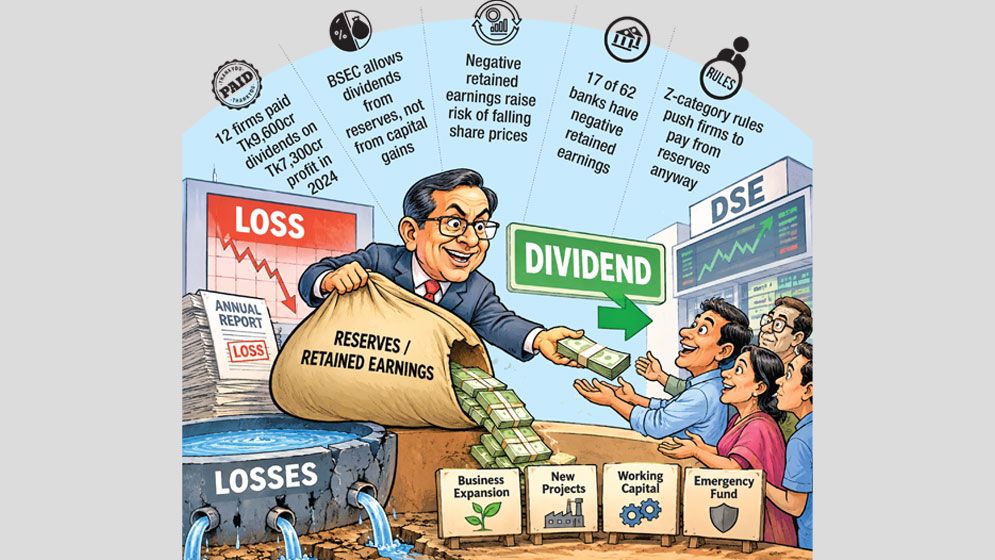
Several listed companies on the country's capital market have declared dividends for investors in years when they reported losses, drawing the payouts from reserves or retained earnings rather than current profits.
In some cases, dividends have been paid from previously accumulated profits even after reserves turned negative, according to Dhaka Stock Exchange (DSE) data and company filings.
Singer Bangladesh reported a loss of nearly Tk49 crore in 2024 but paid a 10% cash dividend. RAK Ceramics recommended a similar 10% cash dividend despite posting a loss. Titas Gas, which recorded a loss of Tk744 crore in the 2023-24 financial year, paid a 5% cash dividend – around Tk49 crore – from retained earnings. DESCO paid a 10% cash dividend to general shareholders from reserves after a Tk541 crore loss in 2022-23; once its retained earnings turned negative, it paid no dividend for the following two years, and several of its peers were moved to the Z category.
A similar pattern has emerged among multinationals. Reckitt Benckiser, Bata Shoe and Unilever Consumer Care have each declared cash dividends exceeding their profits, with the shortfall drawn from reserves.
In 2024, 12 companies together posted Tk7,300 crore in profit but paid out Tk9,600 crore in cash dividends, meaning roughly Tk2,300 crore came from reserves.
ICB Chairman and capital market analyst Abu Ahmed told the Daily Sun that companies are permitted to pay dividends from reserves, but not as a continuous practice.
He said firms that had done so previously, simply to preserve their market category rather than on the strength of profits, had gone on to disappoint investors.
Reserves, he said, are best used for business expansion or raising production, though paying dividends does let sponsor-directors share in the payout alongside investors.
He added that while the new commission is examining the issue, the soundest course would be to stop dividend payments from reserves altogether.
Why companies hold reserves
Under DSE guidance and company law, reserves are meant chiefly for business expansion, new projects, working capital and emergencies.
The Companies Act 1994 and BSEC rules permit dividends only from the current year's profit or free reserves built up in earlier years; paying from capital reserves, revaluation reserves or unrealised gains is barred.
A company cannot let retained earnings go negative, or create a debit balance, by paying a dividend – though BSEC clarified in 2018 that a cash dividend may still be paid from current-year profit even if accumulated retained earnings are already negative.
Stock dividends face tighter conditions: they must come from accumulated profits, and post-dividend retained earnings cannot be pushed negative.
The risk of negative reserves
Negative retained earnings signal that a company has exhausted its accumulated profits through past losses, raising the investment risk. DESCO, ICB, several banks and non-bank financial institutions (NBFIs), and numerous textile firms have seen retained earnings turn negative.
Market participants say this lowers the likelihood of future dividends, erodes net asset value and raises the risk of falling share prices.
Under DSE rules, a company that skips dividends for two consecutive years is moved to the Z category, loses eligibility for margin loans and faces trading restrictions – a key reason companies lean on reserves even in loss-making years.
BSEC spokesperson Abul Kalam said many companies need prior approval for stock dividends, particularly where IPO funds remain unutilised or the company has been listed for under three years, and that DSE routinely verifies PSI and audit reports.
He confirmed that a company missing dividends for two straight years is automatically moved to the Z category, but said there is no separate bar on paying cash dividends from reserves during a loss-making year, provided BSEC's conditions are met.
Capital market analysts note that while paying dividends from reserves during a loss is legally permissible, it raises questions of transparency and governance.
Persistent losses paired with reserves being drawn down to fund dividends, they say, signal that future returns may dry up once those reserves run out.
Latest DSE data show 17 of the 62 scheduled banks had negative retained earnings, with the banking sector's combined retained earnings at a negative Tk7,421 crore. At least 15 companies were moved to the Z category in 2024 for related reasons.
Read More