



 For all latest news, follow the Daily Sun's Google News channel.


China, US agree to $30b tariff cut, AI dialogue
Says Beijing after Xi’s visit to US
Reuters, Shanghai
Published: 27 Sep 2026, 12:00 AM
China said on Saturday it had agreed with the US on a $30 billion reciprocal tariff-reduction arrangement and on launching a dialogue on AI, under an eight-point consensus reached during Chinese President Xi Jinping's visit to Washington.
The two sides have also agreed to set up a trade council and extend the outcomes of earlier talks in Kuala Lumpur, the Chinese Foreign Ministry said.
The agreement follows an earlier move by the world's two largest economies to extend by two months a trade truce that had been due to expire on 10 November, allowing more time to work on a potentially bigger trade deal, US Treasury Secretary Scott Bessent said on Wednesday.
The three-day summit between Xi and US President Donald Trump, which ended on Friday, showcased personal diplomacy rather than big public breakthroughs. Xi has since landed in Beijing, Chinese state news agency Xinhua reported on Saturday.
"This historic visit enriched the constructive and stable China-US relationship, upheld the overall stability of bilateral ties, opened a new chapter in China-US relations, and will have a far-reaching impact on world peace and development," Chinese Foreign Minister Wang Yi said in a statement.
On artificial intelligence, the two sides agreed to hold a dialogue on the technology's risks and benefits, with the next round of discussions set for November, and to set up a communication channel for AI-related incidents, the Chinese Foreign Ministry said.
The ministry also said in a separate statement that Beijing valued Washington's use of the term "super intelligence" in place of "artificial intelligence". As AI technology continues to advance, the two sides should step up exchanges and work toward consensus in line with new developments, it said.
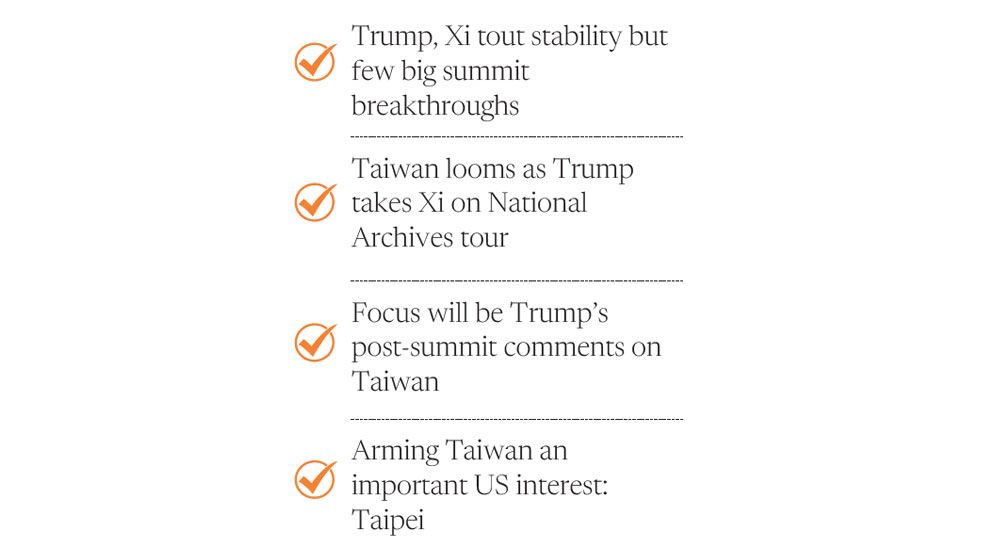
During the high-stakes summit, Trump and Chinese President Xi Jinping drank tea at the White House and visited the National Archives on Friday, ending a three-day summit that showcased personal diplomacy rather than big public breakthroughs on a host of contentious issues.
The summit between the world's two largest economies featured military flyovers, ceremonial tours and a state dinner, but left unresolved major differences over trade, artificial intelligence, Taiwan and China's ties to Iran. Details of the limited trade agreements reached during the visit will be released on Monday, US Trade Representative Jamieson Greer said.
One tangible outcome of the visit was that the US and China agreed to extend by two months a trade truce that was due to expire on November 10, allowing more time to work on a potentially bigger trade deal.
Greer told CNBC that the US has agreed with China on exempting some key goods from disputes over trade, including exports to China of agricultural products and medical devices and imports of consumer and non-sensitive goods.
Trump highlighted progress under a bilateral trade mechanism, citing what he described as increased market access for US farmers and ranchers, while both leaders identified AI as an area for dialogue.
After tea in the White House Red Room, Trump and Xi rode in limousines to the National Archives, where they reviewed the US Declaration of Independence, the Constitution and the Bill of Rights.
Asked about Iran, Trump said he and Xi had discussed it and that "I think we're going to do great," without elaborating. Beijing has denied US allegations of helping Iran's leaders in the conflict launched by Trump in February.
Xi pressed Trump on Taiwan on Thursday, saying he hoped the US would "handle the Taiwan question with prudence." China's state news agency also reported that Xi "hopes the US side will adhere to the correct position of opposing 'Taiwan independence'."
Meanwhile, following the high-stakes summit, a senior Taiwanese diplomat said on Saturday said the United States providing weapons to Taiwan to protect its freedom and provide semiconductors to the world is in the US national interest.
Xi told Trump in Washington on Thursday that he hoped the US would adhere to the "correct position" of opposing Taiwan independence.
Speaking to reporters in Taipei, Deputy Foreign Minister Francois Wu asked whether making concessions on Taiwan would actually serve US interests.