




 For all latest news, follow the Daily Sun's Google News channel.


Schools built to fail
56% of zero-pass institutions in this year’s SSC, equivalent exams had fewer than 10 students, as experts blame lax approvals

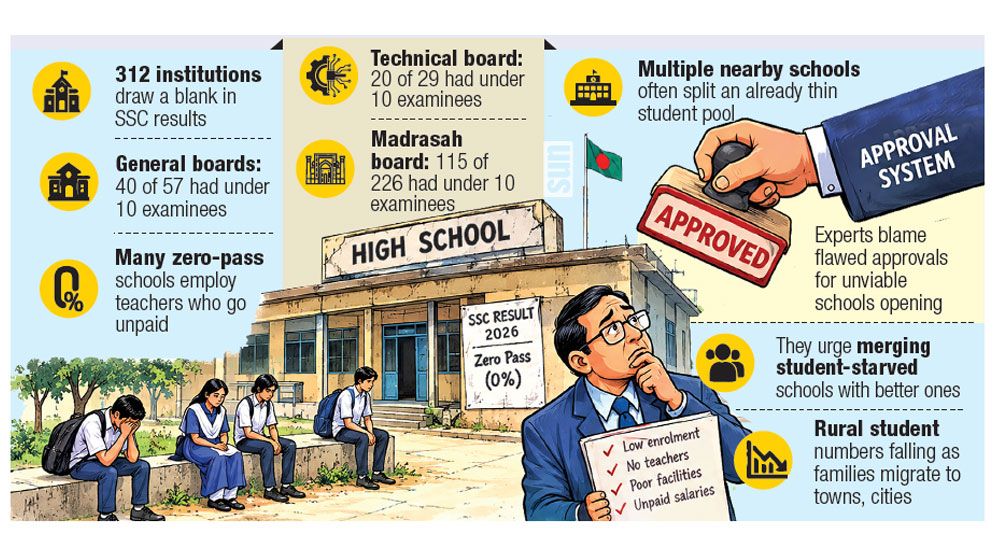
Behind the headline figure of 312 educational institutions where not a single student passed this year’s SSC and equivalent examinations lies a more troubling pattern: schools with barely a handful of examinees, teachers going unpaid, and an approval system that critics say allowed institutions to open without the students to sustain them.
An analysis by the Daily Sun has found that 56% of these zero-pass institutions had fewer than 10 examinees sitting the exam at all – a figure officials and education experts say points less to a single bad exam year than to a deeper structural failure across the general, madrasah and technical education boards.
Following the results, the boards issued show-cause notices requiring the institutions to respond in person, and officials interviewed by the Daily Sun described a familiar set of causes: low enrolment, difficulty attracting students, inadequate facilities, and a shortage of teachers, many of whom go unpaid.
Experts, meanwhile, have turned their attention further upstream, questioning the approval process that allowed such institutions to be established in the first place.
A pattern repeats across the general boards
Among the nine general education boards, only Sylhet and Cumilla recorded no zero-pass institutions.
Across the remaining seven, 57 institutions produced no successful candidates, and 40 of them had fewer than 10 examinees – schools that, on paper, barely function as functioning exam centres at all.
Under the Dhaka Board, Jangalia Union Girls’ High School in Pakundia upazila, Kishoreganj, had just five examinees; Jaldia High School in Rajbari Sadar upazila had seven; and Salimabad Anwar Khan Model High School in Nagarpur upazila, Tangail, had eight.
Board data show roughly 27 teachers are employed across these thinly enrolled schools – a ratio officials did not directly address. Ariful Haque, deputy school inspector of the Dhaka Education Board, said the institutions had responded to show-cause notices “citing various reasons and apologising for their poor results,” and pledged improvement.
Recommendations to the ministry would follow a review of re-scrutiny results, he said – but no timeline was given for when, or whether, action would go beyond paperwork.
The same story recurs board after board. Under Rajshahi, five of five zero-pass institutions had fewer than 10 examinees, bar one. All 11 under Jashore had fewer than 10.
“Student numbers are low in these institutions, while there is also a shortage of teachers. They do not receive salaries,” said Muhammad Niamat Elahi, deputy controller of examinations at the Jessore board – an admission that raises the question of how such schools continue to operate, let alone teach, without paid staff.
In Chattogram, three of eight zero-pass schools had fewer than 10 examinees; the highest count was 19.
Board Secretary Professor Mohammed Zahirul Hoque Swapan cited remote locations, shortages of both students and teachers, and infrastructural problems – a combination that, taken together, suggests these are not isolated failures but symptoms of schools placed where they cannot realistically function.
Barishal offered perhaps the starkest illustration: all five zero-pass institutions had fewer than 10 examinees, including West Ratanpur Pankaj Debnath High School in Mehendiganj, which had just seven students against 11 teachers on its books.
Inspector of Schools Md Syfur Rahman Howlader pointed to a further structural flaw: in some areas, multiple schools sit within a short distance of one another, splitting an already thin pool of students.
Asked about solutions, he said mergers with better-performing schools remained possible “if the government wants” – a conditional answer that leaves the decision, notably, with policymakers rather than the boards themselves.
Dinajpur recorded the highest number of zero-pass institutions among general boards, at 18, of which 13 had fewer than 10 examinees.
Here, officials shifted blame toward students, citing irregular attendance and outside distractions, while promising extra classes.
Mymensingh’s four zero-pass schools told a similar story of thin enrolment and competition from nearby madrasahs.
Madrasahs and technical schools show the same fault lines
The Madrasah Education Board recorded by far the highest number of zero-pass institutions nationwide – 226, of which 115 had fewer than 10 examinees.
Professor Md Farque Ahmed, the board’s controller of examinations, offered the most detailed diagnosis of any official: teachers assigned to Dakhil classes often have to cover Ebtedayee students as well, students frequently arrive from primary schools with gaps in Arabic learning, and management problems compound the strain.
“As students are increasingly moving towards towns and cities, the number of students in rural areas has declined,” he said – an acknowledgment that the crisis is tied to broader migration patterns, not merely local mismanagement.
Among the Technical Education Board’s 29 zero-pass institutions, 20 had fewer than 10 examinees, including three MPO-listed schools drawing government funding despite producing no passing students.
Controller of Examinations Engr Md Abul Kalam Azad said the institutions had cited “reasonable causes” and pledged improvement, noting some had recorded such results for the first time.
Why were these schools approved at all?
Professor Mohammad Mojibur Rahman of the Institute of Education and Research (IER) at Dhaka University said institutions starved of students at the secondary level could be merged into stronger ones, with transport arranged where needed.
He called for a comprehensive mapping of schools, madrasahs and technical institutions nationwide, with decisions on establishing, retaining or merging institutions tied strictly to local student numbers.
“It is not reasonable to spend public money simply to keep institutions running when there are no students,” he said, adding, “The establishment of unnecessary institutions due to political or local influence should be stopped, and institutions must be operated in accordance with proper policies.”
Officials across the seven boards attributed the zero-pass results to low enrolment and teacher shortages.
Mojibur Rahman’s remarks point to an earlier stage in the process – the approval of schools in locations and numbers that boards themselves now describe as unable to sustain a functioning student body.