


 For all latest news, follow the Daily Sun's Google News channel.


Iran could ‘prolong war’ until Trump out of office
Says adviser to IRGC commander
Agencies, Tehran/Washington
Published: 13 Aug 2026, 12:00 AM
Iran could “prolong” the war with the US until President Donald Trump is out of office, a top adviser to the commander of Iran’s Islamic Revolutionary Guard Corps has said.
“We have to attain deterrence so that the enemy never dares to attack us, so we can live with security,” Mohammad Reza Naqdi told PBS in an interview published on Tuesday. “One way is to prolong this war until we get to the next term of the presidency and cause attrition, so that if anyone else wants to attack Iran, they will know there is a cost.”
When asked if he believes Iran is currently in control of the war, Naqdi said: “Certainly, victory is on our side.”
Washington is conducting a “war without strategy,” he said. “Every two or three days, they announced a new objective,” including the invasion of Kharg Island and the reopening of the Strait of Hormuz,” Naqdi continued.
“The longer this war lasts, the more experience we gain. We had never seen a real war to gain real experience to learn how to fight with America. In these five months, we have learned how,” Naqdi added. “We have also seen how the American military is weaker than what we perceived.”
The adviser discussed his country’s bombardment of ships in the Strait of Hormuz, saying that if vessels are traveling through an area out of Iran’s control, “it could be that they’re transporting supplies for the enemy.”
On missiles, Naqdi said that Iran manufactures more of these weapons than it uses every day.
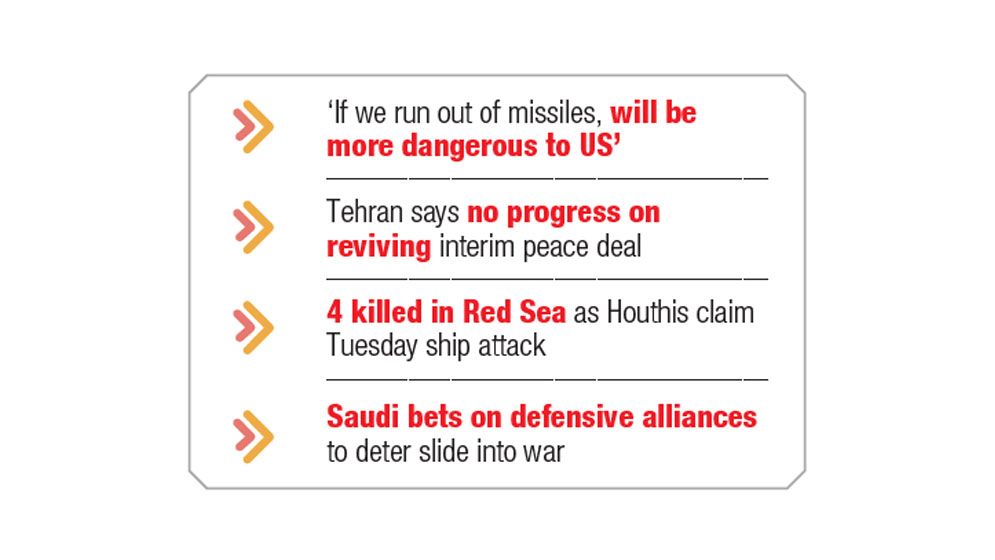
“If there comes a day when Iran has no more missiles left, that’s when we will be even more dangerous for America. Because America has thousands of economic interests throughout the world, and all of them can be easily destroyed,” he said.
Meanwhile, Iran and the United States remain at loggerheads over efforts to agree a permanent end to the war in the Gulf, according to a senior Iranian source who said there had been no progress in talks to revive the interim deal agreed in June and define a timeframe to implement it.
The comments were a further blow to hopes of a swift resolution to the crisis, following attacks on shipping in the region on Tuesday that pushed oil prices higher.
"One of the issues that is being discussed via mediators is the US returning to the interim agreement and defining a timeframe for implementing the commitments. There has been absolutely no progress on this issue," the Iranian source said.
Yemen's Iran-aligned Houthis attacked a ship in the Bab el-Mandeb Strait, at the southern entrance to the Red Sea, on Tuesday, Houthi-run news agency Saba reported, and Pakistan said on Wednesday that three of its nationals had been killed in an attack on a ship.
Four crew members of a small cargo ship were killed when it was hit by the Houthis on Tuesday, Yemen's transport ministry said, adding the dead also included an Indonesian.
On the other hand, increasingly dragged into a war it did not choose, Saudi Arabia is building regional defensive alliances that it hopes will keep its enemies at bay and help it respond more robustly to attacks by Iran and its network of regional allies.
But nascent attempts to construct a multinational maritime coalition in the Red Sea, and the decision to bring Turkey into a defence pact with the kingdom and Pakistan, have so far failed to ward off attacks, analysts and diplomats said.
The kingdom's own military responses to attacks from Iran, Iraq and from Yemen's Houthis, who last month opened a southern front against the kingdom and have attacked Saudi shipping, have so far been limited.
Riyadh faces a dilemma: how to deter attacks and protect the ambitious economic vision it is pursuing without becoming entangled in a broader conflict in the region sparked by the war between the U.S. and Iran.
As one Middle Eastern official put it, "Saudi Arabia's problem is that the kingdom's enemies know it wants to avoid war. They are abusing that."
The Saudi government media office did not respond to a request for comment for this story.
"This is all very concerning and is exactly what Saudi Arabia wanted to avoid," said Aziz al-Ghashian, a Saudi analyst and senior non-resident fellow at the Gulf International Forum.
"Iran and its affiliates think Saudi won't respond. They understood restraint as basically an acceptance of being targeted and this is why it was very important for Saudi to find a way to deter them. The trick is how to balance it," he said.
After the defence pact was signed, the Houthis again attacked oil installations in the kingdom.