


 For all latest news, follow the Daily Sun's Google News channel.


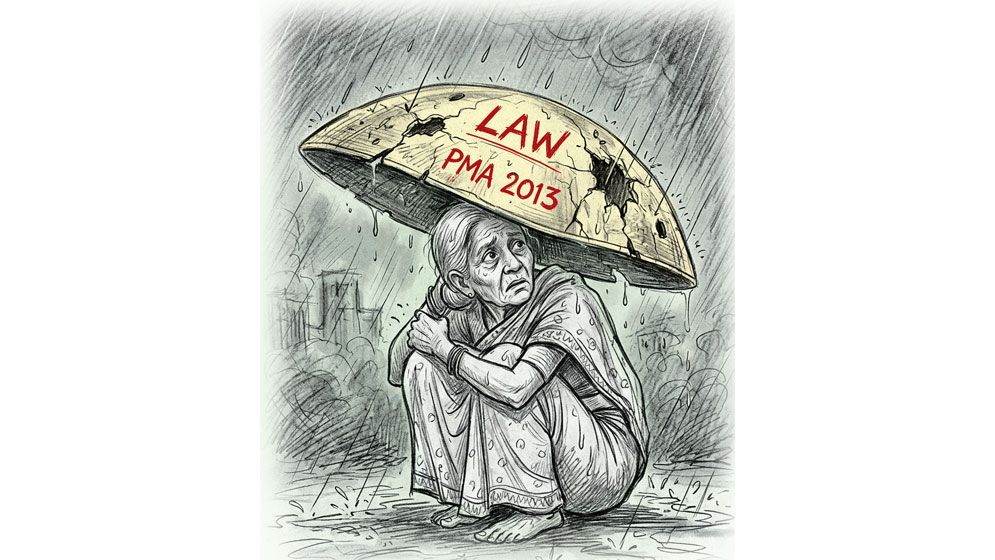
Bangladesh has a law to protect elderly parents from neglect, but is rarely enforced – and experts say – its own design may be part of the problem.
The back-to-back recovery of decomposed bodies of two elderly women in Dhaka last week has refocused attention on the Parents’ Maintenance Act (PMA) 2013 that obliges children to care for ageing parents but has delivered little in practice.
Advocates say the law is undermined by weak enforcement, poor public awareness, and a critical procedural flaw that leaves the most vulnerable with no effective recourse.

Under Section 3 of the Act, every child is legally required to maintain their parents – visiting regularly where they live separately, contributing financially from their income, and attending to their health and medical needs.
The law also prohibits children from compelling parents to reside in old-age homes against their will.
Section 4 extends these duties to grandparents in the absence of a parent. Violations are punishable with a fine of up to Tk1 lakh or up to three months’ imprisonment in default.
Spouses or relatives who obstruct the provision of such care face the same penalty as abettors.
Yet the law contains a structural flaw that renders it largely toothless: no complaint can be taken into cognisance by a court unless it is filed by the parent personally. For frail, isolated, or incapacitated elders – precisely those most at risk – this threshold is frequently impossible to meet.
Supreme Court lawyer Ishrat Hasan said the provision is in urgent need of reform.
“The law sets a bar that the court cannot take any accusation into cognisance unless it is filed by the parents themselves, which is not always possible for elderly parents,” she said.
She also noted that where neglect results in death, prosecution is possible under Section 304A of the Penal Code for causing death by negligence – but said police have so far failed to act in such cases, citing possible negligence or other intentions on the part of the authorities.
The two recent deaths – 75-year-old Nurjahan Begum, found decomposed in her flat on 31 May after reportedly lying unattended for about a week, and 55-year-old Selina Afroza, recovered from Pallabi on 4 June – drew a wave of public outrage. But experts warn that moral condemnation alone will not address a deepening structural crisis in how Bangladesh cares for its elderly.
Rafea Khatun, a PhD candidate at the University of New England researching elderly well-being, argued that the country’s family-centric model of elder care is no longer adequate.
“Elderly well-being is not an issue of any single person, family, society, or country; rather, it requires polycentric stewardship involving all stakeholders,” she said, calling for sustainable, society-wide solutions that go beyond reliance on individual families.
“We should treat the elderly like they once served countries, families, and society; now it is our responsibility to stand by them in their vulnerability,” she added.
Both experts agreed that legislation, however well-intentioned, cannot substitute for a shift in social values – and that enforcement mechanisms must be redesigned so that vulnerable elders do not bear the burden of seeking justice themselves.
Read More