


 For all latest news, follow the Daily Sun's Google News channel.


Fresh foreign investment slumps 43% in 5 years
Structural weaknesses, policy uncertainty keep global investors cautious despite rebound in overall FDI

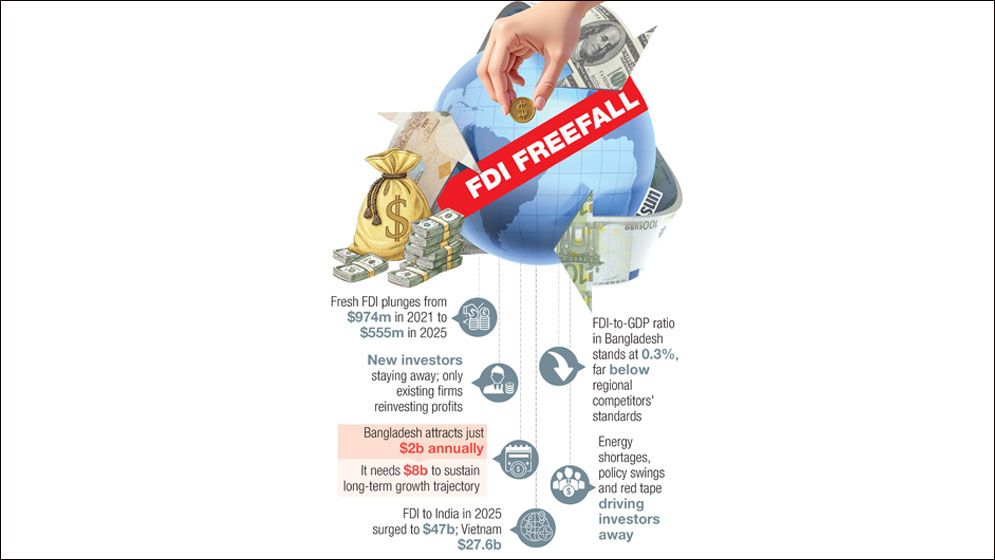
Fresh foreign direct investment (FDI) into Bangladesh has fallen by nearly 43% over the past five years, exposing deep structural weaknesses that continue to deter new global investors despite a recent uptick in overall foreign direct investment figures.
Bangladesh Bank data shows equity capital – widely regarded as the most reliable indicator of genuinely new foreign investment – dropped to $554.63 million in 2025 from $973.43 million in 2021.
The figures paint a troubling picture: whilst foreign firms already operating in the country are ploughing profits back in, very few new investors are committing fresh capital.
Total net FDI inflows did rise, climbing 39.36% to $1.77 billion in 2025 from $1.27 billion the previous year. But economists are quick to temper any optimism. Much of that growth came from reinvested earnings, which jumped to $781.67 million from $390.57 million in 2021, and from intra-company loans, which surged to $434.11 million.
The message, analysts say, is clear: existing multinationals are keeping the lights on, but new entrants are not arriving.
“There is definitely a risk emerging here,” said Dr Zahid Hussain, former lead economist at the World Bank’s Dhaka office.
He argued the problem runs far deeper than budgetary fixes or stimulus packages.
“If ports remain inefficient, if investors need six months to obtain licences and a year for environmental clearances, and if gas and electricity supplies remain unreliable, foreign investors will not come.”
Bangladesh currently receives the equivalent of roughly Tk1,300 in foreign investment per person annually – a figure economists describe as negligible for an economy with ambitions to reach upper-middle-income status.
The country’s FDI-to-GDP ratio stands at just 0.3%, well below the threshold economists consider necessary for serious industrial transformation. Experts estimate Bangladesh requires at least $8 billion in annual FDI to sustain its long-term growth trajectory.
The contrast with regional peers is stark. India saw FDI surge 73% to $47 billion in 2025, buoyed by manufacturing expansion and policies designed to embed the country in global supply chains.
Vietnam recorded an estimated $27.62 billion in disbursed FDI, whilst even Cambodia attracted $5.1 billion – up from $4.4 billion a year earlier. Bangladesh, meanwhile, is still struggling to break the $2 billion annual barrier.
Dr Mustafa K Mujeri, former chief economist of Bangladesh Bank, pointed to the connection between domestic and foreign investor sentiment.
“Foreign investors first observe domestic investors,” he said.
“If local investors are not expanding investment, foreigners naturally become cautious. They assume local businesses understand the risks better than anyone else.”
That caution appears well-founded: Bangladesh’s investment-to-GDP ratio has slid from 32.05% in FY22 to 28.54% in FY25.
Business leaders highlight the unpredictability of operating conditions as a persistent grievance.
Rupali Chowdhury, president of the Foreign Investors’ Chamber of Commerce and Industry and managing director of Berger Paints Bangladesh, noted that investors entering 20- to 25-year contracts frequently encounter sudden shifts in gas pricing and policy terms.
“Without predictability and reliable implementation, confidence weakens,” she said.
Energy reliability has become perhaps the single most cited barrier. Gas shortages, load-shedding and delays in utility connections have stalled numerous expansion plans.
Industry voices warn that unless power supply improves substantially, Bangladesh risks forfeiting ground in high-value export sectors such as electronics and pharmaceuticals to more dependable competitors.
Political uncertainty following the 2024 national elections compounded matters further, nudging several foreign firms into a prolonged wait-and-see posture.
Government efforts to streamline procedures through One-Stop Service facilities have so far yielded modest results, with businesses reporting that bureaucratic delays remain largely unchanged on the ground.
Dr Zahid Hussain was direct about what genuine reform requires.
“Investors do not come because of an individual person,” he said. “They come because they trust the investment environment.”
Ashik Chowdhury, executive chairman of the Bangladesh Investment Development Authority, acknowledged that absolute inflows remain below potential, noting that a global decline in greenfield investment had hit developing economies particularly hard.
“With current global conditions still uncertain, we are preparing so that when the tide turns, Bangladesh is better placed to compete for serious capital,” he said.
Read More