


 For all latest news, follow the Daily Sun's Google News channel.


Bangladesh is entering a new phase of development financing, with the government increasingly turning to external sources to sustain its ambitious infrastructure and social spending agenda.
The proposed Annual Development Programme (ADP) for FY2026-27 clearly reflects this shift, raising important questions about fiscal sustainability and economic strategy.
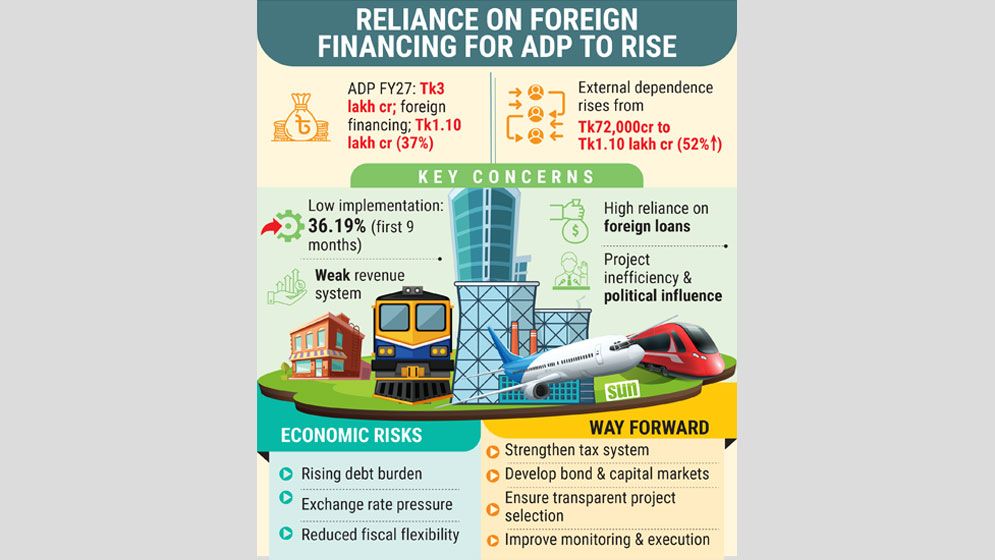
The government has set the ADP at a record Tk3 lakh crore, a 50% increase from the revised Tk2 lakh crore in the current fiscal year. Around Tk72,000 crore came through foreign financing in the revised ADP of the outgoing fiscal year, while Tk1.10 lakh crore – more than one-third of the total – will come from foreign loans and assistance in the upcoming programme, signalling a structural transition that development is no longer being driven primarily by domestic resources, but by external financing.
A strategic shift or a forced choice?
The growing dependence on foreign funds appears to be less a strategic preference and more a response to constraints at home. Weak revenue mobilisation, a narrow tax base, and limited depth in domestic capital markets have reduced the government’s ability to finance large-scale projects internally.
Economist and public policy expert Dr M Masrur Reaz has termed the increasing reliance on foreign financing in the upcoming ADP – around a 52% rise in the upcoming ADP – as a “warning signal” for the economy. He argues that this trend reflects longstanding weaknesses in fiscal management, which have become more pronounced in recent years.
He said Bangladesh’s revenue mobilisation system remains structurally weak, while modern financing instruments such as the bond market have not been effectively utilised. He also points out that political influence and unnecessary expenditure have undermined the quality of development projects, further increasing dependence on external borrowing.
Dr Reaz emphasises that addressing these challenges will require a three-pronged approach: strengthening the tax system, expanding the use of both domestic and global capital markets, and ensuring greater transparency and discipline in project selection. In his view, such reforms are essential to gradually steer the economy towards a more stable and sustainable path.
Development priorities remain ambitious
Despite these constraints, the government is pushing ahead with major investments across key sectors-many of which are closely tied to foreign financing.
The local government sector has been allocated the highest ADP share at Tk36,620 crore, reflecting a strong push for rural infrastructure, municipalities, and urban services, often backed by development partners.
The road transport and highways sector follows with Tk32,303 crore, underscoring continued emphasis on large-scale infrastructure and mega projects-areas that typically depend heavily on external loans.
The health sector has seen a significant jump, with allocation nearly doubling to Tk20,608 crore from Tk11,618 crore a year earlier, signalling a renewed policy focus on strengthening public health systems with support from multilateral agencies.
The power sector has been allocated Tk19,188 crore, reflecting ongoing investments in electricity generation and energy security, another capital-intensive area reliant on foreign financing.
Meanwhile, the science and technology sector will receive Tk17,666 crore, highlighting efforts to advance digital transformation and innovation, often supported by concessional external funding.
Other key sectors such as water resources and education continue to receive substantial allocations-generally in the range of Tk10,000-15,000 crore or more – ensuring a balance between infrastructure development and human capital investment.
Implementation gap raises concerns
While the ADP focuses on boosting infrastructural strength, the effectiveness of this strategy depends heavily on execution – an area where Bangladesh continues to struggle.
ADP implementation stood at just 36.19% during the first nine months of the current fiscal year, the lowest in five years. Large portions of allocated funds remain unspent, with some ministries failing to utilise even 10% of their budgets.
This raises a fundamental concern: increasing the size of the development budget and financing it through foreign loans may not translate into real economic gains if institutional capacity remains weak.
Dr Zahid Hussain, former lead economist of the World Bank’s Dhaka office, questioned the realism of the expanded ADP, arguing that it does not fully reflect current economic pressures, including inflation and slowing growth. He has called for greater prioritisation and austerity in public spending.
Long-term risks of external dependence
The share of foreign financing in the ADP – around 37% and especially high in key sectors – introduces several long-term risks for the economy. It increases pressure on debt sustainability, particularly if development projects fail to generate adequate economic returns. At the same time, it heightens exchange rate vulnerability, as a growing portion of repayment obligations must be met in foreign currency. This trend also reduces fiscal flexibility, limiting the government’s ability to respond effectively to external shocks or domestic economic pressures. Moreover, concerns about project quality, political influence, and inefficiencies further compound these risks, potentially leading to suboptimal use of borrowed funds.
To balance ambition with sustainability, economists emphasise the need for structural reforms. Strengthening the tax system, expanding domestic capital markets, and improving project selection and monitoring are seen as critical steps.
The Planning Ministry has outlined reform measures, including better alignment of projects with medium-term frameworks and stronger oversight mechanisms. However, implementation will be key.
The reporter can be reached at [email protected]