


 For all latest news, follow the Daily Sun's Google News channel.


Mount Kailash: The unconquered mountain that continues to defy the modern world
Hedaet Ullah Soukhin
Published: 14 Nov 2026, 04:11 PM
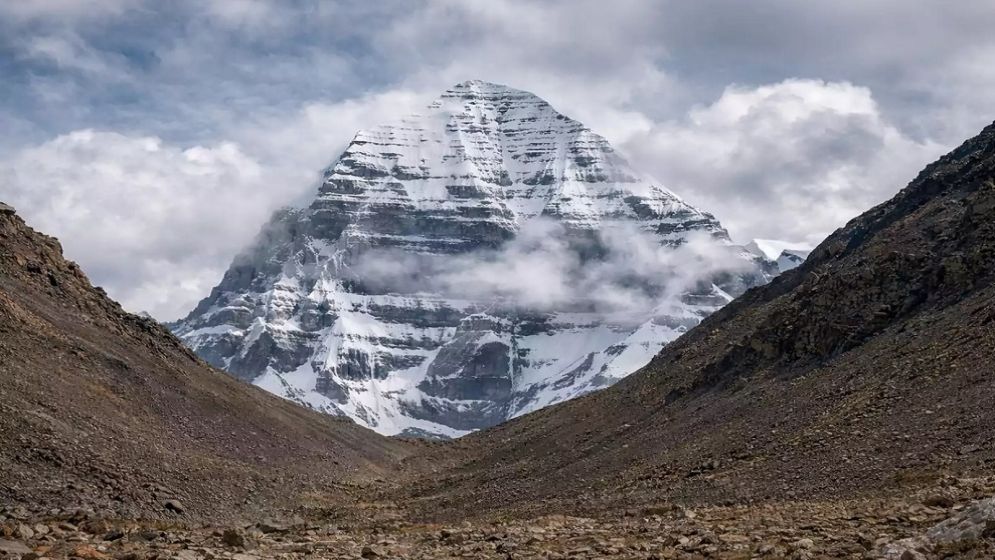
Mount Kailash: The unconquered mountain that continues to defy the modern world. Photo: Collected
Mount Kailash remains one of nature's greatest mysteries. Despite being considerably shorter than Mount Everest, no verified modern mountaineering expedition has ever reached its summit. Located in the region where China, India and Nepal meet, the mountain is surrounded by legends, religious beliefs and scientific speculation.
Known as ‘Kang Rinpoche’, meaning ‘Precious Snow Mountain’, in Tibetan, Mount Kailash is believed to derive its name from the Sanskrit word ‘Kelasa’, meaning crystal.
Historical accounts suggest that no climber has successfully reached its summit. Over the years, various explanations and fascinating stories have emerged about why the mountain remains unconquered. Some believe it has an unusual magnetic field that makes climbing impossible. Others claim that time passes faster there, causing visitors to age unusually quickly, with their hair and beards turning grey. There are also theories that the mountain is an enormous pyramid built by humans, while legends speak of the mysterious city of Shambhala hidden within it.
In reality, reaching Mount Kailash itself is a considerable challenge. Rising approximately 6,638 metres above sea level, the mountain is surrounded by snow, low-oxygen conditions and unpredictable weather. The risk of landslides adds to the difficulties of travelling through the region.
Beyond these widely circulated stories, however, Kailash holds a far greater significance for millions of people. It is considered sacred by followers of four religions: Hinduism, Buddhism, Jainism and Bon.
According to UNESCO records, the religious history of the mountain dates back approximately 3,000 years. In Hinduism, Mount Kailash is believed to be the abode of Lord Shiva and Goddess Parvati. Buddhists also regard it as an exceptionally sacred place and, according to their beliefs, the centre of the universe. For Jains, it is the place where Rishabhadeva attained moksha, or liberation. Followers of Bon consider the mountain their spiritual centre and believe it connects the earth with heaven.
Pilgrims from these four religious traditions undertake a journey around the mountain along a route approximately 52 kilometres long. This sacred circumambulation is known as ‘Kora’ in Tibetan. Hindus and Buddhists traditionally walk clockwise, while followers of Bon and Jainism follow an anticlockwise route.
The mystery of Kailash is further enhanced by two lakes, Manasarovar and Rakshastal, situated at an altitude of more than 4,500 metres above sea level. Although separated by only about three kilometres, the lakes have strikingly different characteristics.
Lake Manasarovar is a freshwater lake regarded as sacred by Hindus and Buddhists. Pilgrims traditionally bathe in its waters as an act of spiritual purification. However, bathing is now strictly prohibited to protect the lake and its surrounding environment. The region around Mount Kailash and Lake Manasarovar is also associated with the sources of four major rivers: the Indus, Sutlej, Brahmaputra and Karnali.
Rakshastal, by contrast, contains highly saline water. In Hindu mythology, the lake is associated with Ravana, the demon king of Lanka, and is traditionally regarded as inauspicious.
Scientifically, Rakshastal is an endorheic lake, meaning it has no outlet. As water evaporates, salts and minerals remain behind, gradually increasing the lake's salinity over thousands of years. Its highly saline conditions make it unsuitable for most aquatic life.
The question of why nobody has conquered Mount Kailash has both physical and religious dimensions. Its unusual structure is considered one of the main obstacles. The mountain has extremely steep slopes on all sides, making an ascent particularly difficult.
In the early 19th century, British explorer Hugh Ruttledge described the mountain's northern face as unclimbable after examining it. Shortly afterwards, Colonel RC Wilson attempted to identify an alternative route from the south but was forced to abandon his effort because of adverse weather.
Mountaineers have conquered peaks considered more dangerous than Kailash. Yet no modern climbing expedition has reached its summit. Religious reverence and opposition to disturbing the mountain's sacred status have played a major role in keeping climbers away.
In 1985, renowned Italian mountaineer Reinhold Messner was offered the opportunity to climb Mount Kailash but declined, respecting its religious significance.
In 2001, Spanish mountaineer Jesus Martinez Novas was reportedly granted permission to organise an expedition to the mountain. However, the proposal sparked widespread opposition from Tibetans and followers of different religions, prompting the authorities to cancel the expedition. Chinese authorities subsequently imposed a ban on climbing the mountain.
According to Buddhist legend, the 11th-century Tibetan yogi Milarepa was the only person to reach its summit.
Although there is no scientific evidence to support the extraordinary claims surrounding Mount Kailash, its imposing landscape, difficult terrain and profound religious significance continue to make it one of the world's most fascinating and mysterious mountains. For millions of people, it is not simply a mountain to be conquered but a sacred place to be revered.