



 For all latest news, follow the Daily Sun's Google News channel.


A thread of sunshine: How solar light weaves brighter future for Jamdani
The work demands more than skill; it demands steady, reliable light that does not flicker or fail at the wrong moment
Daily Sun Report, Dhaka
Published: 08 Nov 2026, 08:27 PM
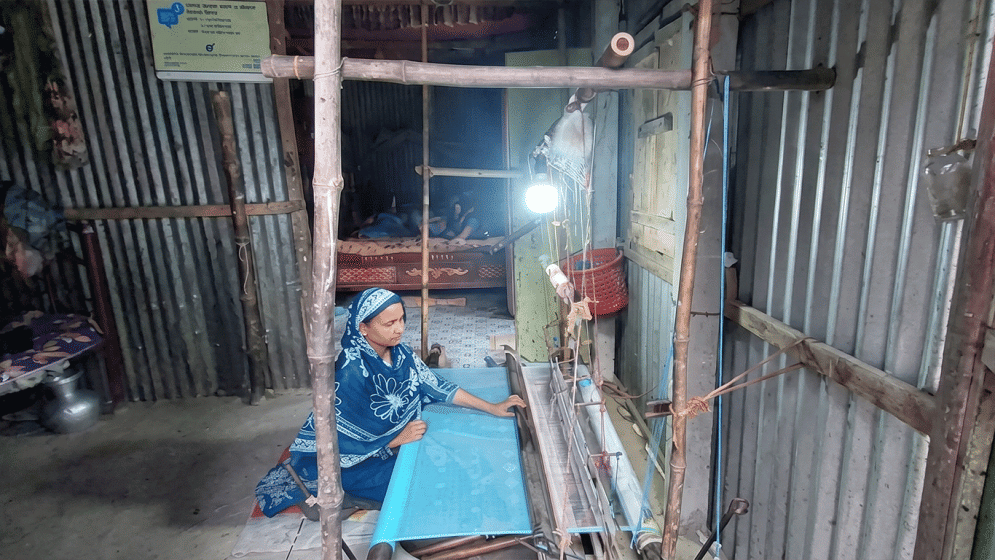
Photo: Daily Sun
In the quiet workshops of Jampur, where the air still carries the soft, rhythmic clack of handlooms, a different kind of light is beginning to fall across the threads.
Before a Jamdani sari becomes the treasured garment
that travels from Sonargaon to the world, it is a patient daily conversation
between artisan and loom. Thread by thread, pattern by pattern, the weaver must
see every fine intersection with absolute clarity.
The work demands more than skill; it demands steady,
reliable light that does not flicker or fail at the wrong moment. For
generations that light came from the sun through open windows or, later, from
the uncertain glow of the national grid. Now, on the rooftop of Romi Akter’s
modest workshop in BrahmonBaoga, a 100-watt solar panel has begun to rewrite
the terms of that conversation.
Romi has worked this craft since 2012 with a single
manual loom. In a good year the loom yields forty-eight saris four a month
bringing in roughly Tk336,000. Grid electricity once supplied the lamps she
needed to distinguish the delicate weft, yet the meter still recorded 23
kilowatt-hours in a single baseline month, and the supply was never guaranteed.
A sudden outage could leave the most intricate motif unfinished in shadow,
forcing her to wait for daylight or risk imperfect work.
“Before, whenever the electricity went out, I had to
stop weaving. Now, with solar lights, I can continue my work even during power
cuts. It may seem like a small change, but for someone like me, it means a lot,”
said Romi Akter, Jamdani micro-entrepreneur.
Enter the Sustainable Microenterprise and Resilient
Transformation (SMART) Project, a five-year, $300 million partnership between
the World Bank and Palli Karma-Sahayak Foundation (PKSF).
Across Bangladesh the project aims to reach 80,000
microenterprises, helping them adopt cleaner production methods and prepare for
climate risks. These businesses, according to PKSF, account for a quarter of
the country’s GDP and more than half of its employment.
In Jampur, the ambition arrives not as grand
machinery but in the form of rooftop panels, batteries and LED bulbs.
VERC, working under the project’s Jampur branch,
installed Romi’s system at a cost of Tk18,450. A grant covered half of that
amount Tk9,225 making the technology reachable for a one-loom enterprise. The
panel charges a battery that now powers two 14-watt LEDs and a pair of fans.
What once depended on the grid’s mood now draws a
measure of independence from the sky itself. Battery storage means the
collected sunlight can still serve after dusk, within the limits of the system,
extending the usable working day without increasing the draw on the national
network.
Romi’s workshop is not an isolated case. VERC’s
solar register for the BrahmonBaoga Jamdani cluster lists nine such installations,
with a combined cost of Tk529,410. Every system includes battery backup. Every
entry mentions the same practical trinity: LED lighting, fans, and the quiet
promise of stored sunlight. Read as a list of equipment, the register can sound
unremarkable.
“We spend long hours working on our traditional
looms. The solar lights and fans have made our workplace more comfortable. Now
we can focus better on our work without worrying so much about electricity,”
said Jakir Hossain, Jamdani micro-entrepreneur.
Resource Efficient and Cleaner Production, or RECP,
becomes less an abstract acronym and more a simple question answered: Can the
artisan see clearly? Can she work in comfort? Can the energy that powers her
livelihood also lighten its environmental load?
In the context of Bangladesh’s nine million
microenterprises, that question carries weight. Many small businesses know
exactly where they could save electricity or reduce waste, yet lack the money
or technical guidance to act. SMART was designed to close that gap. In Brahmon
Baoga it does so by placing solar power not as a distant policy goal but as a
practical companion to the loom.
There is a deeper resonance here. In a country where
climate risks are rising and energy access remains uneven, solutions that serve
both resilience and tradition matter. Solar power in these workshops is not
about transforming the craft into something industrial. It is about allowing
the craft to continue under conditions that are slightly more humane, slightly
more sustainable and slightly less dependent on systems beyond the artisan’s
control. The fans reduce the physical strain of long hours. The LEDs reduce the
strain on the eyes. The battery reduces the vulnerability to outages. Together
they form a quiet infrastructure of support.
Across the BrahmonBaoga cluster, similar panels are
catching the same sun. Nine workshops, nine batteries, nine small acts of
adaptation. They will not solve every challenge faced by Bangladesh’s
microenterprises. They will not rewrite the economics of handloom production
overnight. But they offer something valuable and concrete: the possibility that
the future of Jamdani can be lit, at least in part, by the same sun that has
always shone on these fields and villages gathered carefully, stored wisely, and
returned as light on the work that keeps a living tradition alive.