


 For all latest news, follow the Daily Sun's Google News channel.


BOOK REVIEW
Autobiography of Red by Anne Carson: A Novel in Verse
Reviewed by Ruth Padel
Published: 29 Oct 2026, 12:00 AM
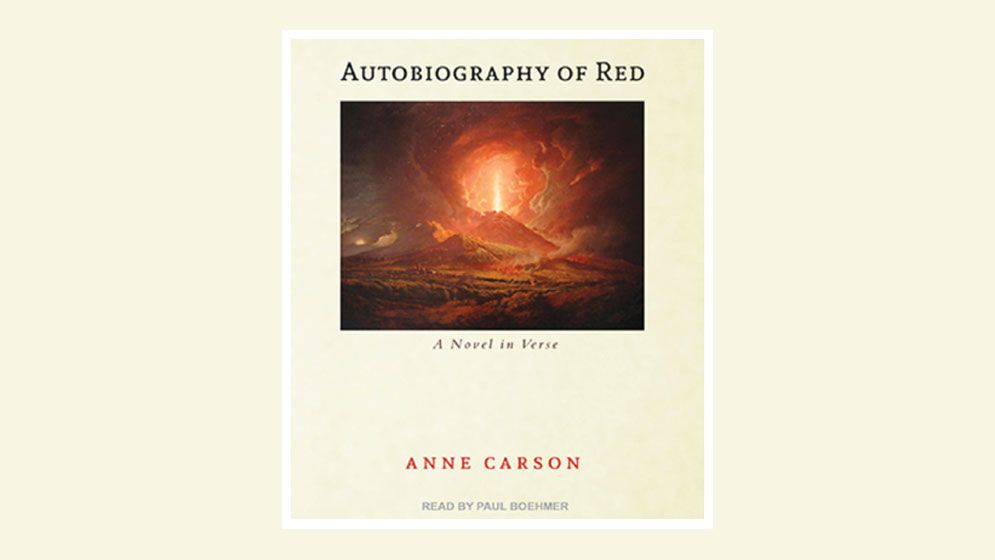
Classical scholarship, rebuilding ancient meaning from papyrus fragments and linguistic likelihood, is suddenly the new image for obsessive love. “The Invention of Love”, Tom Stoppard’s play about the scholar and poet A. E. Housman, is packing London’s Royal National Theatre and entrancing unscholarly audiences with Housman’s scholarly lectures on the Roman poet Propertius as well as Housman’s own poems of unrequited love. In lyric mode, the scholar and poet Anne Carson has created, from fragments of the Greek poet Stesichorus, a profound love story -- a reverie on the mystery of one person’s power over another, seen through the double lens of scholarship and verse.
Stesichorus was a Sicilian Greek from the early Classical Age. Little of his poetry survives, but it was famous for being both sweet (a nightingale, it was said, sang on his lips in the cradle) and, according to the ancient rhetorician Quintilian, ‘’extravagant.’’ Giving lyric poetry an epic grandeur, he failed to observe conventional lyric boundaries. (This, says Quintilian, is ‘’the fault of a well-stored mind.’’’) He also wrote a poem, now lost, that showed Helen of Troy in a shameful light. Since Helen was a goddess, as well as a mythical character, she retaliated, he claimed, by blinding him. He wrote a replay -- a palinode that denied what he had written and said Helen had never gone to Troy -- and found he could see again.
All this flickers through Carson’s ‘’Autobiography of Red’’, a hybrid work of poetry and prose that includes witty critical reflections on Stesichorus and an imaginary interview with him. (Like other famous authors questioned about the ‘’concealment drama’’ in their work, he produces inconsequential remarks that read like a cry for help.) But the core of her book is a reinterpretation of another lost Stesichorus poem, ‘’Tale of Geryon.
In myth, Geryon was a winged red monster killed by Hercules. We know that Stesichorus’ poem imagined Geryon’s life before Hercules. Carson reimagines their encounter as a destructive love affair; in her replay of Stesichorus, Hercules does not kill Geryon, he breaks his heart. Her Geryon is a winged red monster but also a gifted American boy. ‘Where does he get his ideas? ‘’ asks a teacher in elementary school, when the boy produces the Greek myth of Geryon as his own autobiography.) Sexually abused by an older brother, inarticulately attached to his chain-smoking mom, he becomes a photographer. His redness and wings stand for creativity, its power and its pain. (‘’Everyday life as a winged red person had accommodated him’’ to ridicule.) Since Hercules is Action Man, an unreflective, testosterone-personified person, their relationship is inevitably fraught. (‘’Jesus,’’ says Hercules, ‘’I hate it when you cry.’’ He wants Geryon to enjoy sex, as he does himself, without the awful complexity of thinking.) So this poem is about knowing and loving a man who has a good time with you but will never know you back. Geryon’s redness is his inmost being, his selfhood, but Hercules dreams about him in yellow.
After the affair he lives a ‘’numb life’’ until, years later in Buenos Aires, he bumps into Hercules again. Hercules, with his new Peruvian boyfriend, Ancash, takes Geryon to an Andes village whose inhabitants believe winged red people are volcano survivors -- people who have been in flame and lived. Here the sexual triangle triggers violence but ultimately a healing, creative insight.
For unlike Stesichorus, Carson is interested in Geryon’s survival through art. Geryon’s photographic lens is a wonderfully rich image for what Carson herself is doing in her book. As Stesichorus got his sight back by reinterpreting myth, Carson’s reinterpretation turns myth into the recording and surviving of pain through the viewfinder of poetry. Like ‘’Lava Man’’, a volcano survivor whose veins hold ‘’ocher-coloured drops that sizzled when they hit the plate’’, Geryon comes through volcanic passion and out the other side. He is the eyewitness of the catastrophe that was survived.
The essential “Autobiography of Red”, the poem sequence, gains extra light from its playfully scholarly setting. But the poems also stand alone. Carson varies their tone wonderfully, in perfect control all the way from dry wit to high poeticism. She counterpoints domesticity with ecstasy, the profound with the bizarre. And Carson writes in language any poet would kill for: sensuous and funny, poignant, musical and tender, and brilliantly lighted.
Courtesy: New York Times