



 For all latest news, follow the Daily Sun's Google News channel.


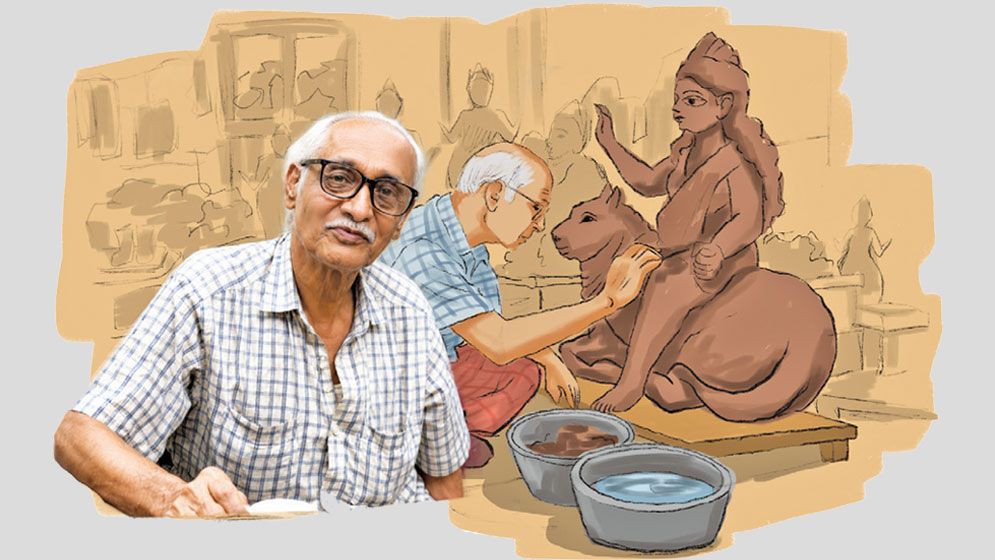
Illustration: SANZIDA
If you walk into Shakhari Bazar, it feels like time has completely stopped. Tucked away in a crowded, noisy corner of Old Dhaka, this narrow alley has barely changed since the time of the Mughals. The air smells of sweet incense and carved conch shells (shankha).
In a small workshop at House No. 42, soft sunlight shines through a single window onto dozens of clay statues of Goddess Durga & Lord Ganesh in different stages of completion. Some are newly molded from earth, while others are painted bright pink, waiting quietly on the shelves.
“People worship Ganesh during Pohela Baishakh for new beginnings, but our busiest time of the year has always been Durga Puja,” says Haripada Pal, the quiet sculptor sitting inside. He speaks softly, like someone who has answered this question many times before.
To Haripada Pal, these statues are not just decorations; they are expressions of deep devotion.
For over 300 years, Shakhari Bazar has been the heart of Hindu craftsmanship in Dhaka. Its history goes back to the 1600s, when the Mughal ruler Islam Khan made Dhaka the capital and brought skilled workers here. Among them were the Shankharis, who carved shell jewelry and gave the area its name. Yet, it was Haripada Pal who truly shaped the artistic DNA of Shakhari Bazar.

Haripada Pal was born in Chirulia village, Noarpara, in Jessore district, which feels worlds away from the busy streets of Dhaka. His grandfather was the first in the family to work as a sculptor, and Haripada grew up watching him shape clay into something divine. Before the Liberation War of 1971, he traveled to Narshingdi to work alongside his grandfather and eventually made his way to Dhaka.
was one of the first full-time sculptors to start afresh in Shakhari Bazar after the war, helping a grieving city rebuild its festivals and beauty.
As one local artisan put it, “Most of the sculptors in Shakhari Bazar were made by him. Everyone in this field learned from him.” It is a legacy without a trophy, one that lives in the spirits of the students he trained and the quiet presence of the deities he shaped.
Over the years, he set the standard for idol making in the country, especially during major festivals like Durga Puja. If you go to famous temples like Dhakeshwari Mandir or Siddheshwari Kali Mandir today, you are looking at his life’s work.
His most intriguing project was a huge, ten-headed statue of Ravana for the Mohakali Puja in Ramna Park.
“Ravana is a hard character to make,” Haripada explains. “He has ten different faces, and each face has to show a different emotion.” When the statue was finally revealed to the public, the crowd stood in awe. Haripada calls that afternoon the most memorable day of his life.
In 2012, Haripada traveled all the way to Washington, D.C. A visiting American professor who loved his work arranged for Haripada to represent his craft at the Smithsonian Folklife Festival. It was a remarkable leap, from a cramped workshop in Shakhari Bazar to the National Mall in Washington.
But even on the international stage, Haripada stayed humble. When people asked him to stay longer in America, he shook his head. He said he had to get back to work - the autumn worship season was coming, and the clay was waiting. Bright city lights couldn't replace the smell of wet clay in his little workshop. He went back home and kept sculpting.
Now, time is catching up with him. His eyesight is getting weak, and he can no longer work as fast as he used to. He talks about his health calmly, like a worker who knows his main tool is wearing out.
Life has also brought him deep personal pain. He and his wife lost both of their children when they were very young - their daughter to Pneumonia and their son shortly after. Today, it is just the two of them living quietly together.
What worries Haripada the most isn’t his failing eyes or his private sadness. It is the fact that no one is left to continue his craft. This sacred knowledge, passed down from his grandfather, of how to give a shape to a God, will most likely end with him.
Outside shop No. 42, the streets of Shakhari Bazar are loud and busy with shoppers preparing for the next festival season. But inside, surrounded by rows of clay idols, an ancient art form is slowly coming to an end, kept alive by the quiet hands of one old master who refuses to stop.
_____________________________________
Farzana Faiza is a Research Associate at The Daily Sun and Farin Tasnim is an English Teacher at Academia School, Dhaka.
Read More