


 For all latest news, follow the Daily Sun's Google News channel.


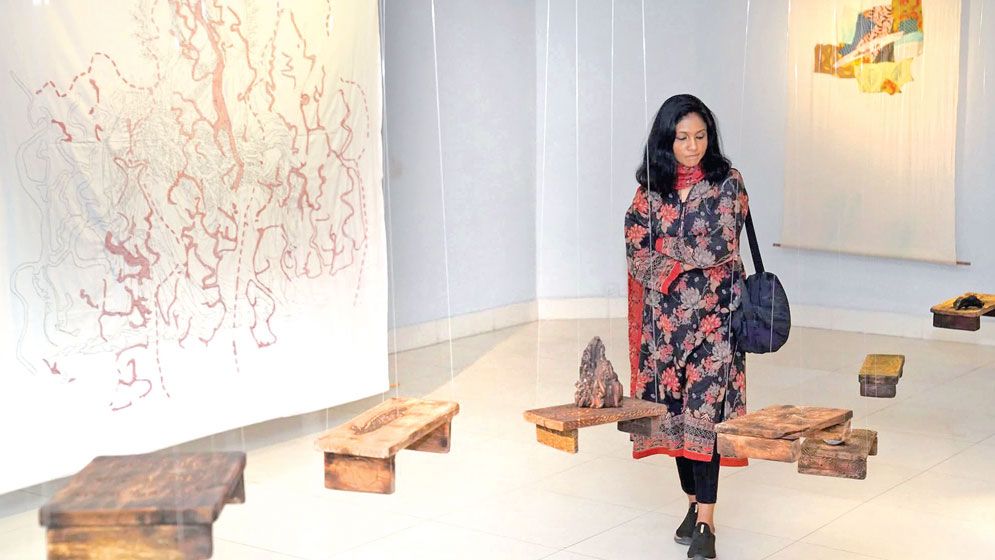
A solo art exhibition titled “Non-duality” (Adwaita) by artist Moni Majhi is underway at La Galerie of Alliance Française de Dhaka (AFD) in the capital’s Dhanmondi area. The exhibition, which opened on Friday, explores the profound relationship between human life, nature and cultural traditions rooted in the riverine landscape of the Sundarbans.
Through artistic exploration, Moni Majhi uniquely presents a compelling narrative of coexistence, shared identity and ecological interdependence, encouraging visitors to reconsider humanity’s relationship with the natural world.
The exhibition draws inspiration from the concept of “Non-duality”, a philosophy that transcends religious boundaries and celebrates the interconnectedness of different beliefs, identities and forms of life.
Basically, “Non-duality” reflects the cultural and spiritual traditions of communities living around the Sundarbans, where religious differences often give way to shared beliefs and practices.
In these traditions, “Bon Durga” and “Bonbibi” are regarded as manifestations of the same Mother, while “Paban Thakur” and “Paban Pir” represent a common spiritual understanding. Such beliefs highlight a distinctive cultural environment where mutual respect, hospitality and peaceful coexistence shape everyday life.
The exhibition also highlights the ecological richness of the Sundarbans, drawing on its rivers, forests, tides, saline waters, soil, wildlife, myths and folklore. These elements collectively illustrate a worldview in which human existence remains deeply connected with the surrounding environment.
Everyday cultural objects and rituals also carry symbolic significance in Moni Majhi’s artistic presentation.
The “piri”, a traditional low wooden stool offered to guests as a gesture of respect, emerges as a symbol of hospitality, dignity and belonging. Similarly, the folk practice of offering sinni and payesh reflects reverence towards natural forces and an acknowledgement of humanity’s dependence on nature.
Traditional beliefs surrounding Paban, or the wind, particularly during storms and heavy rainfall, further demonstrate the intimate relationship between local communities and the natural environment.
However, the exhibition also draws attention to the growing threats facing these longstanding relationships.
Climate change, competition for natural resources, development pressures and struggles for power are rapidly transforming the ecological and cultural landscape of the Sundarbans.
Against this backdrop, Moni Majhi introduces the thought-provoking idea that humanity and nature have become “refugees of the green.”
The expression expands the conventional understanding of displacement beyond human communities to include rivers, seeds, trees, animals and other living beings whose natural habitats are gradually disappearing.
Through this perspective, the exhibition portrays ecological destruction not merely as an environmental problem but as a collective crisis affecting the foundations of life itself.
Majhi’s works invite viewers to reflect on the consequences of losing the delicate connections that sustain communities, cultures and ecosystems.
Rather than portraying humanity as separate from or superior to nature, “Non-duality” advocates a reciprocal relationship in which every living being forms an essential part of a greater whole.
The exhibition ultimately offers a meditation on belonging, displacement, environmental responsibility and the possibility of restoring connections with nature. By bringing the cultural wisdom of the Sundarbans into conversation with contemporary environmental challenges, Moni Majhi encourages the audience to recognise the shared destiny of all living beings.
The exhibition will remain open to all daily from 3pm to 9pm till 10 November.