


 For all latest news, follow the Daily Sun's Google News channel.


Sundarbans sees tourist surge as peak season continues
Gazi Moniruzzaman, Khulna
Published: 04 Jan 2026, 12:00 AM
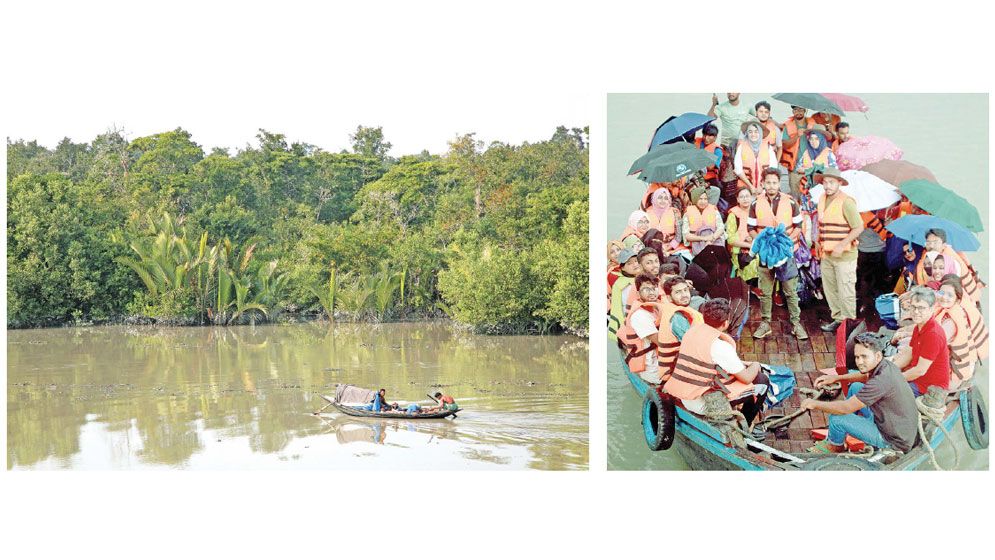
The Sundarbans, the world’s largest mangrove forest and a UNESCO World Heritage site, is witnessing a surge in tourist arrivals during the peak winter season, with popular ecotourism spots bustling with visitors from home and abroad.
Tour guides said tourism spots such as Andharmanik, Kachikhali, Katka, Dimerchar, Jamtala Sea Beach and Karamjal have remained crowded in recent weeks, particularly on weekends. On average, seven to eight small and large luxury vessels are seen anchoring daily at these destinations.
According to AZM Hasanur Rahman, divisional forest officer of the Sundarbans (West), the protected forest hosts about 375 species of wildlife, including 42 mammals, 35 reptiles and eight amphibians. “In addition, the Sundarbans has 334 plant species, 165 species of algae and 13 orchid species,” he said, adding that around 450 rivers and canals support more than 200 species of fish and other aquatic life.
Rahman noted that November to February is considered the best time to visit the Sundarbans due to calm weather and navigable rivers, allowing tourists to access most scenic locations safely.
Under the Sundarbans Protection Project, the Forest Department has developed ecotourism centres at Karamjal, Harbaria, Andharmanik, Katka, Kachikhali, Alibanda, Dubla, Nilkamal, Shekhertek, Kalagachhia, Dobeki and Kalabogi. Four newly developed centres — Andharmanik, Alibanda, Shekhertek and Kalabogi — have emerged as major attractions, allowing visitors to return the same day after touring.
Tourists say the experience of seeing wildlife in its natural habitat is unforgettable. During recent visits, crocodiles were spotted basking along canal banks at Karamjal, while eagles, kingfishers, herons and migratory birds filled the skies. The calls of owls, magpies and other forest birds added to the wilderness experience.
Rezaul Haque and his wife Tanisha Akter Brishti, newlyweds visiting from Sylhet, said seeing the Sundarbans firsthand was far more captivating than reading about it in books. “To rediscover oneself in the lap of nature, there is no alternative to the Sundarbans,” they said.
However, tourism operators have raised concerns about inadequate facilities. Nazmul Azam David, general secretary of the Tour Operators Association of Sundarbans (TOAS), said tourist numbers are increasing, but infrastructure has not kept pace. “Emergency medical services, safe drinking water, night accommodation facilities and adequate security are still insufficient. Many watchtowers and jetties are also in fragile condition,” he said.
Responding to the concerns, Md Imran Ahmed, conservator of forests of the Sundarbans Khulna Circle, said overnight stays inside the forest are not permitted to protect its fragile ecosystem. “The Sundarbans is a biodiversity-rich protected forest with many rare and endangered species. Building cottages inside the forest is not scientifically viable,” he said, adding that tourists may stay overnight on vessels but not on forest land.
Ahmed emphasised that the Forest Department does not set revenue targets for tourism. “We want tourism to remain within a tolerable limit so that biodiversity is not harmed. The Sundarbans is a World Heritage Site, and protecting it is a collective responsibility,” he said.
Authorities said plans are underway to develop additional ecotourism centres in the future, with a focus on sustainable and environment-friendly tourism.
Every year, several hundred thousand tourists visit the Sundarbans to experience its pristine natural environment, rich biodiversity and unique riverine landscape. The forest, located along the Bay of Bengal in Bangladesh’s southwest, spans Khulna, Bagerhat and Satkhira districts, with a portion extending into India’s West Bengal.
The Sundarbans is home to the Royal Bengal Tiger and a wide range of wildlife, including deer, crocodiles, monkeys, wild boar and numerous bird and fish species. Visitors frequently spot herds of spotted deer and monkeys along riverbanks, while dolphins are often seen swimming in the forest’s rivers and canals.
Read More