


 For all latest news, follow the Daily Sun's Google News channel.


Khalilur seeks concrete action on ICJ Rohingya verdict
Daily Sun Report, Dhaka
Published: 21 Nov 2026, 12:00 AM
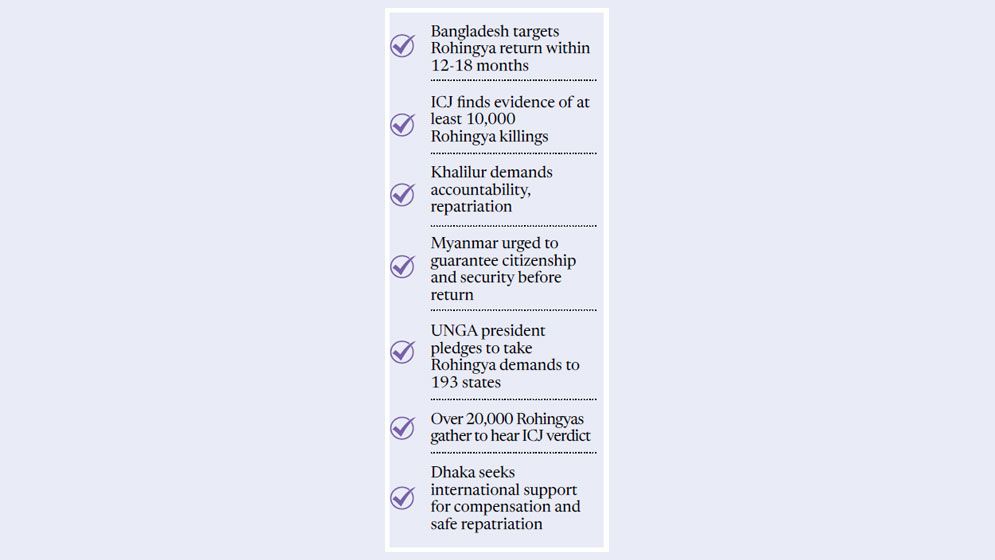
United Nations General Assembly President and Foreign Minister Dr Khalilur Rahman has urged Myanmar to ensure the safe, voluntary and dignified return of Rohingyas, stressing that the International Court of Justice’s (ICJ) verdict on the genocide must translate into concrete action.
Addressing more than 20,000 Rohingyas at Camp 4 in Ukhiya, Cox’s Bazar, on Friday, he said the landmark ruling must bring tangible changes to their lives rather than remain confined to legal documents.
“Justice must now be implemented in the camps and in the villages in Rakhine where the Rohingyas belong,” he said, urging Myanmar to guarantee security, protection from discrimination, freedom of movement and citizenship before repatriation.
The ICJ on Thursday delivered its judgment in The Gambia's genocide case against Myanmar over the 2017 atrocities. Dr Khalilur said the court found evidence of systematic killings, widespread sexual violence, attacks on women and children and destruction of Rohingya villages by Myanmar's security forces. It also cited at least 10,000 killings and intent to destroy a substantial part of the Rohingya community in northern Rakhine State.
He said the verdict was significant for accountability and recognition of the Rohingyas' distinct identity and historical roots in Myanmar.
“No judgment can bring back those who were killed or heal every wound. But recognition of the truth is the beginning of justice,” he said, noting that survivors' experiences and testimonies had finally been reflected in an international judicial process.
Four priorities for implementing verdict
Outlining four priorities—accountability, repatriation, compensation and institutional reforms to prevent another genocide—the UNGA president urged Myanmar to investigate, prosecute and punish those reasonably suspected of Genocide Convention violations, address gaps in domestic laws and prevent similar crimes. He also called on the international community to unite in pressuring Myanmar and supporting compliance with the ruling.
On repatriation, he said Myanmar must ensure safe, voluntary and dignified return for Rohingyas displaced internally and those sheltering in neighbouring countries. No refugee should be forced to return where their life or security is at risk.
Conditions must include protection from discrimination, freedom of movement, restoration of citizenship and meaningful Rohingya participation in decisions about their future. He also called for family reunification, restoration of homes, land and property or alternatives, medical treatment for the injured, tracing missing people and dignified reburial of the deceased in accordance with Rohingya traditions.
Repatriation must respect Rohingyas' wishes and aspirations, with citizenship a fundamental protection, he said. Myanmar must ensure UN access to facilitate accountability and justice, while humanitarian assistance must continue until repatriation becomes possible.
On compensation, he said Myanmar must provide individual and collective reparations for material losses not adequately addressed through property restoration and report within two years on reparation measures, including the proposed amount and compensation mechanism.
While money could never restore lost lives or fill the void left by missing family members, proper compensation could help survivors regain security and hope, he said, urging particular attention to women's and young people's aspirations.
The fourth priority was Myanmar's compliance with the judgment through legal and institutional reforms, including proper security-force training and effective civilian oversight, to prevent future atrocities.
Citing Article 94 of the UN Charter, he said member states were committed to complying with ICJ decisions in cases to which they were parties, and non-compliance could be referred to the UN Security Council. As UNGA president, he would engage member states on implementing the judgment.
Bangladesh thanked for sheltering Rohingyas
Dr Khalilur thanked The Gambia for bringing the case, the Organisation of Islamic Cooperation (OIC) for supporting it, 11 intervening countries, the court's judges and UN investigators who collected evidence.
He also thanked Bangladesh's government and people, particularly communities in Ukhiya and Teknaf, for sheltering Rohingyas, and paid tribute to survivors, especially women who courageously shared their experiences of persecution and violence.
Referring to the 1946 UN General Assembly declaration describing genocide as an affront to humanity's conscience and the 1948 Genocide Convention, he said preventing genocide and punishing perpetrators were obligations of signatory states. Protecting communities from genocide was a collective legal interest transcending national borders and individual state interests.
Rohingyas hopeful about return
Addressing refugees, UNGA President Dr Khalilur Rahman said the ICJ judgment showed the international community had not forgotten them. He pledged to convey their concerns to all 193 UN member states, particularly highlighting the voices of women, children and young people.
He hoped 19 November 2026 would mark the beginning of a journey towards their return home. Recalling his previous visits to the camps as Bangladesh's high representative on the Rohingya issue, he said he wanted to meet refugees in person rather than discuss their plight from New York.
Vowing that no section of the community would face genocide again, he stressed that “Never Again” must truly mean never again.
Rohingya leaders welcomed his remarks, hoping the judgment would lead to concrete international pressure on Myanmar rather than remain a diplomatic discussion.
Kin Maung, president of the Rohingya organisation UCR, thanked Dr Khalilur for visiting the camps and hearing their suffering and aspirations.
“We do not want to remain in refugee camps indefinitely. We want to return to our homeland with security, citizenship and fundamental rights,” he said, hoping their demands would reach the international community.
Rohingya youth rights activist Mujibur Rahman said the judgment had raised hopes after years of waiting for justice. “But a verdict alone is not enough. Those responsible for persecuting us must be held accountable,” he said.
Former UCR president Syed Ullah said the Rohingyas were grateful to Bangladesh for sheltering them but wanted to return home. Myanmar must guarantee their security, citizenship and freedom of movement before their return, he said.
More than 20,000 Rohingyas attended the gathering at the camp football ground, many carrying placards demanding justice, recognition of their identity and repatriation. It gave them an opportunity to convey their long-standing demands directly to a senior UN representative following the ICJ judgment.
Bangladesh seeks Rohingya return within one and a half years: Humaiun
State Minister for Foreign Affairs Humaiun Kobir said on Friday Bangladesh would intensify diplomatic efforts with the UN and key international partners to facilitate the safe return of Rohingyas to Myanmar within 12 to 18 months.
The timeline depends on adequate security and safeguards in Rakhine State to allow them to return and rebuild their lives.
"We will pursue these discussions vigorously so that we can provide safe passage within a year to a year and a half," Humaiun told journalists at a briefing on the ICJ judgment.
He said the ruling had strengthened Bangladesh's legal grounds to demand justice, safe repatriation and compensation. Dhaka would coordinate with UN agencies, regional powers and other international stakeholders to ensure conditions for a safe, voluntary and sustainable return, which he described as the only viable solution to the prolonged refugee crisis.
On compensation, Humaiun said Bangladesh would pursue reparations through the UN system and bilateral diplomatic channels, but an arrangement with Myanmar alone would be insufficient, requiring broader international engagement. Although no money could compensate for lost lives or ease families' suffering, Bangladesh would urge Myanmar to provide financial compensation and help survivors' families rebuild their lives.
Asked whether compensation could be raised at the UN Security Council, he said Bangladesh would work through the UN framework if The Gambia, which brought the case, placed the matter before the council.
On a possible international peacekeeping force in Rakhine, he said Bangladesh would consult relevant UN bodies and bilateral partners if the issue reached the Security Council, but had announced no formal initiative to propose one.
Explaining the judgment, Humaiun said the ICJ had held Myanmar responsible for genocide against the Rohingya in Rakhine State, the first time the court had found a state responsible for committing genocide.
The ruling recognised the Rohingya as a distinct ethnic community with their own language, culture and identity, documenting how discriminatory laws, restrictions and hate campaigns had stripped them of their rights over several decades.
The court also found that Myanmar had failed to prevent genocidal acts committed by individuals acting alongside its security forces and had not preserved evidence as required by its 2020 order on provisional measures, he said.
The judgment directed Myanmar to introduce effective laws to prevent genocide, stop ongoing violence and investigate and prosecute, where appropriate, those reasonably suspected of involvement. It also addressed reparations, including restitution and financial compensation.
Humaiun stressed that the judgment was final, legally binding on the parties and not subject to appeal.
Although Bangladesh was not a party to the proceedings, it closely monitored the case as it shelters around 1.3 million forcibly displaced Rohingyas.
He thanked The Gambia's government and people for initiating the case on 11 November 2019, the OIC and 11 countries that submitted written declarations before the court. He also recognised the Rohingya community's campaign for justice and Cox's Bazar host communities' contributions.
Urging swift implementation of the judgment, he called on development partners and donors to maintain humanitarian support for displaced Rohingyas and their Bangladeshi host communities until repatriation is completed.
Foreign Secretary Salahuddin Noman Chowdhury was also present at the briefing.