


 For all latest news, follow the Daily Sun's Google News channel.


COP31: Speakers call for stronger protection of Bangladesh’s eroding islands
Daily Sun Report, Dhaka
Published: 15 Nov 2026, 02:40 PM
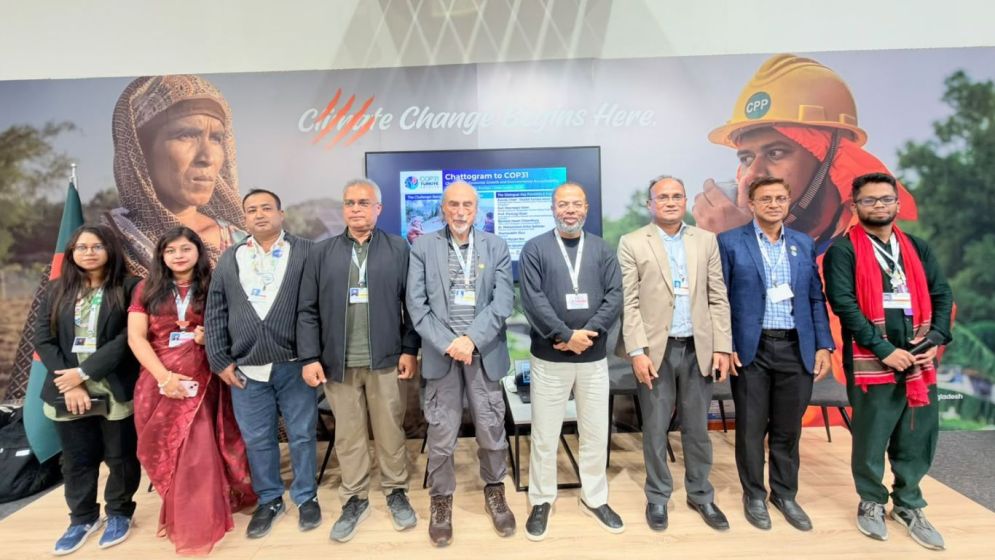
Photo: Courtesy
Speakers at a Bangladesh Pavilion session at COP31 on Saturday called for increased climate finance, stronger coastal protection and greater recognition of economic and non-economic loss and damage, warning that erosion, tidal flooding and environmental degradation are threatening vulnerable coastal islands, including Sandwip, Urirchar and Kutubdia.
They warned that these climate-related threats are destroying homes and livelihoods, damaging ecosystems and putting the cultural identities of generations at risk. They stressed that communities contributing least to global greenhouse gas emissions should not be left to bear the consequences of the climate crisis alone.
Titled “Chattogram to COP31: Climate Risk, Economic Growth and Environmental Accountability”, the session was organised by Human24. It brought together government representatives, policy experts, campaigners, academics, political representatives and journalists to discuss the growing environmental and socioeconomic challenges facing Bangladesh’s coastal islands.
State Minister for Environment, Forest and Climate Change Shaikh Faridul Islam chaired the session. Prof Pierluigi Bozzi of the International University Network on Cultural and Biological Diversity (IUNCBD) and Monira Sharmin, joint convener of the National Citizen Party (NCP), joined the panel.
Saleh Noman, chief of the team at Human24, delivered the keynote address, while Sohanur Rahman, executive coordinator of YouthNet Global, moderated the discussion.
Special speakers included Arifur Rahman, chief executive of Young Power in Social Action (YPSA); Sadia Jahan Rothi of the Centre for Climate Change and Environmental Research (C3ER) at BRAC University; journalist Shamsuddin Illius; and Golam Maula Murad, general secretary of the Chattogram Press Club.
The state minister highlighted the deterioration of coastal infrastructure caused by salinity intrusion and the growing drinking water crisis. He said many cyclone shelters and other coastal structures were deteriorating, adding to the challenges faced by communities already exposed to climate hazards.
“Due to salinity intrusion, our structures automatically degrade within seven to eight years,” he said.
He outlined government initiatives, including large-scale tree plantation, canal excavation, improved waste management and the promotion of electric vehicles and buses to reduce urban pollution. He also said the government was moving towards replacing traditional brickfields with concrete blocks for roads and infrastructure.
“With proper technology and solid foundations, Bangladesh has significant potential for wind turbines and solar energy to transition away from fossil fuels,” he said.
Erosion threatens homes, livelihoods and heritage
In his keynote address, Saleh Noman highlighted the dramatic geographical changes Sandwip has undergone over the past century.
Historical figures presented at the session showed that the island covered approximately 502 square kilometres in 1880, compared with around 258 square kilometres in recent assessments. It reportedly lost more than 71 square kilometres of land between 1973 and 2020. Villages, including Katghar, Batajora and Namaste, have disappeared beneath the water.
Although sediment deposition is creating new land in parts of the Meghna estuary, the newly emerged chars remain highly vulnerable to erosion and tidal flooding. This makes permanent settlement, livelihood security and access to essential services increasingly uncertain.
“More than half of Sandwip’s residents have lost their homes at least once. But the world treats their suffering as inevitable, a ‘natural destiny’,” Saleh Noman said.
“They are not responsible for this crisis. Our initiative seeks to amplify their voices, push for accountability, and demand climate justice,” he added.
He said displaced families lose far more than their homes and physical assets. They also lose agricultural land, fishing grounds, community networks, traditional livelihoods and cultural roots.
Speakers stressed that displacement should not be treated as an unavoidable geographical fate. They called for the experiences of coastal communities to feature in national and international climate policies, alongside stronger accountability and support for families facing repeated displacement.
Economic and non-economic loss and damage
Speakers called for greater recognition of both economic and non-economic losses and damage caused by climate change.
Economic losses include damaged homes, agricultural land, infrastructure, fishing equipment and other livelihood assets. Non-economic losses include ancestral heritage, biodiversity, traditional knowledge, cultural identity and community networks.
They stressed that financial compensation alone cannot restore an ancestral village, recover traditional knowledge or replace a community’s cultural identity after displacement.
They called for loss and damage mechanisms that respond directly to affected communities’ priorities and experiences rather than relying exclusively on top-down approaches. Recovery programmes, they said, must address the social, cultural and psychological consequences of displacement alongside physical and economic damage.
Women and persons with disabilities must be included
Speakers warned that displacement, livelihood insecurity and weakened social protection systems can increase the risks of gender-based violence and other forms of discrimination.
They called for gender-responsive climate policies, accessible protection mechanisms and meaningful participation of women in adaptation planning and decision-making.
The discussion also highlighted the additional barriers persons with disabilities face in accessing early warning information, evacuation facilities, cyclone shelters, healthcare and livelihood recovery services.
Speakers stressed that persons with disabilities must participate as active partners in designing, implementing and monitoring climate policies rather than being treated merely as beneficiaries of assistance.
They also called for the meaningful participation of young people, fishing communities, coastal workers and other marginalised groups in setting development priorities and deciding how climate resources are allocated.
Economic growth must go hand in hand with environmental accountability
Speakers stressed that infrastructure development and economic growth must not come at the expense of coastal ecosystems or shift environmental costs onto communities already facing climate risks.
They called for stronger environmental accountability in development planning, greater attention to fishing communities and coastal workers, and protection of natural ecosystems that sustain livelihoods and reduce climate risks.
The discussion also highlighted the need for a just transition that protects existing livelihoods while creating sustainable economic opportunities for communities affected by environmental degradation and climate-related displacement.
Development policies, speakers said, must recognise the links between environmental protection, economic security and social justice, particularly in areas where communities depend directly on coastal and marine resources.
Ocean protection must be central to climate action
Beyond the Bangladesh Pavilion discussions, ocean protection also features prominently in the broader COP31 Action Agenda, which identifies the ocean-climate nexus as an important area for international cooperation and climate action.
The agenda highlights the integration of blue carbon ecosystems, including mangroves and seagrass meadows, into national climate strategies and Nationally Determined Contributions (NDCs). Other priorities include strengthening coastal ecosystem resilience, addressing marine heatwaves and ocean acidification, and expanding ocean observation systems and access to scientific data.
It also emphasises support for coastal communities that depend on marine and coastal resources and face growing climate risks.
For Bangladesh, where millions of people depend on coastal and marine resources, these priorities carry particular significance. Mangroves and other coastal ecosystems help protect shorelines, support biodiversity, sustain livelihoods and strengthen resilience to climate impacts.
Speakers stressed the importance of translating international ocean protection commitments into practical action in vulnerable coastal areas through ecosystem restoration, scientific monitoring, stronger coastal protection and support for communities dependent on healthy marine ecosystems.
Climate finance and community-led solutions
Adequate, predictable and accessible climate finance emerged as a key requirement for strengthening coastal resilience and supporting affected communities.
The state minister called for greater accountability from major greenhouse gas emitters and stronger cooperation among Global South countries and vulnerable island states to secure dedicated funding for adaptation, mitigation and ecosystem restoration.
Referring to international climate finance negotiations, he mentioned the goal of mobilising at least $300 billion annually by 2035 for developing countries, with developed countries taking the lead. The target was agreed under the New Collective Quantified Goal on Climate Finance at COP29.
The broader international climate finance ambition is to scale up financing from all public and private sources to at least $1.3 trillion annually by 2035. Speakers stressed that these commitments must translate into tangible resources for climate-vulnerable communities.
They called for climate finance to come primarily in the form of grants rather than loans, arguing that countries already suffering significant climate losses should not face further debt to address a crisis to which they have contributed relatively little.
They also demanded transparent and accountable financing mechanisms to ensure resources reach affected communities and support locally led adaptation, coastal protection, ecosystem restoration and livelihood recovery.
Prof Bozzi underscored the importance of grassroots initiatives alongside international agreements and government interventions.
“Local institutions and individual households must dedicate time and effort to planning and developing their own sustainable futures and economic activities rather than waiting solely on top-down measures,” he said.
His remarks highlighted the importance of community participation and local institutional capacity in building long-term resilience. Speakers, however, stressed that community-led action must complement, not replace, the financial and political responsibilities of governments and major emitters.
Protecting Bangladesh’s vulnerable islands requires more than engineering interventions. Speakers called for climate justice, environmental accountability, accessible grant-based climate finance, protection of coastal and marine ecosystems and meaningful participation of affected communities.
They stressed that safeguarding these communities also means protecting their cultural heritage, traditional knowledge, livelihoods and identities.