


 For all latest news, follow the Daily Sun's Google News channel.


Bangladesh showcases natural fibre, stresses zero waste at COP31
State Minister for Foreign Affairs Shama Obaed Islam chaired the session
Daily Sun Report, Dhaka
Published: 14 Nov 2026, 06:22 PM
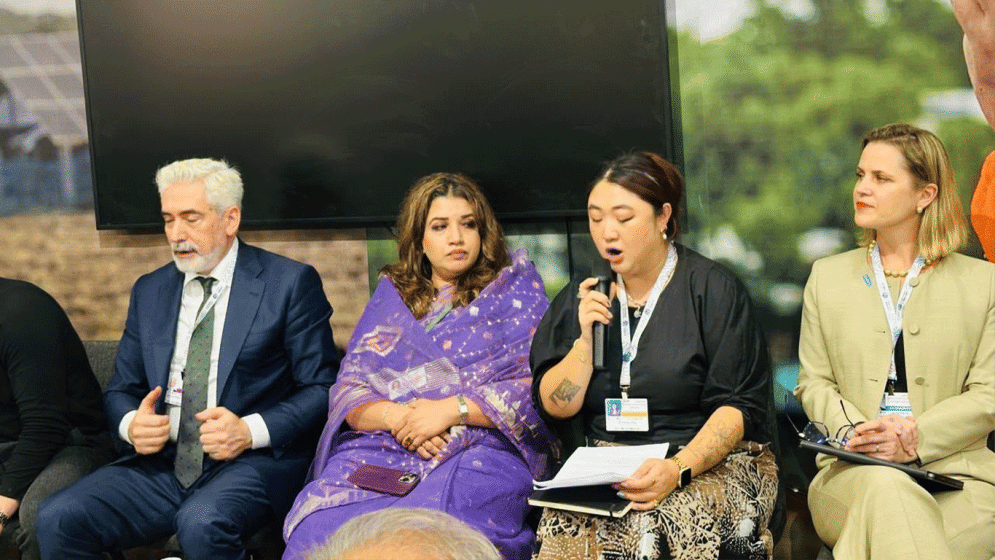
Photo: Courtesy
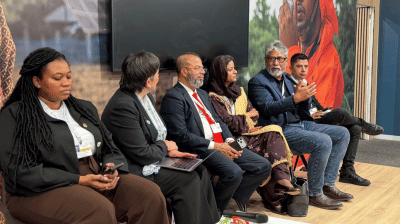
Bangladesh hosted a side event titled “Natural Fibres, Zero Waste and Frugal Adaptation: Jute as a Solution from Bangladesh for the COP31 Action Agenda” at the Bangladesh Pavilion in the Blue Zone of the UN Climate Change Conference (COP31) in Antalya, Türkiye on Friday.
State Minister for Foreign Affairs Shama Obaed Islam
chaired the session. The event was organised by the Ministry of Foreign
Affairs, the Ministry of Textiles and Jute and the Ministry of Agriculture, in
partnership with the Zero Waste Foundation of Türkiye, the United Nations
Office for Project Services (UNOPS) and the Global Center on Adaptation (GCA),
said a press release.
In her welcome address, the state minister thanked
the government and people of Türkiye and the COP31 Presidency for their
hospitality, and presented jute, Bangladesh’s golden fibre, as a renewable and
biodegradable solution that Bangladeshi farmers grow and the industry produces
at commercial scale.
“The materials we choose today will shape the planet
our children inherit tomorrow,” she said.
Commending Türkiye’s Zero Waste movement, she
described zero waste and natural fibres as two halves of the same promise. She
also shared Bangladesh’s frugal adaptation practices, including floating gardens,
early warning systems and saline-tolerant crops, noting that resilience need
not be costly.
Mehmet Galip Ensarioğlu, chairman of the Environment
Committee of the Grand National Assembly of Türkiye, said that climate policies
must be implemented in a balanced and realistic manner that takes the
development priorities of each country into account.
“Türkiye attaches great importance to its relations
with Bangladesh. Bangladesh’s expertise in jute is an outstanding example for
the entire sector,” he said.
Recalling that Türkiye’s Zero Waste project,
launched in 2017, marked an important starting point for adaptation and waste
management, he said that Bangladesh’s experience in jute offers valuable
lessons for a circular economy model.
Sara Austin Netzer, director, Asia Pacific Region,
UNOPS, said that UNOPS has been supporting Bangladesh in green and
climate-resilient construction and would strengthen its partnership with the government
in implementing Bangladesh’s third Nationally Determined Contribution (NDC
3.0).
“Bangladesh has the fibre, the skills and the
production capacity. Natural fibres connect local resources with farmers and
designers, and that is where lasting value is created,” she said.
She added that the International Jute Trade and Expo
in Dhaka would offer an opportunity to work together on nature-based solutions.
Sophia Yang, founder of Threading Change and a
global shaper of the World Economic Forum, called for a fair and equitable
future for fashion, noting that most clothing today is made from plastic-based
synthetic fibres.
“Replacing synthetics with natural fibres is
essential, and Bangladesh has the solution. Our generation wants the fibres of
the future,” she said.
Fitore Pacolli, minister of environment and spatial
planning of Kosovo, said that environmental choices have a direct bearing on
people’s everyday lives and that sustainable materials must become part of
daily consumption.
“Kosovo will welcome jute, and our renowned
designers are ready to create jute products,” she said, expressing interest in
working with Bangladesh.
Matthew McKinnon, founder and executive director of
Aroha, described the Jute Pavilion as “a real testament to what jute can do.”
He said that Bangladesh, while contributing almost nothing to global emissions,
remains one of the most climate-vulnerable countries in the world and continues
to carry a disproportionate burden.
“Jute can further scale up Bangladesh’s contribution
to global climate action,” he said.