



 For all latest news, follow the Daily Sun's Google News channel.


Bangladesh High Commission in Delhi observes National Revolution and Solidarity Day
Daily Sun Report, Dhaka
Published: 07 Nov 2026, 06:39 PM
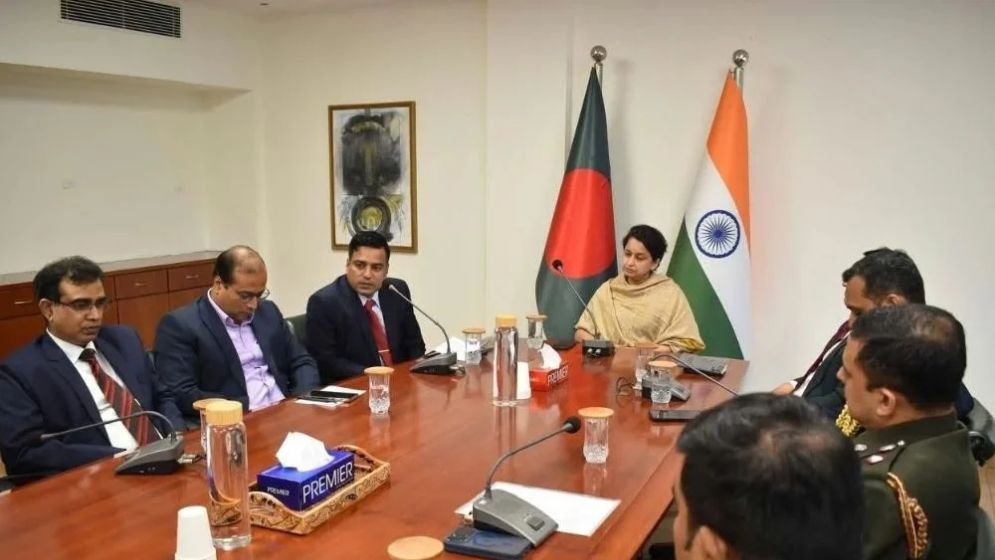
Photo: Courtesy
The Bangladesh High Commission in New Delhi observed National Revolution and Solidarity Day on Saturday, marking the historic 7 November occasion with a discussion meeting highlighting its political and diplomatic significance.
During
the discussion, Minister (Press) at the mission Saidur Rahman spoke about the
significance of the day, the political philosophy and foreign policy of Shaheed
President Ziaur Rahman, former prime minister Khaleda Zia's uncompromising
struggle for democracy, and the ‘Bangladesh First’ policy under the leadership
of Prime Minister Tarique Rahman.
The
discussion was chaired by Acting High Commissioner Preeti Rahman.
Commerce
Counsellor Iftekhar Uddin Shamim and Assistant Defence Adviser Lieutenant Colonel
Ruman Parvez read out the President's message. Other officials and employees of
the mission were also present. The meeting was moderated by Head of Chancery
(HOC) Mahmudul Haque.
Earlier,
the national flag was hoisted at the mission at 9:30am to mark the occasion.
In
his remarks, Saidur Rahman described 7 November as a highly significant day in Bangladesh's
political history.
He
said soldiers and civilians had jointly thwarted conspiracies against
Bangladesh on 7 November 1975. Chanting slogans demanding Ziaur Rahman's
release, they had taken to the streets and secured his freedom, he added.
He paid tribute to the soldiers and civilians who took part in the events, saying the day had marked the beginning of an important chapter in the country's political history and helped safeguard its independence and sovereignty.
As
a representative of the Bangladesh High Commission in New Delhi, he said, he
believed that 7 November was not only a reminder of the country's struggle to
protect its national history and sovereignty but also of how Bangladesh, under
Ziaur Rahman's leadership, established its position internationally through an
independent foreign policy.
He
claimed that Bangladesh secured full diplomatic recognition during Ziaur
Rahman's presidency and strengthened relations with the United States, China
and the Muslim world, alongside India and Russia. Several Muslim countries also
established embassies in Dhaka during that period, he added.
Saidur
Rahman further said Bangladesh was elected a non-permanent member of the United
Nations Security Council for the first time in 1978 under Ziaur Rahman's
leadership.
He
also highlighted Ziaur Rahman's initiative to promote regional cooperation,
peace, stability and economic development in South Asia through the
establishment of a regional organisation. The initiative eventually led to the
formal establishment of the South Asian Association for Regional Cooperation
(SAARC) in Dhaka on 8 December 1985.
Referring
to the current government's foreign policy, he said Prime Minister Tarique
Rahman was pursuing diplomatic initiatives based on the ‘Bangladesh First’
principle, drawing on the ideals of his parents.
He
said Bangladesh aimed to strengthen relations with all countries, including
India, on the basis of mutual respect, trust, equality and shared interests.
Describing
Bangladesh-India relations as historically, geographically, culturally and
economically significant, he expressed hope that ties between the two countries
would become deeper and more meaningful through mutual respect, trust and
cooperation.
He also called on diplomats to work sincerely from their respective positions to advance these objectives.