


 For all latest news, follow the Daily Sun's Google News channel.


China, Bangladesh will stand together, whatever happens: Liu Haixing
Bangladesh-China Centre for Party and State Governance Studies inaugurated
Daily Sun Report, Dhaka
Published: 04 Nov 2026, 11:13 PM
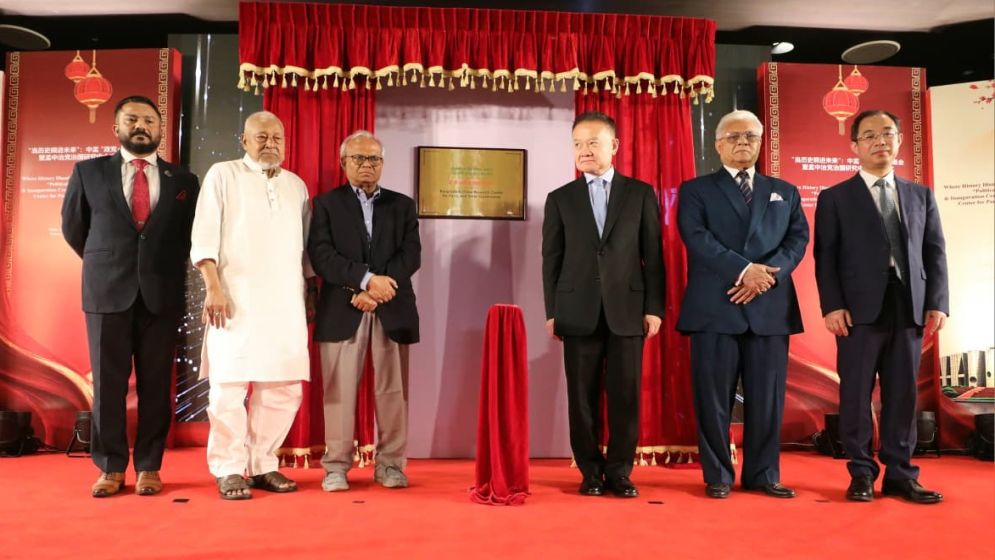
CPC Leader Liu Haixing is seen on stage with other participants of a high level seminar at a city hotel in Dhaka on Wednesday. Photo: Kamrul Islam Ratan
China and Bangladesh will continue to stand by each other regardless of changes in the international situation, Minister of the International Department of the Communist Party of China (CPC) Central Committee Liu Haixing said on Wednesday.
He stressed the importance of strengthening bilateral cooperation in trade, investment, development and political exchanges.
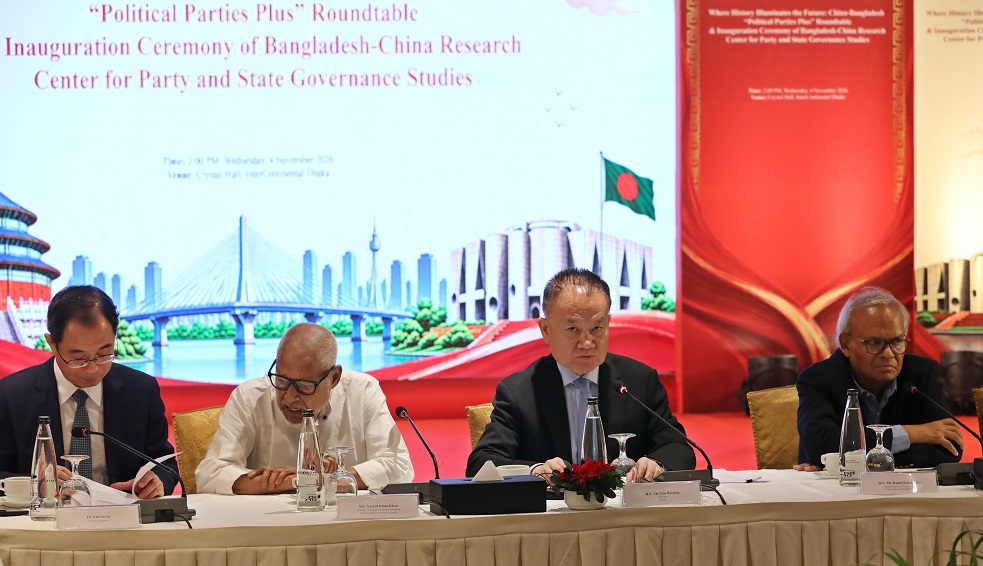
He made the remarks at a high-level seminar in Dhaka, organised by the Chinese Embassy, where the Bangladesh-China Centre for Party and State Governance Studies was formally inaugurated.
Titled “Where History Illuminates the Future: China-Bangladesh ‘Political Parties Plus’ Roundtable & Inauguration Ceremony of Bangladesh-China Centre for Party and State Governance Studies”, the event brought together senior leaders from major political parties, government representatives, diplomats, foreign policy experts and business leaders.
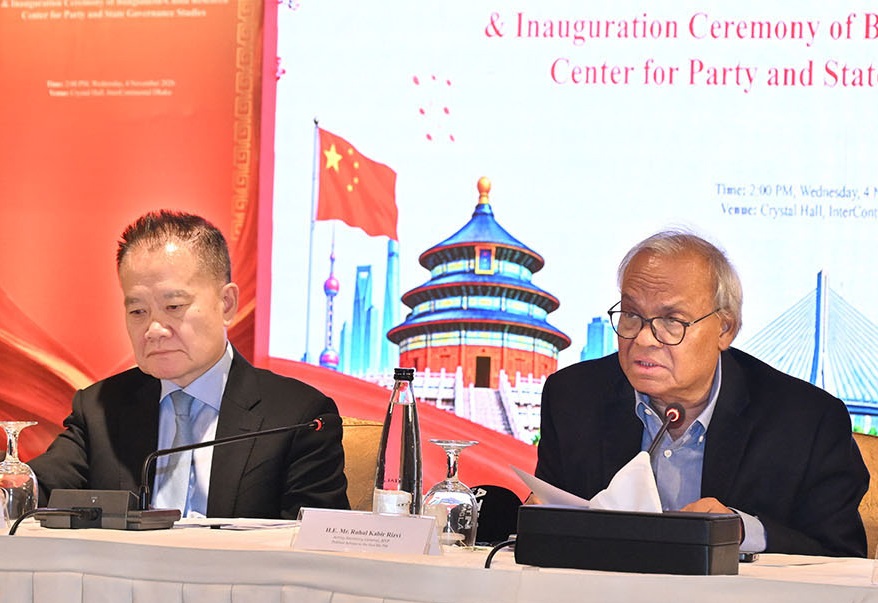
BNP Acting Secretary General Advocate Ruhul Kabir Rizvi, the chief guest, inaugurated the centre alongside other distinguished guests. Chinese Embassy Chargé d’Affaires Dr Liu Yuyin moderated the seminar.
Among those present were Prime Minister's Adviser and BNP Standing Committee Member Nazrul Islam Khan, BNP Vice Chairman Air Vice Marshal (retd) Altaf Hossain Chowdhury, State Minister for Foreign Affairs and BNP Organising Secretary Shama Obaed Islam, Jamaat-e-Islami Secretary General Mia Golam Porwar, and National Citizen Party (NCP) Convener and Opposition Chief Whip Nahid Islam.
Historical ties and mutual trust
Liu Haixing identified historical trust, mutual respect for sovereignty, expanding economic cooperation and cultural exchanges as the main pillars of Bangladesh-China relations.
He said both countries remained committed to safeguarding their sovereignty, security and national interests while pursuing mutually beneficial development.
Referring to the positive perception of China among Bangladeshis, Liu said surveys showed that 90 percent of people in Bangladesh held favourable views of China.
“This has been achieved through long-term efforts and should be carefully preserved by both countries,” he said.
Recalling the long history of bilateral relations, Liu said his father had served as China's ambassador to Bangladesh 46 years ago. He had often heard his father speak fondly of the hardworking and sincere people of Bangladesh.
The friendship between the two countries, he said, had transcended generations and taken deep root among their peoples.
Strategic partnership and shared future
Liu said Bangladesh-China relations were elevated to a strategic partnership of cooperation during Chinese President and Communist Party General Secretary Xi Jinping's visit to Bangladesh 10 years ago.
He also referred to a meeting between Xi and Prime Minister Tarique Rahman in China last June, during which the two sides announced their commitment to building a China-Bangladesh community with a shared future in the new era.
Expanding trade and infrastructure cooperation
Highlighting the growth of bilateral trade, Liu said the volume had increased from US$15 million to more than US$23 billion over the past five decades.
He noted that Bangladesh was the first country in South Asia to sign a memorandum of understanding with China on Belt and Road cooperation.
Referring to Chinese-backed infrastructure projects in Bangladesh, including roads, bridges and tunnels, Liu said progress was also being made on the Mongla Port Industrial Park and the Teesta River Comprehensive Management, Restoration and Reclamation Project.
He expressed hope that these initiatives would deliver greater benefits to the people of both countries.
Political exchanges and governance cooperation
Liu said China had begun implementing its 15th Five-Year Plan, while Bangladesh had entered a new phase of political transition, making exchanges of governance and development experiences between the two countries particularly important.
He said political parties in both countries had significant responsibilities in advancing development and cooperation.
China wanted to maintain friendly relations with all major political parties in Bangladesh, whether they were in government or opposition, Liu said, adding that Beijing did not consider a party's ideological position or political status when engaging with it.
He said the Bangladesh-China Centre for Party and State Governance Studies had been established to strengthen communication, facilitate experience-sharing and promote cooperation between political parties in the two countries.
China's development ambitions
Speaking about China's economic and development goals, Liu said the country's per capita GDP had reached around US$13,000, with plans to double it over the next decade.
China also aimed to increase its middle-income population from 400 million to 800 million and achieve its long-term goal of becoming a modern socialist nation by 2049, he said.
BNP hopes Chinese investment will create 100,000 jobs in Bangladesh
BNP Acting Secretary General Advocate Ruhul Kabir Rizvi has said Bangladesh offers significant investment opportunities in manufacturing, infrastructure, energy, information technology, agro-processing, pharmaceuticals and textiles.
He expressed hope that around 30 Chinese companies would invest in the proposed China Economic and Industrial Zone, creating opportunities for economic growth and employment.
“Bangladesh offers significant investment opportunities, particularly in manufacturing, infrastructure, energy, information technology, agro-processing, pharmaceuticals and textiles. We hope around 30 Chinese companies will invest in the proposed China Economic and Industrial Zone,” Rizvi said.
He described China as one of Bangladesh's most important partners in investment, development and infrastructure cooperation, noting that it was the country's largest trading partner and second-largest development partner.
Chinese assistance, he said, had played an important role in developing roads, bridges, power generation, transport and communication infrastructure.
Rizvi said bilateral trade reached $12.8 billion in the first six months of 2026. To make trade relations more balanced and sustainable, Bangladesh needed greater access to the Chinese market, diversified exports and stronger engagement between the private sectors of the two countries.
He said China's experience in economic transformation, poverty alleviation, industrialisation and infrastructure development offered valuable lessons for Bangladesh.
Rizvi said the BNP was committed to building a prosperous, modern and inclusive Bangladesh and wanted to expand cooperation with China in infrastructure development, industrial modernisation, renewable energy, digital transformation, agriculture, water management and human resource development.
Future cooperation, he added, should be based on mutual interests, transparency, sustainable development and tangible benefits for the people of Bangladesh.
BNP reaffirms support for One-China policy
Rizvi reaffirmed the BNP's strong support for Bangladesh's One-China policy, saying there was only one China in the world.
He said the BNP and the Communist Party of China had maintained longstanding friendly relations, with former President Ziaur Rahman's visits to China in 1977 and 1980 laying the foundation for closer ties between the two countries and the two parties.
Referring to recent exchanges, Rizvi said a 21-member BNP delegation led by the party's then secretary general visited China in April 2026, while senior BNP leaders also travelled there in June 2025.
He also referred to a memorandum of understanding signed between the BNP and the CPC in June this year, saying regular reciprocal visits and communication were essential to implementing the agreement.
Regular dialogue, he said, would strengthen political trust and mutual understanding and make bilateral relations more dynamic.
Rizvi proposes technical university with Chinese support
Rizvi sought China's cooperation in education and human resource development, noting that China was becoming an important destination for Bangladeshi students pursuing higher education, particularly in medical studies.
He suggested that China consider establishing a technical university in Bangladesh to harness the potential of the country's young population.
On foreign policy, Rizvi said a BNP government would pursue an independent, balanced and forward-looking approach, prioritising national interests.
The party wanted to maintain friendly and mutually beneficial relations with all countries under its “Bangladesh First” policy, he said.
Referring to Prime Minister Tarique Rahman's visit to China from 22 to 26 June, Rizvi said the prime minister had held meetings with Chinese President Xi Jinping, Premier Li Qiang and Zhao Leji, chairman of the Standing Committee of the National People's Congress.
The meetings discussed ways to strengthen cooperation in trade, investment, infrastructure, connectivity, technology and development, he added.
Rizvi said political parties could play an important role in advancing Bangladesh-China relations through regular communication, institutional dialogue, youth and research exchanges, and sharing experiences in development and governance.
Jamaat seeks closer ties with CPC
Jamaat-e-Islami Secretary General Mia Golam Porwar called for stronger party-to-party relations between Bangladesh Jamaat-e-Islami and the Communist Party of China, proposing regular exchanges, youth engagement and cooperation in governance and development.
He said political changes in Bangladesh should not affect longstanding relations between political parties and the peoples of the two countries.
“Government changes, but the ties between parties and people remain. That is why party-to-party exchanges are an important part of the friendship between our two countries,” Porwar said.
NCP proposes greater Chinese investment and education cooperation
NCP Convener and Opposition Chief Whip Nahid Islam called for increased Chinese investment in Bangladesh and wider cooperation in education, skills development and technology.
He proposed expanding educational collaboration through scholarships, joint degree programmes and teacher exchange initiatives.
“Let us cooperate in scholarships, joint degrees and teacher exchanges, as well as technical and vocational training, robotics and digital skills,” he said.
BCCCI calls for greater investment and market access
Bangladesh China Chamber of Commerce and Industry (BCCCI) President Mohammad Khorshed Alam called for increased Chinese investment in Bangladesh, improved access for Bangladeshi products to the Chinese market and stronger business cooperation.
Describing China as a trusted business partner and longstanding friend, he said there were significant opportunities to expand economic cooperation.
Alam stressed the need to increase Bangladeshi exports to China, particularly textiles, pharmaceutical products and agricultural goods.
Prof Imtiaz identifies six areas for cooperation
International relations expert Prof Imtiaz Ahmed identified six priority areas for stronger Bangladesh-China cooperation: energy security, education, healthcare, infrastructure, digital sovereignty and resolving the Rohingya crisis.
Referring to three surveys conducted by the Centre for Alternatives in 2022, 2023 and 2024 on China's national image in Bangladesh, Imtiaz said nearly 74 percent of the population had a positive perception of China, while only 2 percent held a negative view.
He said favourable perceptions of China had increased consistently over the three years.
Explaining the reasons behind China's positive image, Imtiaz identified historical civilisational connections and Beijing's policy of non-interference in the internal affairs of other countries as two major factors.