


 For all latest news, follow the Daily Sun's Google News channel.


Tarique, Takaichi pledge deeper Bangladesh-japan ties
Daily Sun Report, Dhaka
Published: 28 Oct 2026, 12:00 AM
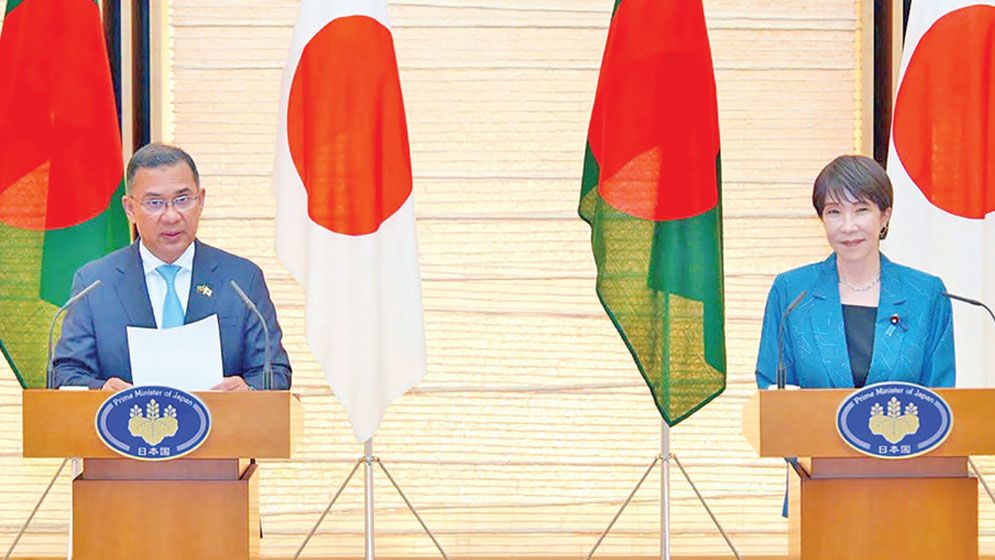
Prime Minister Tarique Rahman speaks during a joint press conference with his Japanese counterpart, Sanae Takaichi, in Tokyo on Tuesday. -PID Photo
Prime Minister Tarique Rahman and his Japanese counterpart Sanae Takaichi have pledged to deepen Dhaka-Tokyo ties, with the two countries agreeing to expand strategic cooperation and advance a proposed 1 trillion-yen, or about US$6.3 billion, Japanese private investment in Bangladesh’s energy, infrastructure and ICT sectors.
At their summit at the Japanese Prime Minister’s Office, or Kantei, in Tokyo on Tuesday, the two leaders also agreed to transform Japan’s flagship economic cooperation  initiative in Bangladesh, the Bay of Bengal Industrial Growth Belt (BIG-B), into “BIG-B for Shared Prosperity”.
The upgraded framework will focus on infrastructure, connectivity, investment and industrial development, with Matarbari Deep-Sea Port at its centre. The aim is to strengthen supply chains and position Bangladesh as a regional logistics and industrial hub linking South and Southeast Asia.
The two sides also signed five cooperation documents covering economic relations, agriculture, fisheries and livestock, and environmental protection, while discussions ranged across energy security, technology, maritime security, disaster resilience and regional issues, including the Rohingya crisis.
$6.3b investment plan
Tarique called for greater Japanese government and private-sector participation in Bangladesh’s economic development, industrialisation and technological advancement.
The two leaders discussed the proposed 1 trillion-yen investment, while a Japanese team is expected to visit Bangladesh soon to accelerate the plan, according to Prime Minister’s Deputy Press Secretary Shahadat Shadhin.
Tarique said Bangladesh could become the world’s ninth-largest consumer economy by 2030, with GDP potentially exceeding US$1 trillion by 2034.
Highlighting energy security, he invited Japanese investment in liquefied natural gas infrastructure, efficient power generation and renewable energy.
He also referred to Japan’s recent 50-billion-yen emergency assistance loan under the Partnership for Power Asia initiative and sought expanded cooperation.
BIG-B to drive connectivity
The proposed “BIG-B for Shared Prosperity” framework will build on three pillars: economic infrastructure, a better investment environment and stronger connectivity.
At its centre will be integrated infrastructure around Matarbari Deep-Sea Port, linking power and energy facilities, airports, roads, railways, inland waterways and special economic zones.
The objective is to strengthen supply chains and position Bangladesh as a regional logistics and industrial hub connecting South and Southeast Asia.
The framework will also focus on human resource development, public-private partnerships and transparent, predictable investment rules.
Both sides will expand trade and investment under the Bangladesh-Japan Economic Partnership Agreement (EPA), signed in February 2026, while improving market access, diversifying exports and upgrading industries.
Priority sectors include manufacturing, logistics, food and agriculture, ICT and pharmaceuticals.
Five cooperation documents signed
The five documents cover economic relations and the business environment, agriculture, fisheries and livestock, and environmental protection.
A memorandum of cooperation was signed between Japan’s Ministry of Economy, Trade and Industry and Bangladesh’s Economic Relations Division.
Separate memoranda were signed between Japan’s Ministry of Agriculture, Forestry and Fisheries and Bangladesh’s ministries responsible for agriculture and fisheries and livestock.
The two sides also signed a memorandum on environmental cooperation between Japan’s Ministry of the Environment and Bangladesh’s Ministry of Environment, Forest and Climate Change, along with a letter of intent between Japan’s Global Environment Bureau and Bangladesh’s Department of Environment.
Tech park, high-speed rail on agenda
Tarique proposed a Bangladesh-Japan Tech Park to connect Japanese companies, universities and investors with Bangladesh’s young workforce, entrepreneurs and technology professionals.
He suggested focusing on artificial intelligence, cloud computing, robotics and electronics manufacturing, while seeking greater cooperation in space science and satellite engineering.
On transport, he outlined plans for a high-speed rail network linking six major divisional cities and elevated roads across the country, seeking Japanese technical assistance, investment and financing.
Tarique said his government would reform regulations, tax policies, customs clearance and fund-transfer procedures to improve the investment climate.
He also proposed a joint ministerial commission to identify priorities and speed up bilateral initiatives.
Maritime security, climate cooperation
The upgraded partnership will extend to maritime security, disaster preparedness, climate resilience and cybersecurity.
Japan will support Bangladesh’s capacity in maritime domain awareness, coastal patrols and port security. The two sides will also pursue patrol-boat cooperation under Japan’s first Official Security Assistance (OSA) project, explore a second OSA project and consider providing patrol vessels through official development assistance.
They will explore energy infrastructure development in Matarbari under Japan’s “POWERR Asia” framework and strengthen emergency response and disaster-prevention infrastructure.
Takaichi backs democratic transition
Takaichi congratulated Tarique on assuming office and described Bangladesh as a friend sharing Japan’s values of democracy and the rule of law.
In a post on her official X account after the summit, she pledged strong support for the Rahman administration’s nation-building efforts following the democratic general elections.
She highlighted Bangladesh’s strategic location between South and Southeast Asia and its importance to Japan’s vision of a Free and Open Indo-Pacific.
Tarique recalled Japan’s early recognition of Bangladesh’s independence in 1971 and its longstanding development support. He invited Takaichi to visit Bangladesh.
Rohingya solution lies in Myanmar
The Rohingya crisis featured prominently in the talks, with Tarique stressing that a lasting solution must be found in Myanmar.
He called for the voluntary, safe, swift and dignified return of forcibly displaced Rohingyas to their homeland and urged an end to violence, unhindered humanitarian assistance and dialogue among the parties concerned.
He also called on Japan to remain actively engaged in efforts to promote peace and stability in Myanmar’s Rakhine State.
Tarique thanked Japan for supporting Bangladesh’s humanitarian efforts for Rohingyas displaced from Rakhine.
The two leaders reaffirmed their commitment to multilateralism, international law and regional stability. Tarique also thanked Japan for supporting Foreign Minister Dr Khalilur Rahman’s election as president of the 81st session of the United Nations General Assembly.
Later on Tuesday, Tarique visited JERA’s onshore liquefied natural gas terminal and power plant in Futtsu, Chiba Prefecture, and the Nittsu Logistics Hub in Ichikawa.
PM’s busy schedule today
On the third day of his visit, Tarique is scheduled to meet Kazuhiko Amakawa, governor of the Japan Bank for International Cooperation (JBIC), and visit the headquarters of Japanese apparel retailer Uniqlo.
He will also meet Susumu Kataoka, president of the Japan External Trade Organization (JETRO), and attend a luncheon hosted by him.
Separate meetings are scheduled with representatives of Mitsui & Co, Sumitomo Corporation and JERA, along with two group meetings involving representatives of 14 other Japanese companies.
The discussions are expected to focus on increasing Japanese investment, establishing factories, creating jobs, promoting industrialisation, facilitating technology transfer and developing human resources.
In the afternoon, Tarique will deliver the keynote address at the Bangladesh-Japan Economic Forum at the JETRO building in Tokyo, focusing on business contacts, trade and new investment opportunities.
In the evening, he will attend an event at the Bangladesh Embassy with signatories to memoranda of understanding on education and human resource development, followed by a community event with expatriate Bangladeshis at Hotel New Otani.
He is scheduled to begin his return journey to Bangladesh tomorrow at 10:35pm Tokyo time.