


 For all latest news, follow the Daily Sun's Google News channel.


Bangladesh highlights midwifery, primary healthcare at UNGA
Daily Sun Report, Dhaka
Published: 25 Sep 2026, 07:18 PM
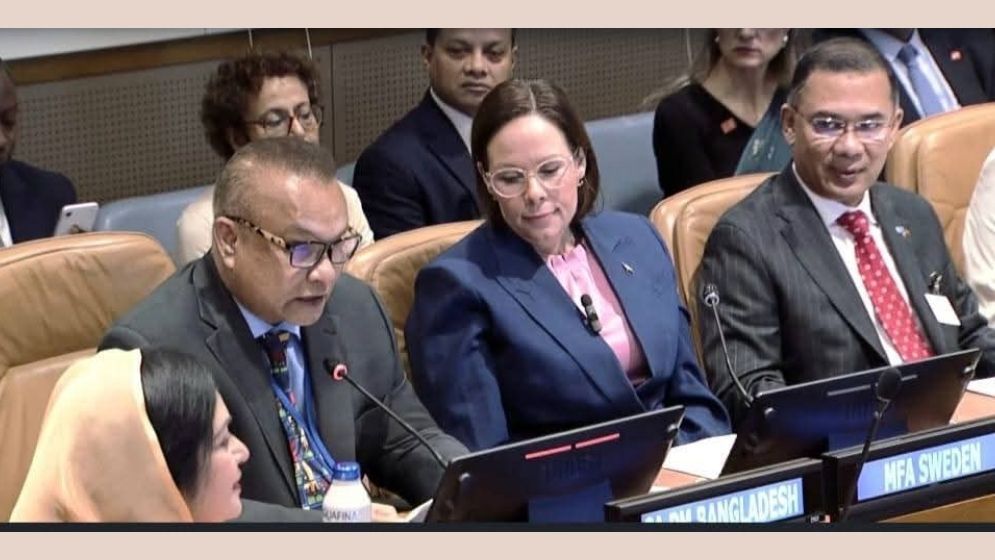
Photo: Courtesy
Bangladesh highlighted its plans to strengthen primary healthcare and expand professional midwifery at a high-level side event of the 81st session of the United Nations General Assembly in New York on Thursday.
The
event, titled “From Commitment to Action: Integrating Midwifery into Primary
Health Care to End Preventable Maternal and Newborn Deaths”, was co-hosted by
Bangladesh and Sweden in partnership with the United Nations Population Fund
(UNFPA) at the UN Headquarters, said a press release.
The discussions focused on integrating professionally trained midwives into primary healthcare systems to expand access to maternal and newborn care and help reduce preventable deaths.
Dr
SM Ziauddin Hyder, Special Assistant to the Prime Minister on Health Affairs,
presented Bangladesh’s approach to strengthening primary healthcare through the
integration and expansion of professional midwifery.
Bangladesh
has committed to creating and deploying 25,000 midwife positions across its
public health system by 2030. The initiative includes strengthening education
and training, deployment, referral systems and digital health services.
The
government’s approach seeks to position professional midwives as members of
primary healthcare teams providing continuous care from pregnancy through
childbirth and the postnatal period, with referrals to higher-level facilities
when complications arise.
Dr Hyder has described the investment in midwives as an investment extending well beyond the health sector:
“When a nation invests in midwives, it invests in healthier pregnancies, safer births, stronger families and more productive societies,” he said.
The initiative forms part of Bangladesh's broader ambition to develop a prevention-centred Primary Health Care system that brings quality services closer to communities and reduces unnecessary dependence on hospital-based care.
The
event also featured a ministerial panel titled “A New Era of Health Workforce
Scaling”, moderated by Dr Hyder.
Representatives
from Nepal, Slovenia, Thailand and Mexico shared experiences on health
workforce planning, financing, education, regulation, deployment and retention.
Other speakers included Kemi Williams, Head of the Women and Girls Department at the United Kingdom’s Foreign, Commonwealth & Development Office; Dr Ariani Dewi Widodo, Director of Human Resources, Education and Research at Harapan Kita Women and Children Hospital in Indonesia; and Karoline Myklebust Linde, Chief Executive Officer of Laerdal Global Health.
UNFPA
said the event highlighted the role of midwives in strengthening primary
healthcare and expanding access to quality sexual and reproductive, maternal,
newborn and adolescent health services. It said professionally trained midwives
can provide up to 90% of essential services in these areas.
UNFPA
has described Bangladesh’s commitment to deploy 25,000 midwives by 2030 as a
major investment in the country’s health workforce. The organisation said the
global health system is facing a shortage of about one million midwives.
The
side event was part of Bangladesh’s wider focus on strengthening primary
healthcare, with an emphasis on prevention, community-based services and
maternal and newborn health.
By bringing
together political leaders, ministers, UN agencies, bilateral partners, health
professionals and private-sector innovators at the United Nations, the event
demonstrated Bangladesh's intention not only to transform its own health system
but also to contribute its experience to the global movement for stronger,
prevention-oriented Primary Health Care.
Under the
leadership of Prime Minister Tarique Rahman, Bangladesh is seeking to translate
its “Healthy Bangladesh” vision into concrete investments in people,
institutions, digital systems and frontline services—with professional midwives
positioned as a critical bridge between women, families, communities and the
wider health system.
The message
emerging from New York was clear: political commitment must now become
implementation; investment must reach the frontline; and every woman and every
newborn, regardless of where they live, should have access to safe, dignified
and high-quality care.