


 For all latest news, follow the Daily Sun's Google News channel.


China seeks to take ties with Bangladesh to new heights: Mahdi Amin
Daily Sun Report, Dhaka
Published: 26 Jun 2026, 01:25 AM

Photo: Courtesy
Chinese Premier Li Qiang has expressed keen interest in elevating bilateral relations with the Bangladesh government led by Prime Minister Tarique Rahman to a new height, according to the Prime Minister’s Office (PMO).
"We believe this visit has taken the 50-year relationship between Bangladesh and China to a new level," PMO spokesperson Mahdi Amin said at an emergency press conference at the Diaoyutai Hotel in central Beijing at 8pm local time (6pm Bangladesh time) on Thursday.
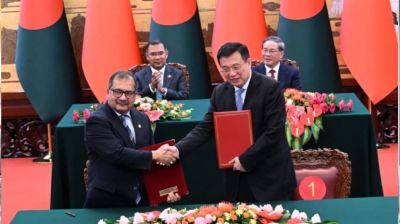
A total of 13 memorandums of understanding (MoUs) were signed between Bangladesh and China in various areas of cooperation in the presence of Prime Minister Tarique Rahman and his Chinese counterpart Li Qiang at the Great Hall of the People in Beijing.
The MoUs were signed following a bilateral meeting between the two leaders.
Referring to the bilateral talks between Tarique Rahman and Li Qiang, Mahdi Amin said they discussed various areas of development cooperation, including concessional loans.
Discussions also focused on ways to reduce interest rates on Chinese loans to Bangladesh and extend their grace periods, he said.
Mahdi Amin, also the prime minister’s adviser, said the discussions also centred on increasing Chinese investment in Bangladesh through economic zones by establishing new Chinese factories and production facilities, which would generate employment opportunities.
Highlighting China's significant contribution to Bangladesh's infrastructure development, he said both sides discussed how China could further support the construction of roads, bridges, tunnels, and ports.
Regarding the Teesta project, Mahdi Amin said Bangladesh has a comprehensive master plan prepared in line with the BNP's election manifesto.
"Based on that master plan, China has expressed its interest in providing technical support from the planning stage onward wherever necessary. Using its expertise, China is willing to assist in defining and planning the project."
He noted that both countries consider a joint feasibility study essential for such a large-scale project, and China has expressed its willingness to work with Bangladesh on it.
He said there is also potential for cooperation in integrated water resources management and drainage systems. Both governments have shown a positive attitude towards these initiatives.
Mahdi Amin said that although China is Bangladesh's biggest trading partner, Bangladesh's exports to China remain significantly lower than its imports.
He added the two sides therefore discussed ways to increase Bangladesh's exports to China, diversify export products and make better use of China's existing duty-free import facilities.
The PMO spokesperson announced that Bangladesh's national fruit, jackfruit, has now secured commercial export access to the Chinese market.
He added that there is also scope for diversifying exports of fruits, vegetables and fishery products. At the same time, sectors such as pharmaceuticals, ceramics, and information technology present opportunities for both Chinese investment and increased Bangladeshi exports to China.
To achieve these objectives, the two countries discussed preparing a joint action plan aimed at creating a mutually beneficial, win-win framework through stronger diplomatic engagement and improved institutional arrangements, he said.
Mahdi Amin further said China is keen to increase investment in Bangladesh. Chinese state-owned enterprises and private companies are interested in investing in the digital economy, information technology, agriculture, infrastructure, logistics, and other production-oriented industries.
He said some Chinese banks are also interested in launching operations in Bangladesh in the coming years.
"As Bangladesh continues to reform and modernise its financial system, China believes there is significant potential for investment and business operations in Bangladesh's banking sector."
He added that several Chinese companies already operating in other countries are planning to establish offices in Bangladesh as well, a move that has received strong support from the Chinese premier.
He said both prime ministers also emphasised strengthening people-to-people connectivity.
In the education sector, Mahdi Amin said, Bangladesh plans to introduce Mandarin as a third language, where China has offered extensive cooperation. China has also expressed interest in supporting Bangladesh's technical and vocational education.
Referring to the healthcare sector, he said China is already involved in hospital projects in Bangladesh, and discussions were held on expanding Chinese investment in healthcare.
He said the Chinese premier also expressed interest in simplifying visa procedures for Bangladeshis seeking medical treatment in China so that they can access better healthcare services.
Mahdi Amin said the two governments also discussed making it easier for Bangladeshi students to obtain Chinese visas and increasing scholarship opportunities.
Discussions also covered strengthening Bangladesh's disaster management capacity.
He also said Bangladesh's engagement with BRICS came up during the discussions, with China expressing its support for Bangladesh's involvement in the organisation.
On the Rohingya issue, he said China is willing to play a constructive role in facilitating dialogue with Myanmar, particularly to support the repatriation of the displaced Rohingyas.
Mahdi Amin said that China believes Bangladesh, under its democratically elected government, will continue its economic and development journey.
"China wants to serve as a strategic partner of Bangladesh, and both countries' people will benefit from this partnership. As a strategic partner, China is eager to work closely with the democratic government of Bangladesh under the leadership of Prime Minister Tarique Rahman in the years ahead," he said.