


 For all latest news, follow the Daily Sun's Google News channel.


Bangladesh Embassy in Nepal observes International Mother Language Day
A video message from the president of the UNESCO General Conference was also screened
Daily Sun Report, Dhaka
Published: 22 Feb 2026, 09:00 PM
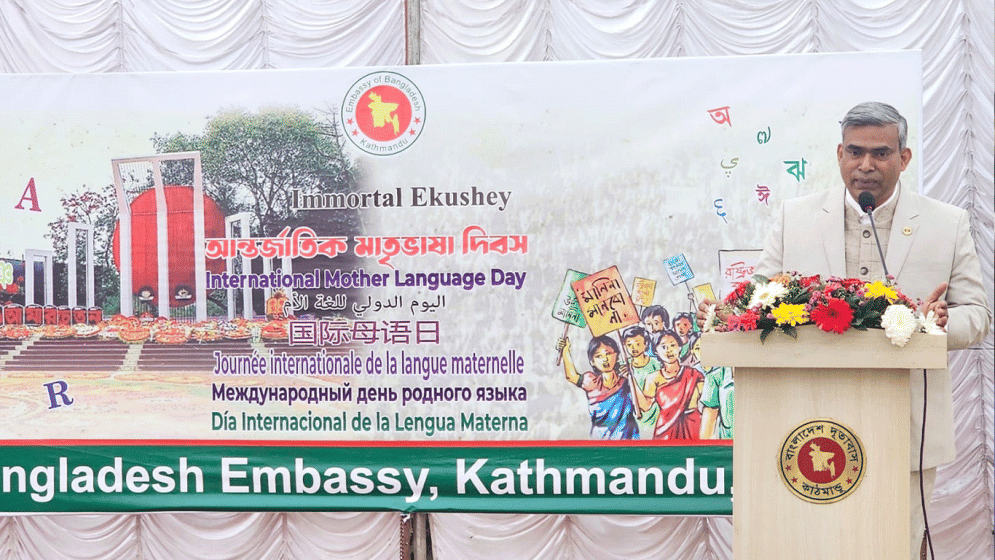
Photo: Daily Sun
The Embassy of Bangladesh in Nepal observed Great Martyrs’ Day and International Mother Language Day 2026 in Kathmandu with due solemnity and fervour.
The observance featured a two-day programme held at
the Embassy premises, comprising a discussion session and a cultural programme
reflecting the linguistic diversity and cultural heritage of different parts of
the world.
The event was graced by heads of mission and
diplomats from various embassies and international organisations based in
Kathmandu, representatives of the SAARC Secretariat, officials of ICIMOD,
linguists, academicians, officials of Biman Bangladesh Airlines, members of the
Bangladesh Club, the Nepal–Bangladesh Friendship Association, the Nepal Chamber
of Commerce, Nepali businesspersons, and members of the Bangladeshi community
in Nepal.
As part of the programme, members of the diplomatic
corps in Nepal laid floral wreaths at the Shaheed Minar located at the Embassy
premises. Messages from the president, prime minister, foreign minister and
state minister for foreign affairs of Bangladesh, issued on the occasion, were
read out by Embassy officials.
A video message from the president of the UNESCO
General Conference was also screened.
In his welcome remarks, the ambassador of Bangladesh
to Nepal Shafiqur Rahman paid deep homage to the language martyrs for upholding
the sanctity of Bangla in 1952.
He underscored the importance of preserving and
promoting mother tongues and highlighted the necessity of multilingual, mother-tongue-based
education as the foundation of a quality education system contributing to
overall development.
Describing language as a powerful and unifying force
that connects people, he emphasised unity in diversity among communities and
networks.
He lauded this year’s theme of the day, “Youth
voices on multilingual education,” and stressed the vital role of young people
in revitalising languages and harnessing technology to promote linguistic
diversity.
The ambassador reiterated Bangladesh’s commitment to
working with Nepal and the international community to advance the ideals of
linguistic diversity, cultural preservation, and inclusive development.
The head of office of UNESCO in Nepal delivered
remarks as special guest. Heads of Mission from Finland, Sri Lanka, Malaysia
and Russia, along with the deputy representative of UNICEF, delivered remarks
in their respective mother tongues—Finnish, Sinhala, Malay, Russian and Korean.
In addition, the UN resident representative in Nepal
and the acting chairperson of the Language Commission of Nepal addressed the
gathering.
All speakers highlighted Bangladesh’s leadership in
promoting the observance of International Mother Language Day worldwide and
emphasised the importance of mother-tongue-based multilingual education for
sustained learning and development, particularly the role of the younger
generation.
The discussion session was followed by a vibrant
multicultural cultural programme featuring musical performances in Nepali,
Newari and Tamang, alongside Bangla songs.
The cultural segment also included a traditional
Tharu dance of Nepal.
The programme was organised in collaboration with a
local school in Kathmandu, with additional performances by singers from the Bangladeshi
community in Nepal.
The event concluded with a dinner featuring
Bangladeshi cuisine.
The observance began on 21 February with the
national flag flown at half-mast. A probhat feri was organised, during which
floral wreaths were laid at the Shaheed Minar established at the Embassy premises.
The first day’s programme concluded with special
prayers offered in remembrance of the language martyrs.