



 For all latest news, follow the Daily Sun's Google News channel.


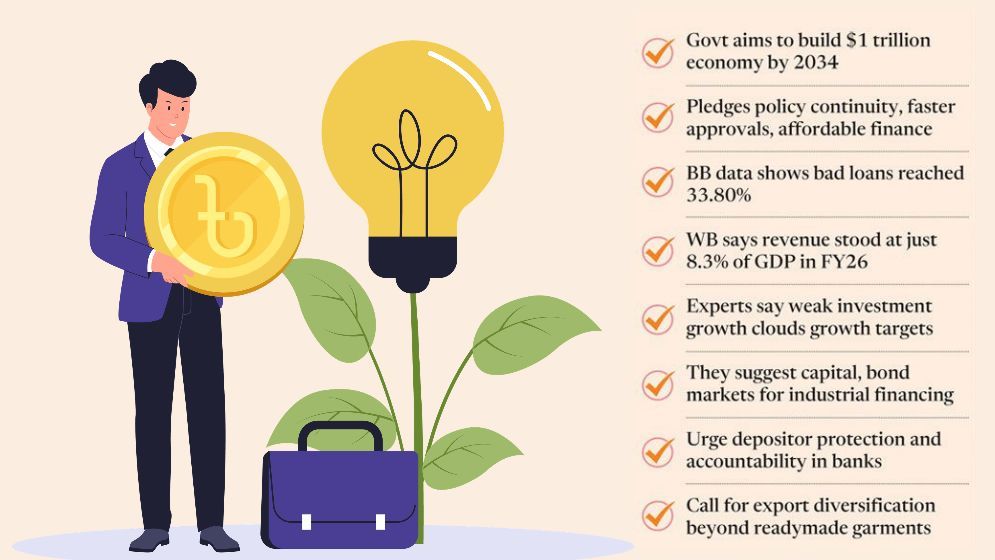
Bangladesh must revive private investment and tackle deep weaknesses in banking, revenue and energy to meet its target of becoming a $1 trillion economy by 2034, economists say.
The government is targeting GDP growth of 6.5% in the ongoing 2026-27 fiscal year (FY27), rising to 7.5% in FY29. The World Bank, however, has projected growth of just 3.4% for the current fiscal year.
The government’s Medium-Term Macroeconomic Policy Statement expects private investment to edge up from 21.33% of GDP in FY27 to 21.65% in FY29.
Zahid Hussain, former lead economist at the World Bank’s Dhaka office, said meeting the growth targets would require a strong recovery in investment, industrial production and exports. Expecting the economy to regain momentum with only a marginal rise in private investment was ambitious, he said.
Prime Minister’s Adviser on Finance and Planning Dr Rashed Al Mahmud Titumir told Daily Sun that investors needed predictability, access to finance, energy security, deregulation and seamless connectivity.
“First, we are ensuring policy continuity. Under the budget framework, we are providing greater predictability in tax rates so investors can plan over several years,” he said.
“Second, we are reducing bureaucratic delays. A committee has been formed to bring different stages of the approval process within specific time limits, while investors will be able to track their applications.”
“Third, financing is being made available, including through refinancing schemes, so businesses can access credit at more affordable rates.”
The Bangladesh Investment Development Authority has also introduced a One-Stop Service and the BanglaBiz platform to simplify approvals. The government aims to raise foreign direct investment (FDI) from 0.45% to 2.7% of GDP.
Professor Abu Ahmed, chairman of the Investment Corporation of Bangladesh, called for wider use of capital and bond markets to finance industry.
“Opportunities to raise capital through stock and bond markets should be expanded rather than relying solely on bank loans for long-term industrial investment,” he told Daily Sun, adding, “This could ease pressure on the banking system while increasing long-term financing for productive sectors.”
Attracting FDI also required policy consistency, clear rules for profit repatriation, faster government services and reliable infrastructure, he said. On energy, the government is pursuing plans to secure uninterrupted electricity and gas supplies to industrial zones, develop infrastructure and strengthen governance in the sector. It is also promoting solar power, including rooftop installations on factories and public buildings, to reduce reliance on imported fossil fuels.
Bad loans weigh on lending
The banking sector presents another major hurdle. The non-performing loan (NPL) ratio rose to 33.80% in September 2026 from 30.6% in December 2025, according to Bangladesh Bank data.
High volumes of bad loans, capital shortfalls and weak governance are undermining lending capacity and investor confidence.
Experts have called for asset quality reviews, full disclosure of bad loans, recovery from defaulters and accountability for irregularities.
Zahid Hussain said restructuring weak banks must prioritise depositor protection and management accountability while reducing political interference. Lending to creditworthy borrowers must also continue so that reforms do not further restrict industrial financing, he added.
The World Bank has said a return to growth led by private investment would be difficult without swift reforms in banking, domestic revenue mobilisation and energy.
Revenue constraint
Revenue collection stood at only 8.3% of GDP in FY26, according to the World Bank, limiting the resources available for infrastructure, education, health, skills development and social protection.
Titumir said the government’s strategy was not simply to raise tax rates.
“We want to expand the tax base, reduce harassment and prevent tax evasion, fraud and avoidance,” he said, adding that the income tax, VAT and customs systems were being digitised and tax rates rationalised.
Zahid Hussain warned that revenue shortfalls could force the government to borrow more from domestic and foreign sources. Excessive borrowing from local banks could reduce credit to the private sector, he said.
Greater dependence on foreign lenders and development partners might not deliver timely benefits because of slow project implementation and administrative bottlenecks, he added. He called for stronger accountability in project selection, procurement, spending and implementation.
Export base remains narrow
Heavy reliance on readymade garments also leaves the economy exposed to external shocks. Economists have urged greater investment in pharmaceuticals, leather goods, agro-processing, light engineering, electronics and technology-based services.
They also stress the need for new markets, better product quality, compliance with international standards, research, technology transfer, skilled workers and long-term financing. Linking small and medium enterprises (SMEs) with larger production and export networks could expand markets and create jobs.
Russel Hossain, an SME entrepreneur in the Manipuri weaving industry, said small businesses needed easier access to affordable loans to expand, improve productivity and create employment.
He also called for better market access and targeted support for small, women-led and technology-driven enterprises. Education and vocational training should match industry requirements, he said, while wider employment for women and young people required safe workplaces, equal opportunities and adequate childcare.