



 For all latest news, follow the Daily Sun's Google News channel.


Govt’s LNG subsidies reach Tk34,000cr in six months: Experts
Experts urge renewable energy expansion, caution against new LNG terminals
Daily Sun Report, Dhaka
Published: 28 Nov 2026, 06:09 PM
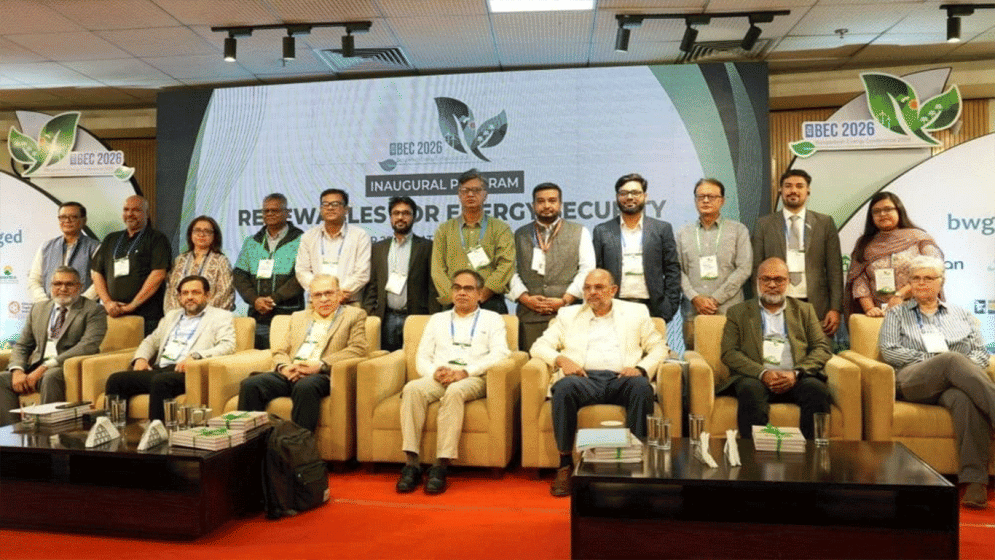
Photo: Daily Sun
The government has spent Tk34,000 crore in subsidies for liquefied natural gas (LNG) imports in just six months, from March to September 2026, highlighting the growing financial burden of the country's dependence on imported fossil fuels.
Against this backdrop, energy experts have urged the
government to prioritise renewable energy expansion instead of investing in new
LNG terminals, warning that continued reliance on imported fuels could put
further pressure on public finances and undermine long-term energy security.
The recommendations came at the inaugural session of
the three-day 4th Bangladesh Energy Conference, which began at the Bangladesh
Military Museum in Dhaka on Saturday.
Held under the theme “Renewables for Energy Security”,
the conference will continue until 30 November.
Speaking as the chief guest, Professor Dr Rashed Al
Mahmud Titumir, prime minister's adviser on finance and planning, said
increasing electricity generation alone would not resolve the country's energy
crisis. Efficiency must be improved across every stage of the energy system,
including generation, transmission and distribution.
He said LNG import subsidies were placing a
substantial financial burden on the state, making it essential to reduce import
dependence and strengthen domestic renewable energy capacity.
The government aims to increase the share of
renewable energy in electricity generation to 20% by 2030 and 30% by 2040, he
said.
To support this transition, the government has
allocated Tk1,500 crore to facilitate solar installations through loans at 6%
interest, repayable over 12 years. Rural households can access the financing,
while rooftop solar installations on public and commercial buildings and solar
development on suitable agricultural land also offer significant opportunities,
he added.
In his welcome address, Hasan Mehedi, member
secretary of the Bangladesh Working Group on Ecology and Development (BWGED),
said the country's renewable energy potential far exceeds the targets set under
existing policies.
“Instead of relying on large-scale power plants, we
need to bring ordinary people into electricity generation,” he said.
He also criticised government plans to construct
five new LNG terminals in environmentally sensitive areas, including Hiron Point
in the Sundarbans region and Mongla.
He said the money spent on importing a single LNG
cargo could generate much greater long-term benefits if invested in renewable
energy, stressing that Bangladesh should strengthen domestic renewable energy
capacity rather than expand fossil fuel imports to meet electricity demand.
Mehedi further emphasised the need to involve
communities in electricity generation and management. He said decentralised,
community-owned energy systems could strengthen energy security while ensuring
greater public participation in the power sector.
Iftekharuzzaman, executive director of Transparency
International Bangladesh (TIB), said domestic and international lobbying had
established structural and institutional dominance of fossil fuels in the
country's energy sector.
To overcome this dominance, he said, renewable
energy must be established not merely as an alternative but as a national
energy priority.
Other speakers at the inaugural session included
Abdullah Al Noman, chief executive of Lawyers for Energy, Environment and
Development (LEED); Abil Bin Amin, executive director of Ethical Trading
Initiative Bangladesh; Shahriar Ahmed Chowdhury, chairman of the Center for
Renewable Energy Services Ltd; Sekendar Ali Meena, executive director of Safety
and Rights Society; Ashanur Rahman, deputy managing director and chief
economist of City Bank PLC; and Mostafa Al Mahmud, president of the Bangladesh
Sustainable and Renewable Energy Association.
Dr Kazi Maruful Islam, convener of BWGED, chaired
the session.
More than 350 national and international
stakeholders are expected to participate in the three-day conference, including
policymakers, government and regulatory officials, financial institutions,
investors, renewable energy entrepreneurs, researchers, academics, journalists,
civil society representatives and youth activists.
The conference will feature 13 thematic sessions
covering energy policy and institutional reforms, the risks of LNG and coal
expansion, financing the energy transition, regional cooperation, industrial
decarbonisation, the role of multilateral development banks and local
governments in promoting renewable energy.
Other discussions will focus on media's role in
energy justice, youth employment, and the inclusion of workers, Indigenous
communities, and women in the energy transition.
The first Bangladesh Energy Conference was held in
April 2023, followed by the second and third editions in 2024 and 2025. BWGED
is organising this year's conference in collaboration with 14 partner
organisations.
A joint declaration outlining key recommendations
and commitments is scheduled to be released on the final day.