



 For all latest news, follow the Daily Sun's Google News channel.


HSIA third terminal deal with Japanese consortium Monday
Construction began on 30 December 2019
BSS, Dhaka
Published: 28 Nov 2026, 05:22 PM
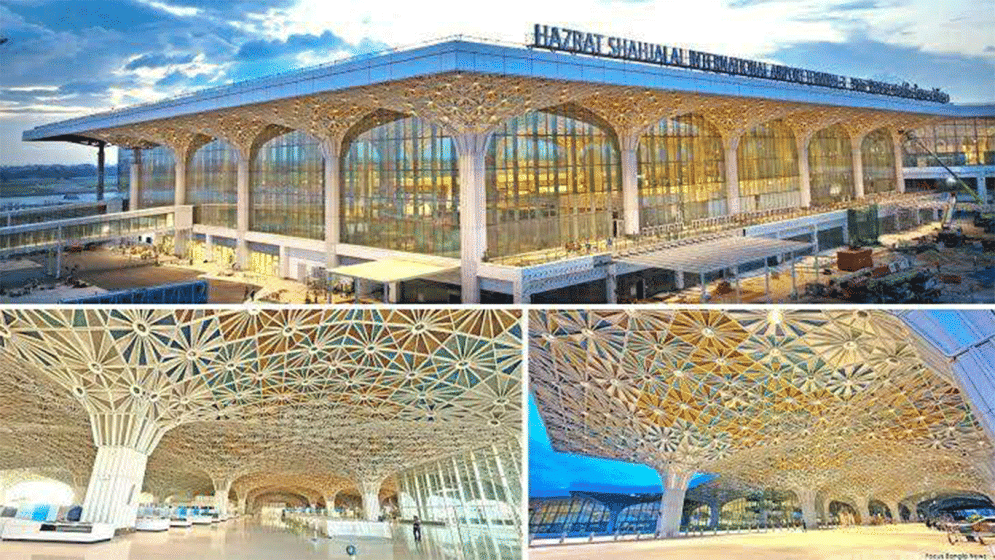
File Photo
The much-awaited concession agreement with a Japanese consortium to operate Hazrat Shahjalal International Airport's (HSIA) third terminal will be signed on 30 November, paving the way for its partial inauguration on 16 December.
The Bangladesh Nationalist Party (BNP) government,
led by Prime Minister Tarique Rahman, had taken up the terminal's operational
launch as a priority after assuming office and subsequently announced a roadmap
for its inauguration on Victory Day.
The agreement will be signed at 7pm at Hotel
InterContinental Dhaka in the presence of Civil Aviation and Tourism Minister M
Rashiduzzaman Millat, Civil Aviation Authority of Bangladesh (CAAB) member
(operations and planning) Air Commodore Abu Sayeed Mehboob Khan said.
He said the agreement would mark a major breakthrough
in the government's efforts to operationalise the long-awaited terminal, which
has remained unused for commercial flights despite its soft opening in October
2023.
"The terminal will be inaugurated on 16
December with the departure of a Biman Bangladesh Airlines flight to either
Dubai or Kuala Lumpur," Khan said, adding that the destination would be
finalised before the launch.
The CAAB member said the terminal would begin
limited regular operations from 17 December, initially handling two arriving and
two departing international flights daily.
He said Biman Bangladesh Airlines would exclusively
operate flights through the new terminal during the first three months,
allowing the authorities to assess operational readiness and gradually
stabilise passenger services.
Subsequently, the number of flights would increase
in phases, with foreign airlines gradually shifting their operations to the new
terminal.
Khan said the concession agreement would be started
full implementation over approximately eight months, with the Japanese
consortium assuming its responsibilities in phases.
During the initial period, CAAB would provide
essential operational support, including cleaning services and passenger
boarding bridge operations, to facilitate the smooth commencement of flights.
The Japanese operator would progressively take over
the relevant responsibilities as the terminal moved towards full-fledged
operations, he said.
The CAAB member also said the Japanese consortium
would appoint a second ground-handling service provider within six months after
December to introduce competition and improve the quality of airport services.
The move is expected to bring an additional operator
alongside Biman Bangladesh Airlines, which currently provides ground-handling
services at the country's principal international airport.
The appointment of a second handler is considered an
important component of the government's plans to improve baggage delivery,
aircraft turnaround and passenger services at the new terminal.
Meanwhile, CAAB Assistant Director (public relations)
Kawsar Mahmud said the authority would hold a press briefing at its headquarters
auditorium on Sunday.
CAAB Chairman Air Vice Marshal Md Mostafa Mahmud
Siddiq will brief journalists on the concession agreement and the arrangements
for launching third terminal operations.
The agreement was approved at CAAB's 321st board
meeting on 10 November following a review of the terms proposed by the Japanese
consortium.
The negotiations had earlier faced complications
over several provisions, including restrictions on international flight
operations through the airport's existing terminals and the development of
competing airports within a 100-kilometre radius for 15 years.
The third terminal, constructed at a cost of
approximately Tk22,000 crore, is one of Bangladesh's largest aviation
infrastructure projects.
Construction began on 30 December 2019, and the
terminal was soft-opened in October 2023, but commercial operations remained
stalled amid prolonged negotiations over its management.
Designed to significantly expand HSIA's
passenger-handling capacity, the new terminal is expected to help the airport
accommodate up to 20 million passengers annually, compared with the existing
terminals' combined capacity of approximately eight million.
The terminal features modern passenger-processing
facilities, including 100 check-in counters, 10 self-check-in kiosks, 16
regular baggage belts, additional oversized baggage facilities and passenger
boarding bridges.
It also includes automated baggage-handling systems,
moving walkways, family-friendly facilities and dedicated healthcare areas.
The 30 November agreement and 16 December
inauguration are expected to end prolonged uncertainty over the project's
operational future, although the transition to full-scale services will take
place gradually.